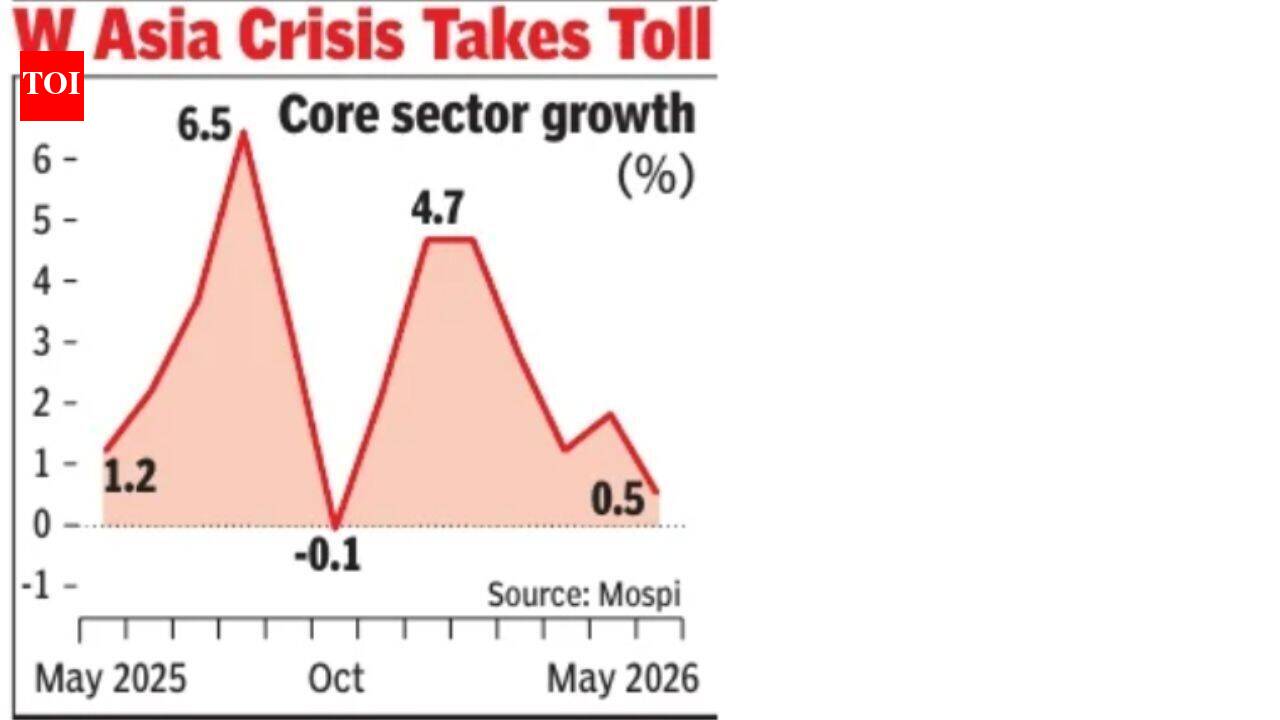
India's expanded core sector grew at the fastest pace in five months, touching 5% in June 2026, compared with 1.1% a year earlier, according to official data with a revised base year 2022-23 released on Monday. The new series expands the core sector basket to nine industries by adding iron ore.
Sectoral Performance
The infrastructure industries showed resilience, while output in energy-dominant industries remained subdued, reflecting the impact of the prolonged West Asia conflict. The newly added iron ore industry, which has a weight of 4.9% in the new index, grew 43.9%. Cement output accelerated 9.8%, and electricity generation decelerated during the month but remained resilient with near double-digit expansion of 9.8%. Steel output decelerated to 4.6%.
| Industry | June 2026 Growth | Weight in Index |
|---|---|---|
| Iron ore | 43.9% | 4.9% |
| Cement | 9.8% | — |
| Electricity | 9.8% | — |
| Steel | 4.6% | — |
| Fertiliser | -3.3% | — |
| Refinery products | -4.7% | — |
| Natural gas | -7.4% | — |
| Crude oil | -4.2% | — |
Subdued Energy and Fertiliser Sectors
Fertiliser production declined 3.3%, its fourth straight month of contraction in the wake of West Asia-led disruptions. Other oil-related sectors also witnessed continued contraction: refinery products (-4.7%), natural gas (-7.4%), and crude oil (-4.2%).
Quarterly Trend
In the first quarter of the current fiscal year (Q1 FY27), the core sector grew 3.6%, compared to 1% in the previous financial year. This indicates a broad-based recovery, although persistent weakness in energy and fertiliser remains a concern.
The overall core sector performance is closely watched as it constitutes about 40% of India's Index of Industrial Production (IIP) and acts as a leading indicator of industrial activity. For investors and corporate strategists, the divergence between infrastructure-driven growth and energy sector decline suggests a two-speed economy, with potential implications for input costs and supply chains.
Sources: