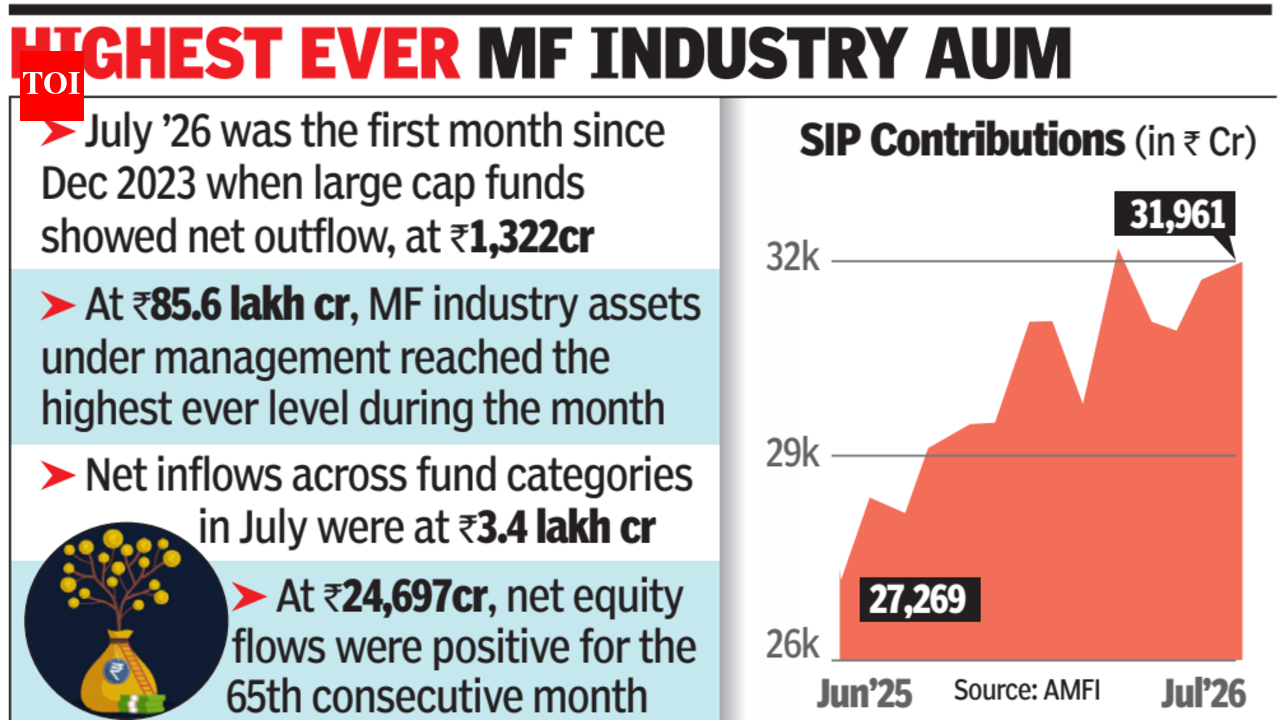
Despite weak stock market returns and persistent foreign selling, Indian retail investors have maintained their systematic investment plan (SIP) commitments, with monthly inflows surging 48% year-on-year to Rs 310 billion ($3.3 billion) in May 2026, according to a recent JP Morgan report cited by Business Today.
Market Headwinds and Persistent SIP Flows
The Nifty 50 delivered a two-year compound annual growth rate (CAGR) of just 0.8% in rupee terms and negative 3.2% in US dollar terms during FY25 and FY26, the report noted. Over the same period, foreign portfolio investors (FPIs) sold Indian equities worth approximately $36 billion (Rs 3.3 trillion).
Despite these headwinds, monthly industry SIP inflows rose 48% year-on-year to Rs 310 billion in May 2026. Cumulative equity and balanced fund net inflows reached Rs 9.43 trillion ($109 billion), the report stated.
| Metric | Value |
|---|---|
| Nifty 50 2-year CAGR (rupee) | 0.8% |
| Nifty 50 2-year CAGR (USD) | -3.2% |
| FPI equity sales (FY25-FY26) | $36 billion (Rs 3.3 trillion) |
| Monthly SIP inflows (May 2026) | Rs 310 billion ($3.3 billion) |
| SIP YoY growth (May 2026) | 48% |
| Cumulative equity & balanced net inflows | Rs 9.43 trillion ($109 billion) |
SIPs as the Demand Anchor
JP Morgan attributed the continued inflows to favourable tax and policy support, expecting money flowing into the capital markets ecosystem to remain strong. "The inflows should continue due to tax and policy," the report noted.
SIPs have become the dominant source of demand for domestic equities, accounting for 77% of total equity and balanced net inflows in FY26. "SIPs have become the sector's demand anchor, contributing 77% of total equity and balanced net inflows in FY26, with monthly flows reaching Rs 310bn in May-26," the report said.
The persistence of SIP inflows reflects a growing "set-and-forget" approach among retail investors, who have continued investing despite market volatility and subdued benchmark returns, according to the report.
Structural Growth in Trading Activity
Beyond SIPs, JP Morgan highlighted structural growth in exchange volumes, driven by index options, weekly expiries, and increased retail and algorithmic trader participation. "Exchange volumes have scaled structurally, led by index options," the report said.
Industry average daily premium turnover rose from Rs 10 billion in FY14 to Rs 699 billion in FY26, the report noted.
Stock Preferences and Sector Outlook
On stock preferences, JP Morgan stated: "Our stock selection reflects business-model quality, regulatory exposure, and valuation; we prefer: Angel One > CAMS > ICICI AMC > NAM > HDFC AMC."
The brokerage said that exchanges and depositories could benefit from stronger pricing power and operating leverage, while low-cost retail brokers may gain from higher scale. Asset management companies (AMCs), although supported by growing assets under management, could face limitations on operating leverage because of regulatory restrictions on total expense ratios (TERs).
Key Risks Identified
While maintaining a positive outlook, JP Morgan flagged several risks: SIP inflows staying below Rs 250 billion for an extended period, adverse regulatory changes resulting in a 20% drop in average daily premium turnover or cancellation of weekly expiries, and a sharp increase in market volatility causing futures and premium turnover to exceed assumptions by more than 15%.
For executives and investors tracking the Indian capital markets, the resilience of SIPs suggests a structural shift in retail participation that supports domestic liquidity even as foreign flows reverse. The sustainability of these inflows will depend on continued tax and policy support, regulatory stability, and the ability of asset managers to maintain operating efficiency within TER constraints.
Sources: