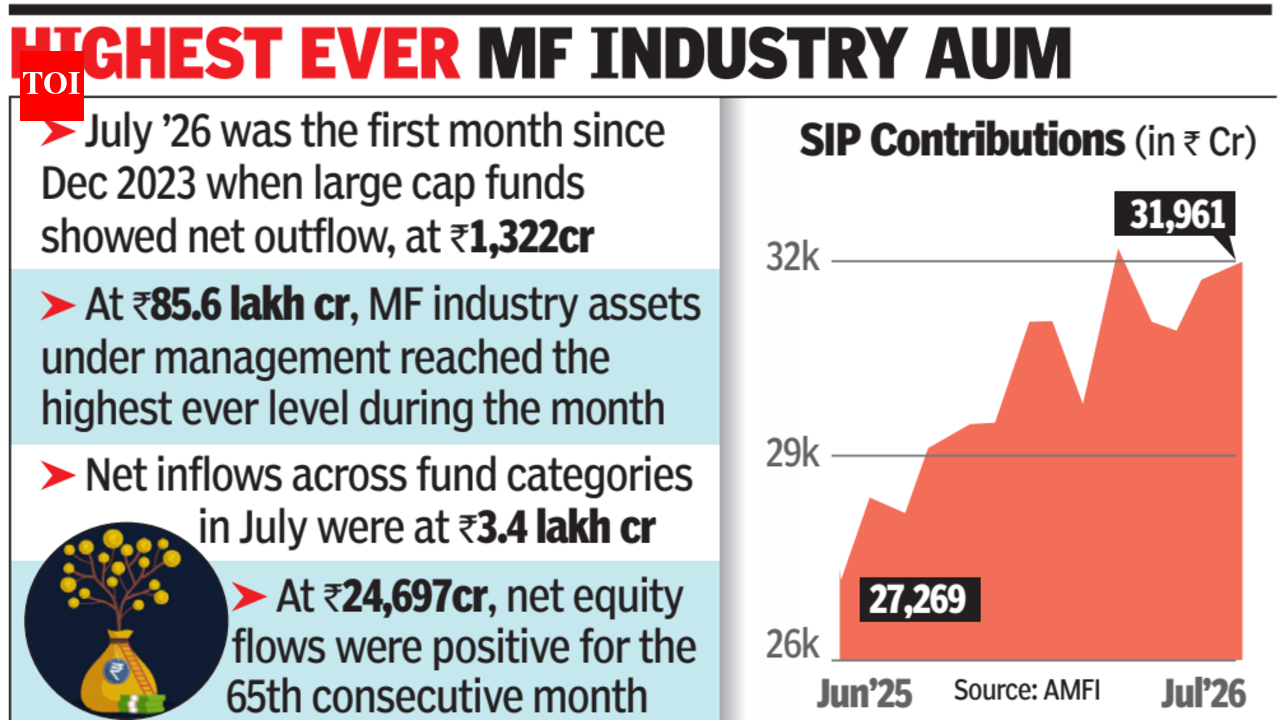
Equity mutual fund inflows in India fell 15 per cent month-on-month to Rs 24,697 crore in July, according to data released by industry body Amfi on Tuesday, even as systematic investment plan (SIP) contributions stayed resilient at Rs 31,961 crore. Business Today reported that the decline did not break the sustained flow: July marked the 65th consecutive month of positive inflows into equity-oriented schemes.
Equity inflows: selectivity amid valuation concerns
July's inflow compared with Rs 28,973 crore recorded in June and Rs 42,702 crore in July last year. Amfi data showed investors favoured diversified categories, with smallcap funds attracting the highest investment at Rs 7,768 crore, followed by midcap funds at Rs 6,192 crore, flexicap funds at Rs 4,710 crore and largecap funds at Rs 1,322 crore.
| Equity category | July inflows |
|---|---|
| Smallcap funds | Rs 7,768 crore |
| Midcap funds | Rs 6,192 crore |
| Flexicap funds | Rs 4,710 crore |
| Largecap funds | Rs 1,322 crore |
Ankur Punj, MD & Business Head at Equirus Wealth, said the moderation in equity mutual fund inflows reflects a degree of selectivity rather than a loss of investor confidence in equities. It also highlights ongoing portfolio rebalancing amid evolving valuations, with investors favouring segments that offer stronger long-term return potential while remaining mindful of associated risks.
Akhil Chaturvedi, Executive Director and Chief Business Officer at Motilal Oswal Asset Management Company, said investors' cautious approach was partly linked to lower returns over the past two years. Santosh Joseph, CEO of Germinate Investor Services, said July's mutual fund flow data is broadly in line with expectations, with investor interest in diversified equity categories remaining steady.
Debt funds drive industry-wide reversal
The mutual fund industry as a whole recorded a net inflow of around Rs 2.36 lakh crore in July, compared with an outflow of Rs 52,949 crore in June. Debt-oriented schemes accounted for much of the turnaround, moving from an outflow of Rs 1.09 lakh crore in June to an inflow of around Rs 1.88 lakh crore in July.
| Metric | June | July |
|---|---|---|
| Equity-oriented scheme inflows | Rs 28,973 crore | Rs 24,697 crore |
| SIP contributions | Rs 31,781 crore | Rs 31,961 crore |
| Industry net flows | -Rs 52,949 crore | +Rs 2.36 lakh crore |
| Debt-oriented scheme flows | -Rs 1.09 lakh crore | +Rs 1.88 lakh crore |
| MF industry AUM | Rs 82.22 lakh crore | Rs 85.76 lakh crore |
| Gold ETF net inflows | Rs 3,443 crore | Rs 1,559 crore |
Liquid funds led the debt category with net inflows of Rs 1,19,066 crore, overnight funds attracted Rs 40,413 crore, and money market funds saw inflows of Rs 21,180 crore. Varun Gupta, CEO of Groww Mutual Fund, said the sharp reversal in debt flows was led by strong inflows into liquid, overnight and money market funds, even as longer-duration categories remained under pressure, suggesting investors continue to value liquidity and flexibility in their debt portfolios rather than making a broad-based shift towards duration risk.
The industry's assets under management rose 4.3 per cent month-on-month to Rs 85.76 lakh crore at the end of July, compared with Rs 82.22 lakh crore at the end of June. Venkat Chalasani, Chief Executive of Amfi, said the increase was largely driven by higher market value and sustained buying by DIIs.
Gold ETF inflows moderate
Gold ETFs continued to draw investments in July, though the pace slowed. The category recorded net inflows of Rs 1,559 crore, down from Rs 3,443 crore in June. Himanshu Srivastava, Principal, Manager Research at Morningstar Investment Research India, said the moderation in flows compared with June may partly reflect profit-booking following gold's strong price appreciation and the robust inflows witnessed during the first half of the year.
For finance executives and treasury professionals tracking capital formation, the July data shows retail equity commitment remains intact — SIP contributions have stayed above Rs 31,000 crore for five consecutive months — while debt investors are parking cash in liquid, overnight and money market funds. The AUM rise, driven by higher market value and sustained DII buying, points to continued domestic participation in Indian capital markets, according to Amfi.
Sources: