
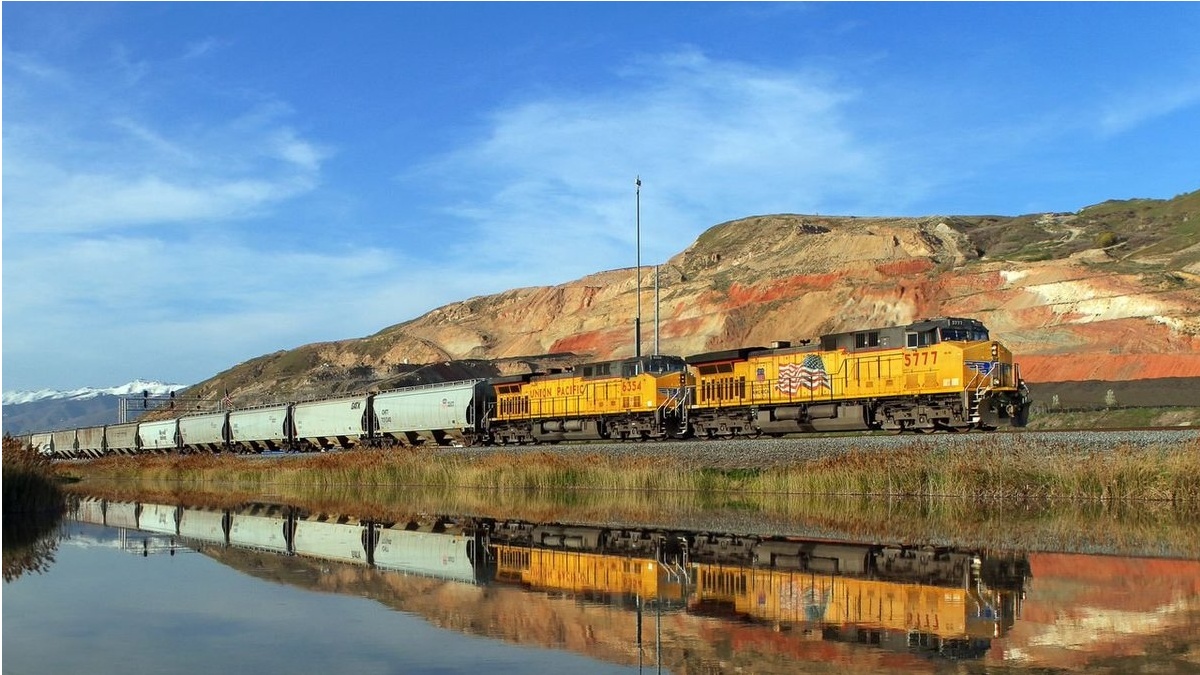
Seven Republican state attorneys general are urging the Surface Transportation Board (STB) to reject Union Pacific's proposed acquisition of Norfolk Southern, warning the deal could raise shipping costs and erode rail-to-rail competition, according to FreightWaves.
The letter, entered into the STB's public record Aug. 11, challenges the railroads' revised application — supplemented in July — and centers on the proposed Committed Gateway Pricing (CGP) arrangement, which the coalition says would preserve only a narrow slice of existing competitive options while potentially raising rates for shippers, FreightWaves reported.
Coalition urges STB to reject merger
The letter was signed by Montana Attorney General Austin Knudsen, joined by Brenna Bird of Iowa, Kris Kobach of Kansas, James Uthmeier of Florida, Drew Wrigley of North Dakota, Marty Jackley of South Dakota and Jonathan Skrmetti of Tennessee, according to FreightWaves.
It is the third such filing seeking to kill the proposal to create the first U.S. transcontinental freight railroad, and comes after President Donald Trump earlier blessed the merger in an Oval Office meeting with Union Pacific Chief Executive Jim Venna, FreightWaves reported. In November 2025, the top law enforcement officials from Florida and Ohio joined the current seven AGs in opposing the merger. A similar scrutiny letter in February dropped Florida and Ohio from the letter.
CGP pricing under fire
The current objection centers on Union Pacific (NYSE: UNP) and Norfolk Southern's (NYSE: NSC) proposed Committed Gateway Pricing arrangement. The plan is intended to establish rate protections for certain existing interline movements involving BNSF Railway (NYSE: BRK-B) and CSX Transportation (NASDAQ: CSX) through Chicago, St. Louis, Memphis and New Orleans, FreightWaves reported.
But the states contend CGP creates no new rail option for shippers. Rather, they say, it would merely allow some current interline movements to continue after the merger — an outcome they characterize as preservation of an existing option, not an enhancement of competition as required by the STB's merger criteria.
The officials also challenge the formula proposed for CGP rates. According to the letter, UP and NS would set rates at the 70th percentile of their own comparable traffic rates, rather than at a median or below-average benchmark. That approach, the coalition argued, means many eligible shippers could receive a higher price than they pay today. The letter further cites the applicants' own expert evidence as acknowledging that the mechanism could incentivize higher rates on the traffic lanes used to calculate the CGP benchmark.
"If UP and NS admit CGP would not create competitive service, we should take them at their word," the attorneys general wrote.
The states also noted that UP and NS have said CGP service would not match post-merger single-line service on speed or reliability and was not designed to compete with it.
Narrow scope, temporary protection
Even under the railroads' revised proposal, the coalition said CGP would apply to only 0.9% of U.S. rail traffic. The arrangement excludes Canadian National (NYSE: CNI) and CPKC (NYSE: CP) interline traffic, automotive and intermodal shipments, storage-in-transit and railroad-owned transload movements, dimensional loads, and routes where more than one rail option already exists at both ends.
| CGP scope | Detail |
|---|---|
| Share of U.S. rail traffic covered | 0.9% |
| Interline partners included | BNSF Railway, CSX Transportation |
| Gateways covered | Chicago, St. Louis, Memphis, New Orleans |
| Excluded traffic | Canadian National, CPKC, automotive, intermodal, storage-in-transit, railroad-owned transload, dimensional loads, routes with more than one rail option |
| Protection duration | Ends with STB oversight period, likely five years |
In addition, the protection would be temporary, ending with the STB's oversight period, which the states said would likely be five years. That limited scope cannot counterbalance a deal that the letter says would create a railroad controlling more than half of the U.S. Class I rail market, the coalition argued.
Implications for shippers and operators
The AGs said rail competition is particularly consequential for agriculture, mining, forestry and manufacturing, whose customers may depend on a limited number of rail transportation options. They warned that further consolidation could bring fewer routing choices, higher rates for captive shippers and supply-chain disruptions, particularly in rural markets.
For freight forwarders, logistics managers and intermodal operators, the dispute directly affects the competitive landscape on key gateway lanes through Chicago, St. Louis, Memphis and New Orleans. If the STB approves the merger as proposed, the CGP mechanism would apply only to a tiny fraction of traffic and would lapse after the oversight period, potentially leaving shippers with fewer interline alternatives, according to FreightWaves.
Watch list
- STB review of the revised Union Pacific–Norfolk Southern application, supplemented in July.
- Any further opposition filings from state attorneys general; the Aug. 11 letter is the third such filing, FreightWaves reported.
- The duration of the STB oversight period, which the states said would likely be five years and would mark the end of CGP protections.
- How CGP benchmark rates at the 70th percentile affect eligible shippers if the merger proceeds, given the coalition's argument that many could pay more than they do today.
Sources:


