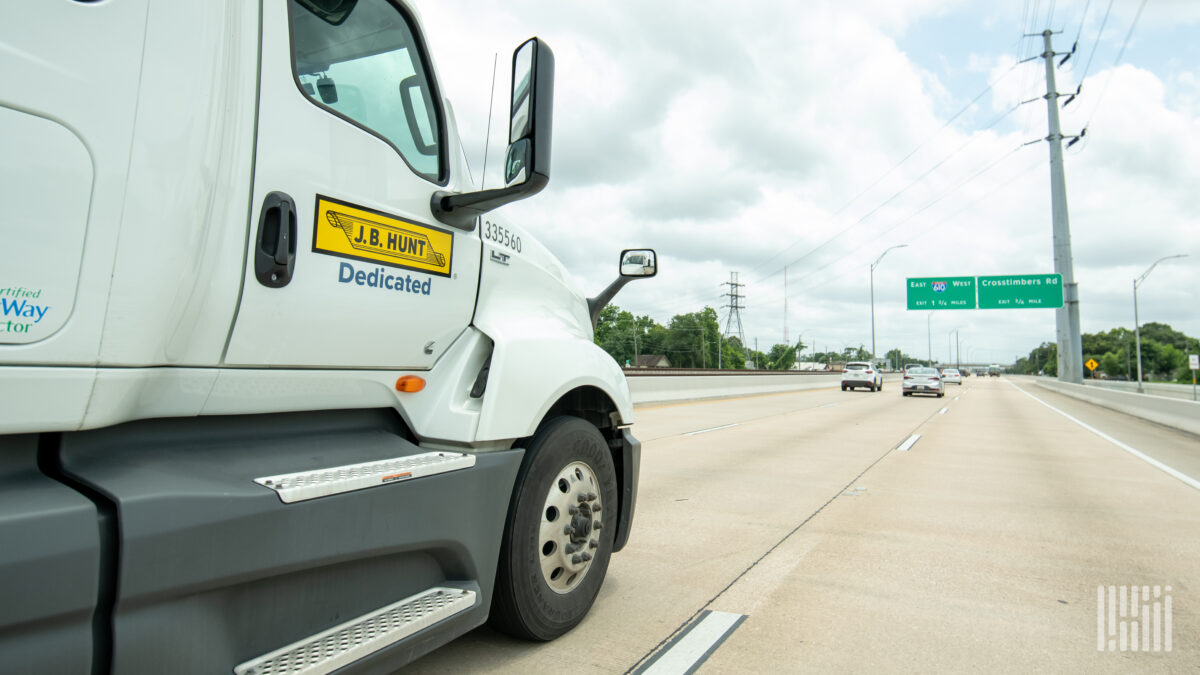
Multimodal transportation provider J.B. Hunt Transport Services (NASDAQ: JBHT) handily beat second-quarter forecasts on Wednesday, sending shares 8.6% higher in after-hours trading, according to FreightWaves. The earnings beat was driven by strong intermodal growth, a rebound in brokerage profitability, and steady dedicated performance.
Revenue of $3.5 billion was 19% higher year over year and outpaced analysts’ expectations for $3.26 billion. Earnings per share of $1.91 were 60 cents higher y/y and 18 cents ahead of consensus. Operating income of $259 million (plus-32% y/y) was driven by higher revenue and recent cost reductions, according to FreightWaves. A lower tax rate and lower interest expense each contributed 4 cents to EPS in the quarter.
Intermodal Volume and Revenue Gains
J.B. Hunt’s intermodal segment reported strong results. Revenue increased 22% year over year to $1.75 billion as loads rose 10% and revenue per load was 11% higher. Transcontinental volumes were up 5% y/y, while volumes in the East surged 16% y/y. By comparison, total intermodal carloads were up 8% y/y on U.S. Class I railroads in the quarter, with North American containers up 5% y/y, according to FreightWaves.
The increase in revenue per load was largely due to higher fuel surcharges. Excluding fuel, yields were 1% higher y/y in the period. Yields are being weighed down by a mix shift to the East, where lengths of haul are shorter (length of haul was down 3% y/y). The unit booked a 91.4% operating ratio (8.6% operating margin), improving 190 basis points year over year.
| Intermodal Metric | Q2 2026 | YoY Change |
|---|---|---|
| Revenue | $1.75B | +22% |
| Loads | – | +10% |
| Revenue per load | – | +11% |
| Transcontinental volumes | – | +5% |
| Eastern volumes | – | +16% |
| Operating ratio | 91.4% | 190 bps improvement |
Dedicated Contract Services
Dedicated revenue increased 9% year over year to $921 million. The increase was entirely attributable to an increase in revenue per truck per week (due to higher fuel surcharges). Revenue per truck per week was 2% higher excluding fuel surcharges. The segment's operating ratio was 88.9%, flat year over year, according to FreightWaves.
Brokerage Returns to Operating Profit
The company’s brokerage business turned an operating profit for the first time in 14 quarters. Revenue was up 49% year over year as loads increased 19% and revenue per load increased 26%. However, a 12.5% gross margin was 300 basis points lower y/y due to elevated purchased transportation costs, which were 54% higher y/y, according to FreightWaves.
Truckload and Operating Outlook
The asset-light truckload business recorded a $1.3 million operating loss in the quarter due to elevated purchased transportation costs, according to FreightWaves. The overall operating income improvement of 32% y/y reflects the strong intermodal and dedicated performance, alongside the brokerage turnaround.
J.B. Hunt will host a call at 5 p.m. EDT on Wednesday to discuss second-quarter results. The company is also participating in the Supply Chain AI Symposium and the Future of Freight Festival, as noted by FreightWaves.
For logistics managers and freight forwarders, J.B. Hunt’s performance signals strong intermodal demand, particularly in eastern U.S. lanes, and a recovery in brokerage margins. The elevated purchased transportation costs in truckload and brokerage highlight ongoing tightness in capacity markets, influencing rate expectations for the remainder of the year.
Sources: