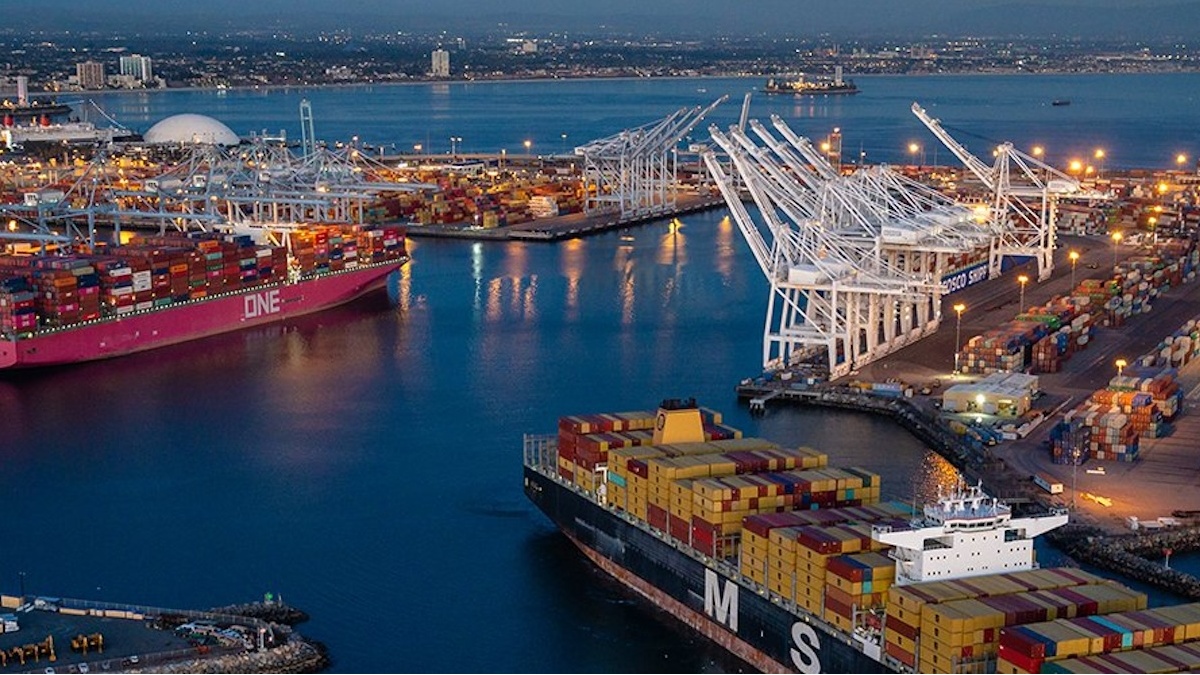
Newly installed Long Beach Harbor Commission President Steven Neal will prioritize the infrastructure, sustainability and technology programs underpinning the Port of Long Beach's long-term "Port of the Future" strategy, according to FreightWaves.
FreightWaves reported Neal, at his first meeting as board president, said the commission would maintain progress on initiatives intended to reinforce the Southern California gateway's position in cargo handling, rail connectivity, customer service and environmental performance.
Mandate: 20 million TEUs and a zero-emissions seaport
The agenda includes the port's recently launched objective of doubling annual container throughput to 20 million twenty-foot equivalent units (TEUs) by 2050 while transitioning to a fully zero-emissions seaport, according to FreightWaves. Neal framed that work as a continuation of the port's history:
Innovation has always defined the Port of Long Beach. From pioneering environmental initiatives to building world-class infrastructure, we have never been afraid to explore bold ideas.
Neal added, according to FreightWaves, that the port is continuing that legacy by responsibly evaluating technologies that could redefine how ports operate for generations to come.
Pier B On-Dock Rail Support Facility
The central infrastructure project is the Pier B On-Dock Rail Support Facility, designed to triple the port's on-dock rail capacity, strengthen connections to the national rail network and reduce rail dwell time from about four days to 24 hours, FreightWaves reported. The project is also intended to reduce truck traffic and associated emissions in and around the harbor complex.
For ocean carriers, freight forwarders and drayage operators using Long Beach's rail network, the dwell-time target is the most operationally significant figure in the plan. FreightWaves reported the facility is designed to reduce rail dwell time from about four days to 24 hours, cutting the time containers spend staged before moving inland.
Energy, nuclear standards and a downtown maritime hub
Neal also highlighted the port's efforts to expand the use of electricity, hydrogen and methanol as lower-emission energy sources, according to FreightWaves. The commission president pointed to a recent partnership with the U.S. Department of Transportation's Maritime Administration aimed at developing operational, safety and security standards for potential nuclear-energy deployment in port operations.
Separately, FreightWaves reported the port this week purchased a 13-story office building in downtown Long Beach for $36 million, with plans to create a maritime business hub.
| Metric | Status |
|---|---|
| Annual container throughput target (2050) | 20 million TEUs |
| Seaport emissions goal | Fully zero-emissions |
| Pier B on-dock rail capacity | Triple current capacity |
| Rail dwell time target | 24 hours (from about four days) |
| Downtown Long Beach office building purchase | $36 million |
Leadership and governance
Neal is serving his second six-year term on the Harbor Commission after first joining the board in 2019, FreightWaves reported. He previously chaired the commission from 2021 to 2022 and served two terms as vice president. Before joining the commission, he represented North Long Beach on the Long Beach City Council from 2010 to 2014.
Under the city charter, the five-member Harbor Commission establishes policy for the port and oversees Chief Executive Officer Noel Hacegaba, who leads an organization of about 600 employees, according to FreightWaves.
Watch list
- Progress on the Pier B On-Dock Rail Support Facility, including whether the 24-hour rail dwell target holds after implementation.
- Development of the maritime business hub in the 13-story downtown Long Beach office building.
- Operational, safety and security standards for potential nuclear-energy deployment, developed with the U.S. Department of Transportation's Maritime Administration.
- Milestones tied to the 20 million TEU-by-2050 throughput target and the transition to a fully zero-emissions seaport.
Sources: