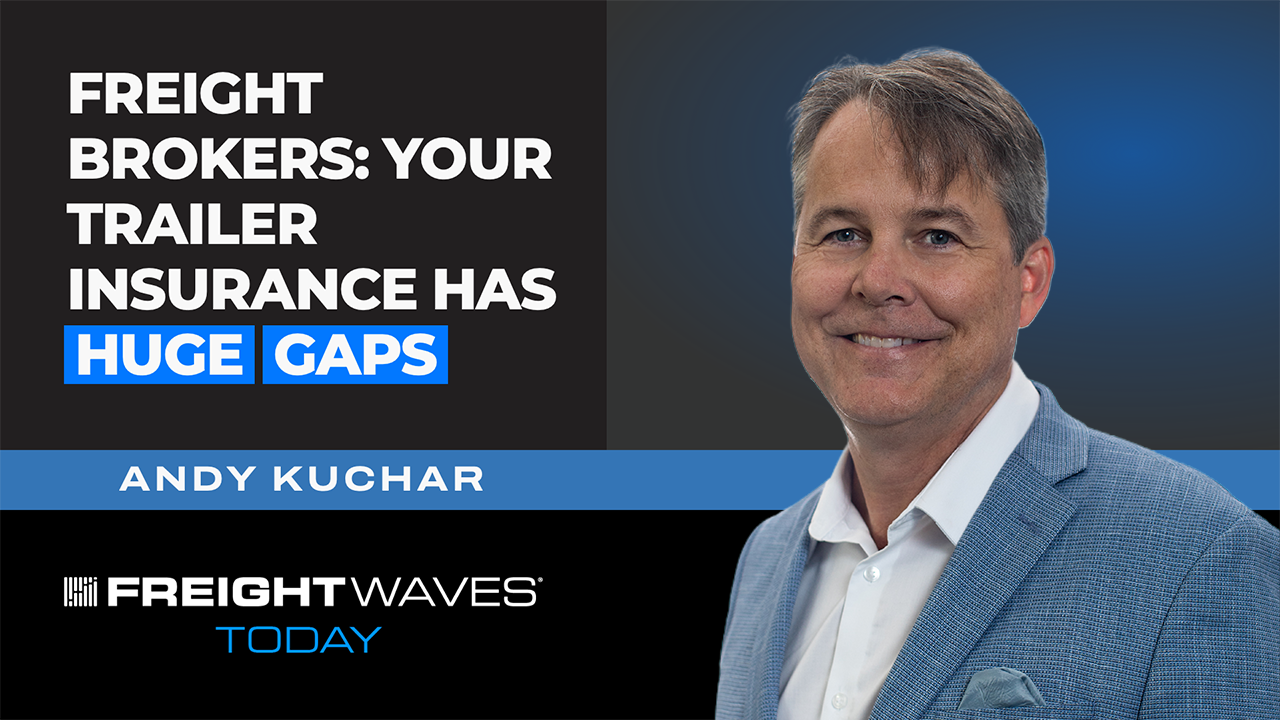
Freight brokers operating trailer pools may be carrying insurance that provides virtually no protection when those trailers are in use on the road, according to FreightWaves. The problem surfaced when Centerline Insurance Company — owned by Watkins Associated Industries, the family behind Watkins Motor Lines that became FedEx Freight — launched a dedicated trailer insurance product roughly five and a half years ago, said Andy Kuchar, the company's president.
The Over-the-Road Coverage Gap
Kuchar told FreightWaves that the first policy he reviewed after entering the market, written by a major carrier he declined to name, contained a specific exclusion for trailers over the road. The broker holding that policy believed it was fully covered and had thousands of trailers in its fleet. “The coverage was with a great company. It was inexpensive, but it didn’t really cover anything,” Kuchar said.
Many trailer insurance policies carry explicit over-the-road exclusions, leaving brokers with pools of leased trailers effectively uninsured for their primary exposure, FreightWaves reported. Kuchar described many trailers as “criminally underinsured.”
“I think you need to start asking some very pointed questions of your insurance agent to say, do I really have this covered? And show me.” — Andy Kuchar, Centerline
Why Brokers Are Increasingly Targeted
The stakes are rising for brokers following the post-Montgomery legal environment, where plaintiffs’ attorneys are increasingly bypassing small single-truck carriers — who typically carry only $1 million in coverage against a federal minimum of $750,000 — and targeting brokers directly because of their deeper pockets, according to FreightWaves.
Providing a trailer to a motor carrier adds a distinct layer of liability beyond brokering a load, Kuchar said, because the equipment itself can be named in litigation. He cited one claim where a worker unloading building materials from a parked trailer was killed in an accident; the trailer lessor was pulled into the lawsuit. “Today to get somebody out of a claim is usually at least $100,000,” he said.
Small Claims, Large Payouts
Small claims compound the exposure. Kuchar noted that in legacy trucking insurance programs his firm previously wrote, a third of property-damage claims involved losses under $2,000 — yet bodily injury payouts on those same claims ran $50,000 to $75,000 or more as claimants continued treatment to inflate values.
| Claim type | Typical loss amount | Bodily injury payout |
|---|---|---|
| Property damage (one-third of claims) | Under $2,000 | $50,000 – $75,000+ |
| Carrier minimum coverage | $750,000 (federal) / $1 million (typical) | – |
| Cost to remove a party from a claim | – | At least $100,000 |
Centerline’s Specialty Trailer Product
Centerline’s trailer liability product is aimed at three customer segments: freight brokers that lease trailers and need coverage acceptable to lessors; transportation firms that operate combined motor carrier, brokerage, and equipment-leasing arms; and, most recently, leasing companies themselves. Kuchar said Centerline has signed master programs with half a dozen leasing companies in the last 30 to 60 days.
The firm also writes per-shipment cargo coverage on high-value loads, with a growing volume of business covering inbound freight from Mexico — often auto parts moving through Laredo — on loads that can reach $1 million in value. Kuchar said that cargo product is nearly 10 years old; the trailer product is five and a half years old. Kuchar, who holds a doctorate in insurance from the University of Georgia and said he personally wrote every word of every policy Centerline has issued, flagged two red flags brokers should watch for in their current coverage.
Red Flags in Existing Broker Policies
According to FreightWaves, brokers should scrutinize any policy language using the word “contingent,” and they should not rely on a motor carrier’s certificate of insurance, which explicitly confers no rights on the certificate holder. Kuchar said Reliance Partners, a Chattanooga-based retail insurance agency, is among Centerline’s largest distribution partners, and that the firm works with any retail broker whose clients need the specialty coverage.
What Brokers Should Ask
FreightWaves reported that many trailers are “criminally underinsured,” and Kuchar’s advice to brokers is to ask pointed questions and demand that agents show proof of coverage. With Centerline signing master programs with half a dozen leasing companies in the last 30 to 60 days, the specialty market is responding to the gap. Brokers, combined carriers, and leasing firms should review their current policies for “contingent” language and avoid relying on certificates of insurance, which confer no rights on the holder.
Sources: