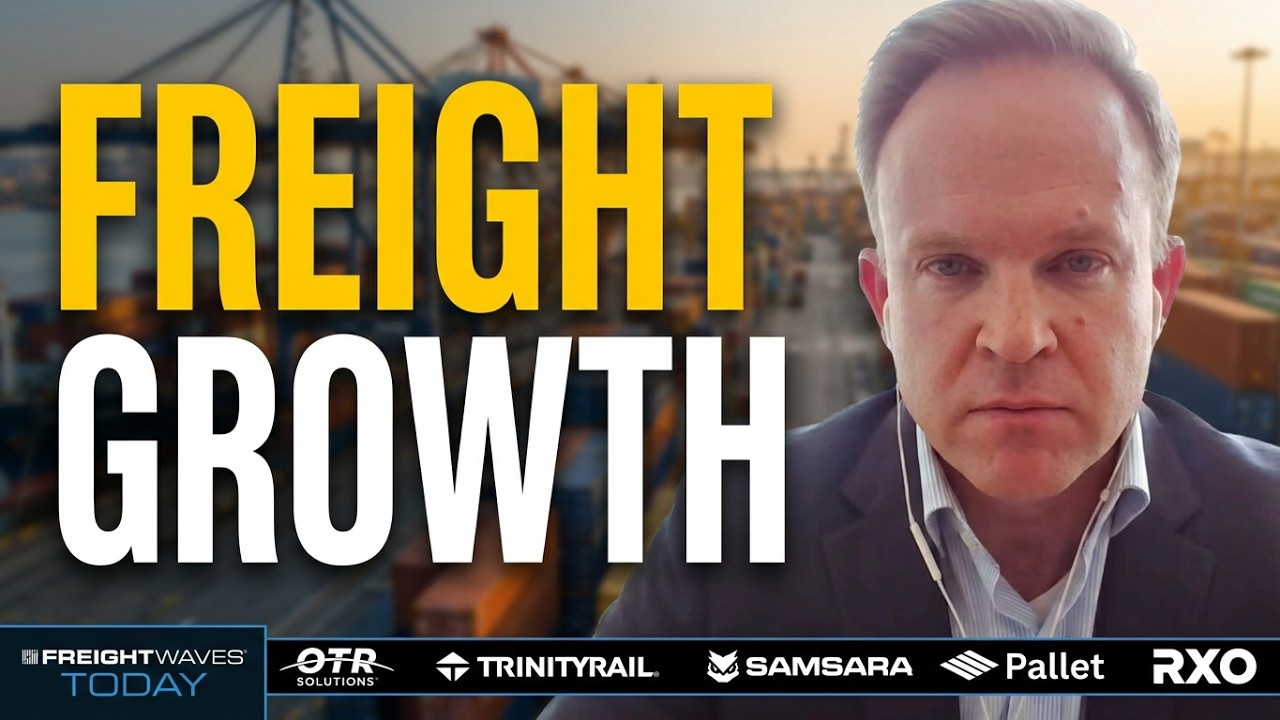
US industrial growth is at its strongest in years, and the freight recession is over, according to RSM industrial analyst Ryan Farlow, who told FreightWaves that the ISM Manufacturing index hit 55.6 — its highest reading in years — with contract rates rising and spot prices up substantially.
The expansion is broad-based. Farlow said 15 of the 18 sectors tracked within ISM Manufacturing increased in the most recent reading, a sign that demand has spread well beyond AI data center construction into aerospace and defense, semiconductors, and chemicals. That breadth matters to carriers and shippers because it signals durable freight demand rather than a single-sector spike, he said. The rebound reflects overlapping forces: data center construction, tax incentives tied to reshoring under the One Big Beautiful Act, tariff policy pushing manufacturing closer to home, and a resilient consumer. Real private demand in the most recent GDP print came in at 3.9%, RSM projects GDP growth of roughly 2.5% in the second half of the year, and RSM sees 2027 shaping up as even more favorable than 2026.
Freight recession ends as rates turn upward
"The freight recession is over," Farlow said, pinpointing November and December of last year as the turning point driven by regulatory and compliance enforcement.
Farlow said executives across RSM's client base of more than 500 transportation and logistics companies — 80% to 90% of them in the middle market or upper middle market — are reporting contract rate increases and stronger July results. Spot prices have risen substantially, and contract rates are expected to follow.
Rising costs and litigation pressure trucking
"Costs in trucking are as high as they've ever been," Farlow said, citing the American Transportation Research Institute's most recent Cost in Trucking report, released last month. Middle-market carriers are running aging equipment longer while navigating elevated insurance expenses and litigation risk from cases such as Montgomery and C.H. Robinson.
Capacity exits and driver shortage tighten supply
On the supply side, Farlow said capacity exits that began with rising bankruptcies in 2023 and 2024 have accelerated under the crackdown on non-domiciled CDLs and the ELP mandate. The driver pool has shrunk to the point where finding qualified drivers is now the top operational concern he hears from client executives. The mismatch is correcting as weaker operators exit.
| Metric | Reading (according to Farlow/FreightWaves) |
|---|---|
| ISM Manufacturing index | 55.6 — highest in years, 7 straight months of expansion |
| ISM sub-sectors expanding | 15 of 18 |
| Real private demand, latest GDP print | 3.9% |
| RSM GDP forecast, H2 | ~2.5% |
| Registered motor carriers since 2019 | +30% |
| Shipment volumes since 2019 | -10% |
| Freight expenditures since 2019 | +12% |
Farlow said the gap between freight expenditures and shipments reflects growing efficiency — carriers moving larger volumes in fewer loads across both truckload and less-than-truckload (LTL). This dynamic is helping the supply-demand imbalance self-correct, but it also means raw shipment counts understate the actual volume of freight moving through the network.
Data center slowdown is the primary risk
Looking ahead, Farlow flagged data center construction slowdowns as the primary risk to the industrial outlook. Birmingham itself imposed a six-month moratorium on new data centers, and roughly 500 municipalities nationwide have enacted bans or pauses. He said the core issue is grid underinvestment rather than data centers themselves, and estimated it will take at least three to five years to make meaningful progress on transmission capacity. Despite near-term friction, Farlow said RSM believes the data center buildout remains a multi-year tailwind for industrials and freight, and that private equity funds investing in transportation infrastructure are already anticipating a surge in deal activity by 2027.
Market signals for shippers and operators
For freight forwarders, 3PLs, and carriers, Farlow's comments point to a market where raw shipment counts understate real freight volumes, contract rates are expected to rise after spot prices moved up substantially, and driver availability is the top operational constraint. The ISM breadth — 15 of 18 sub-sectors expanding — signals durable demand across truckload and LTL. Farlow said the supply-demand imbalance is self-correcting as weaker operators exit, while RSM projects 2027 as even more favorable than 2026, supported by a multi-year data center buildout despite grid constraints.
Sources: