
Chinese shipyards booked more new tonnage in the first six months of 2026 than during any prior full year, tightening their grip on the global order market and signaling massive capacity additions for ocean carriers and logistics operators over the coming years.
Record-Breaking First Half
According to China’s Ministry of Industry and Information Technology, new contracts totalled 121.06m dwt between January and June 2026, a 173.1% year-on-year increase. This six-month haul was already 12.3% above the 107.82m dwt secured during all of 2025. Chinese yards accounted for 82.3% of global ordering on a deadweight basis, cementing their dominant position.
Shipbuilding output reached 36.5m dwt in the first half, up 51.2%, giving China 62.2% of global completions. The country’s orderbook stood at 363.25m dwt at the end of June, an increase of 54.9% from a year earlier and equivalent to 71.2% of tonnage on order worldwide.
Quarterly Breakdown
The pace showed little sign of slowing during the second quarter. Chinese yards added 61.53m dwt of orders between April and June, slightly more than the 59.53m dwt contracted during the opening three months of the year. Shipbuilding deliveries totalled 20.82m dwt in Q2 alone, compared with 15.68m dwt in Q1. The orderbook grew by nearly 41m dwt in the second quarter.
| Metric | H1 2026 | Change vs H1 2025 | Share of Global |
|---|---|---|---|
| New orders (dwt) | 121.06m | +173.1% | 82.3% |
| Output (dwt) | 36.5m | +51.2% | 62.2% |
| Orderbook (dwt) | 363.25m | +54.9% | 71.2% |
Dominance Across Ship Types
Chinese builders took more than 80% of global orders across each of the three largest conventional ship types — bulk carriers, containerships, and tankers. The country also maintained a share of more than 68% of global green vessel orders, a level Chinese yards have held for the past three years, according to the ministry.
For logistics professionals, the surge in containership orders directly points to future fleet expansion on major east-west trade lanes, potentially easing capacity constraints and influencing freight rates in the medium to long term. Bulk carrier and tanker orders similarly signal growing tonnage supply for dry bulk and liquid cargo movements.
Capacity Expansion and Green Vessels
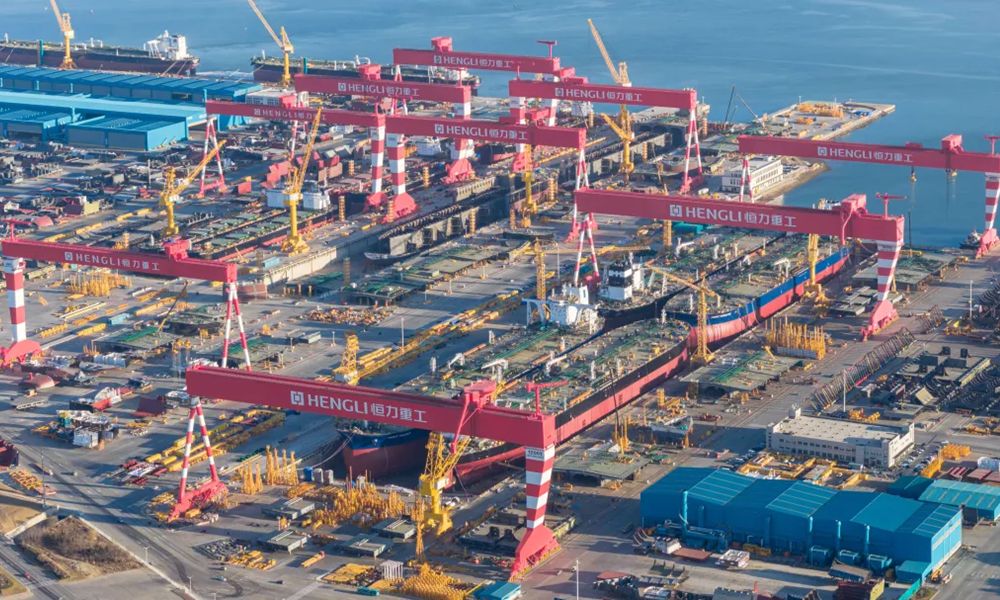
The contracting boom is being matched by another round of capacity growth. Hengli Heavy Industry, one of the fastest-growing names in the sector, has outlined a RMB13.5bn ($1.94bn) capacity investment as the revived yard builds a larger presence across mainstream ship types. Splash reported earlier this year that dormant Chinese yards were being brought back into production and established builders were pursuing major expansions.
This capacity growth, combined with the order record, means a wave of new tonnage will enter service from 2027 onward. For freight forwarders and ocean carriers, the implications include potential downward pressure on freight rates as supply outpaces demand growth, as well as increased scrapping of older, less efficient vessels. Shippers may benefit from greater capacity availability and more competitive pricing on major trade routes, though delivery timelines remain extended due to the sheer volume of orders.
Sources:


