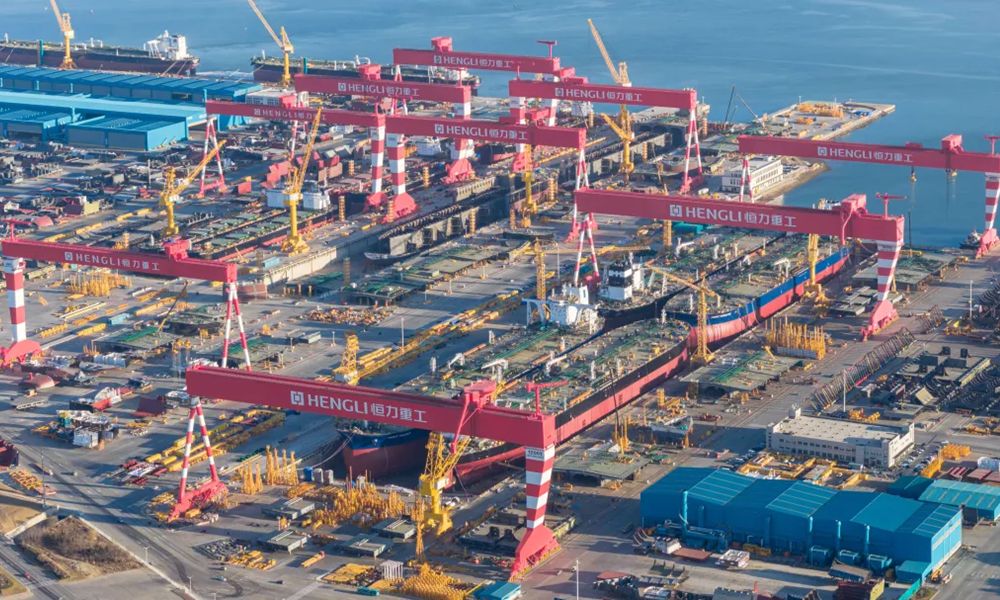
South Korea's top shipbuilders have launched a series of US projects spanning naval vessels, LNG bunkering ships, smart yards, and workforce training, as the operational centre for a $150bn shipbuilding alliance between Seoul and Washington opens in the US capital.
On Thursday, the Korea-US Shipbuilding Partnership Center opened in Washington as the headquarters for the Make American Shipbuilding Great Again (MASGA) programme, according to Splash247. Fifteen agreements were signed by more than 30 shipbuilders, defence companies, technology groups, universities, and research organisations. The projects cover shipyard modernisation, supply chains, workforce development, and joint technology programmes.
Lutnick Sets Performance Yardstick
US Commerce Secretary Howard Lutnick made clear that the Trump administration would judge the venture by physical output rather than announcements. "We are going to judge the centre by the capital you deploy, the facilities you modernise, the workers you train, the supply chains you establish, and ultimately the simple number of how many domestically produced ships we make together," Lutnick said, as reported by Splash247. He promised Commerce Department support to clear regulatory obstacles facing Korean companies building operations in the US.
Key Agreements and Partners
The following table summarises the major agreements announced:
| Company / Partner 1 | Company / Partner 2 | Agreement Type | Purpose |
|---|---|---|---|
| Hanwha Ocean | Leidos Gibbs & Cox | Professional Services Contract | Joint design of a global fast sealift vessel (dual-use commercial/military) |
| Hanwha Ocean | (Separate agreements) | Workforce training, domestic supply chains | Establish US shipbuilding workforce training and supply chains |
| HD Korea Shipbuilding & Offshore Engineering | Siemens Digital Industries Software | Definitive Contract | Next-gen marine platform connecting design, production, procurement, quality control, maintenance via common 3D data environment |
| HD Hyundai Samho | Washington United Terminals (Port of Tacoma) | Contract | Supply of four port cranes |
| Samsung Heavy Industries | Conrad Shipyard | Approval in Principle (ABS) | 12,000 cu m LNG bunkering vessel for US market |
| Samsung Heavy Industries | Saronic Technologies | Agreement | Cooperation on unmanned surface vessels, autonomous navigation, AI systems, robotic shipyard automation |
| Samsung Heavy Industries | Vigor Marine Group | Agreement | Training centre for welders and painters |
| Samsung Heavy Industries | US universities | Agreement | Virtual training systems for shipyard workers |
Technology and R&D Initiatives
HD Korea Shipbuilding & Offshore Engineering also plans to use the Siemens platform to develop virtual shipyards and physical AI facilities where robots and autonomous equipment handle more of the production process. Samsung Heavy Industries secured approval in principle from ABS (American Bureau of Shipping) for its jointly developed 12,000 cu m LNG bunkering vessel aimed at the US market.
Additionally, the two governments launched a Won120bn ($80m) five-year research programme covering eight areas including AI-assisted design, autonomous welding, heavy-block transportation, yard automation, and autonomous navigation. "Innovation succeeds when research, industry insight and practical application come together," commented John McDonald, ABNS chairman and CEO, according to Splash247.
South Korean Minister's Commitment
South Korean Industry Minister Kim Jung-kwan said Korean companies would build naval vessels and LNG carriers in America, reinforcing the strategic intent of the partnership.
Implications for US Maritime Logistics
For logistics operators and freight forwarders, the MASGA programme signals a long-term expansion of US shipbuilding capacity with Korean expertise. The dual-use fast sealift vessel design (commercial cargo during peacetime, military equipment in emergencies) could offer new chartering options for government-contracted freight. The LNG bunkering vessel development may support growing demand for LNG-fueled ships calling at US ports. Port of Tacoma's crane contract with HD Hyundai Samho directly boosts container handling capacity at a key Pacific Northwest gateway. However, the tangible impact on ocean freight rates and vessel availability will take years to materialize as these projects move from design to production.
Sources: