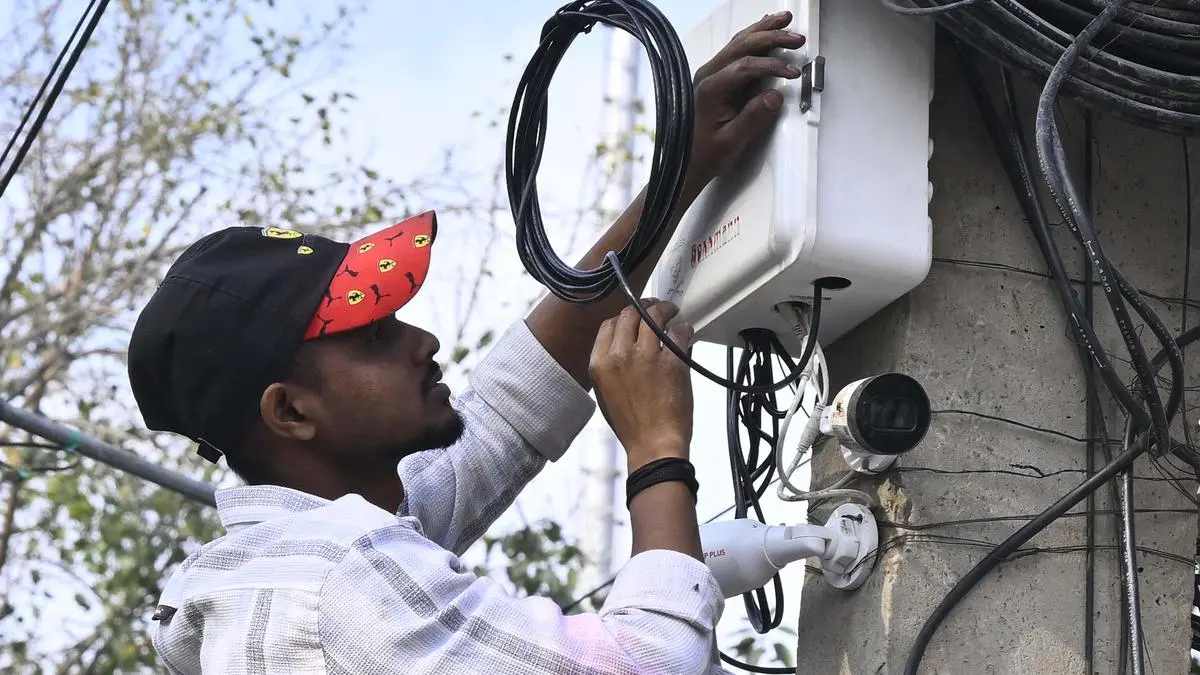
The Indian government may extend the restrictions it imposed on imported CCTV cameras to other sensitive product categories, according to Electronics and IT Secretary S Krishnan. Speaking at a Confederation of Indian Industry (CII) event on semiconductors, Krishnan said the approach applied to the CCTV segment could be expanded, and that New Delhi would assist Indian chip designers in developing end-to-end trusted supply chains for components that carry security implications.
Security rationale behind the CCTV curbs
Krishnan said the restrictions were driven by a security issue, not a trade measure. "It was primarily a security issue, that many of the CCTV cameras had chips and other active components which came from some non-security vetted countries. In the process, what happens is, you have backdoors on which data flows, including from very sensitive locations to hands that you don't want," he said, as reported by PTI. "When we started putting those restrictions (on CCTV), I know that industry was a little opposed to begin with, but I think they adapted to it," he added.
The government has barred the sale of CCTV cameras imported from non-trusted destinations, a constraint that now shapes how surveillance equipment is sourced and deployed across sensitive facilities in India.
Domestic chip design and the design-linked incentive scheme
Krishnan said two companies selected under the design-linked incentive (DLI) scheme are making chips for CCTV cameras and integrating with Indian companies to manufacture CCTV cameras within the country. He also stressed that while producing chips domestically, it is important to ensure a market exists for them — a signal that the government views the DLI scheme as tied to actual product demand, not just fabrication capability.
The DLI scheme, referenced by Krishnan, is the programme under which these two undisclosed chip designers are now working on CCTV-specific semiconductors and partnering with local manufacturers for in-country assembly.
Expansion to other sensitive areas
"That is an approach we will then try to see how we can expand it to other areas," Krishnan said. "I think there are still sensitive areas which are uncovered in the chip part where we need to sort of look at the security dimensions in addition to making sure that we have end-to-end trusted supply chains," he added, according to PTI.
The statement indicates that sectors beyond video surveillance — any product category containing chips or active components that could introduce data backdoors — may face similar sourcing restrictions if they are deemed security-sensitive.
What sourcing teams should watch
For technology procurement leaders and supply chain managers, the remarks signal that suppliers of electronic components destined for Indian security-sensitive environments should anticipate restricted-source rules similar to the CCTV import ban. The stated goal, per Krishnan, is to build end-to-end trusted supply chains of components for products that can have security implications, while ensuring Indian-made chips have a viable market.
| Element | What the source says |
|---|---|
| Restriction scope | Government barred sale of CCTV imported from non-trusted destinations |
| Expansion plan | Approach may be extended to other sensitive areas |
| Support mechanism | Assistance to Indian chip designers for trusted supply chains |
| Incentive programme | Design-linked incentive (DLI) scheme; two companies making CCTV chips |
| Domestic integration | Chip designers integrating with Indian companies to manufacture CCTV cameras locally |
Krishnan did not specify which product categories could be covered next, nor did he name the two companies involved in CCTV chip production. The comments, made on Thursday at the CII semiconductor event, were published by PTI on July 31, 2026.
Sources: