Bankers expect India to draw $80-85 billion of foreign capital through the Reserve Bank of India's swap-backed push spanning FCNR(B) deposits, external commercial borrowings (ECBs), and overseas foreign currency bonds (OFCBs) issued by banks, according to a report in The Times of India. The timing of inflows is likely to be uneven as durations differ across instruments.
Inflow Timing and Components
The early momentum is set to come from FCNR(B) deposits, which bankers said are already seeing traction among non-resident Indians. The FCNR(B) facility closes on September 30, whereas ECB and OFCB schemes remain open until December 31, with bankers indicating that borrowing activity may gather pace in the October-December quarter. Large inflows can provide support to the rupee, which has been under pressure amid global turmoil, the report noted.
The push follows a review meeting chaired by finance minister Nirmala Sitharaman with bank chiefs in the capital, where lenders reported strong interest across geographies including Singapore, Hong Kong, West Asia, the UK and the US. Banks are offering higher returns on FCNR(B) deposits, aided by the suspension of interest rate ceilings, and are stepping up outreach through digital channels to tap diaspora savings.
A day after the finance minister's meeting, RBI Governor Sanjay Malhotra met bank chiefs to discuss deposit mobilisation plans among other issues. Malhotra suggested banks leverage advanced technologies, including AI, to expand their reach, improve operational efficiency, reduce costs and enhance customer experience, while ensuring robust cybersecurity, strong internal controls and safeguards against fraud and data misuse.
Comparison with 2013 Window
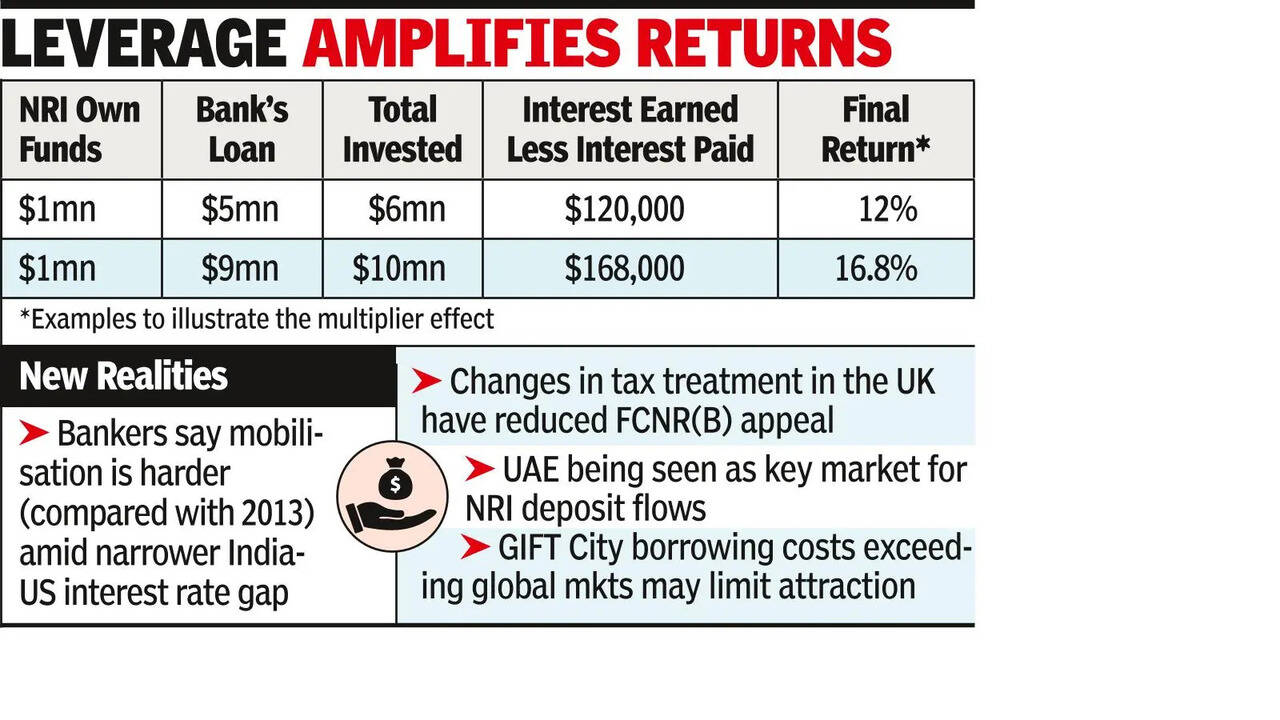
Bankers cautioned that conditions differ markedly from the 2013 swap window, when about $26 billion was mobilised via FCNR(B) deposits and a further $8 billion through overseas borrowings. The interest rate differential between India and the US has since narrowed, while changes in tax treatment in markets such as the UK have reduced the attractiveness of such instruments. This has increased the importance of tapping tax-efficient jurisdictions such as the UAE and encouraging NRI deposits funded through overseas borrowings.
| Metric | 2013 Scheme | Current Scheme (2026) |
|---|---|---|
| Total mobilised | ~$34 billion | Expected $80-85 billion |
| FCNR(B) deposits | $26 billion | Early traction, still open |
| ECBs and OFCBs | $8 billion | Wait-and-watch, open till Dec 31 |
| Interest rate differential | Wider | Narrowed (US rates higher) |
| Tax treatment | More favourable | Less favourable in UK and other markets |
| Key new factor | — | GIFT City emergence |
Another structural shift is the emergence of GIFT City as an international financial centre. While banks can raise and lend foreign currency through its units, lenders note that borrowing costs there may still exceed those in global markets, tempering its appeal.
Policy Support and Monitoring
Officials said the RBI is supporting mobilisation through a real-time monitoring framework, while the finance minister urged banks to intensify engagement with NRIs and sustain the momentum. The schemes, announced in June, offer a dollar-rupee swap at par for FCNR(B) deposits and concessional swaps for ECBs and OFCBs, aimed at bolstering reserves and strengthening the balance of payments amid a more uncertain global backdrop.
Implications for Trade Finance and Currency Markets
For CFOs and treasury directors, the swap facilities effectively lower the cost of foreign currency borrowing for banks, which can translate into more competitive pricing for trade finance products such as letters of credit and working capital loans in dollars. The concessional swap removes the hedging cost for banks, reducing the all-in cost of raising foreign currency—a benefit that can be passed on to importers and exporters. The expected large inflows also provide a buffer for the rupee, reducing volatility for companies with unhedged foreign exchange exposure. However, the narrower interest rate differential and tax changes in key markets mean that banks must focus on tax-efficient jurisdictions like the UAE to sustain momentum. The real-time monitoring framework ensures that the central bank can track inflows and adjust policy if needed, providing predictability for corporate treasuries planning their FX risk management strategies.
Sources: