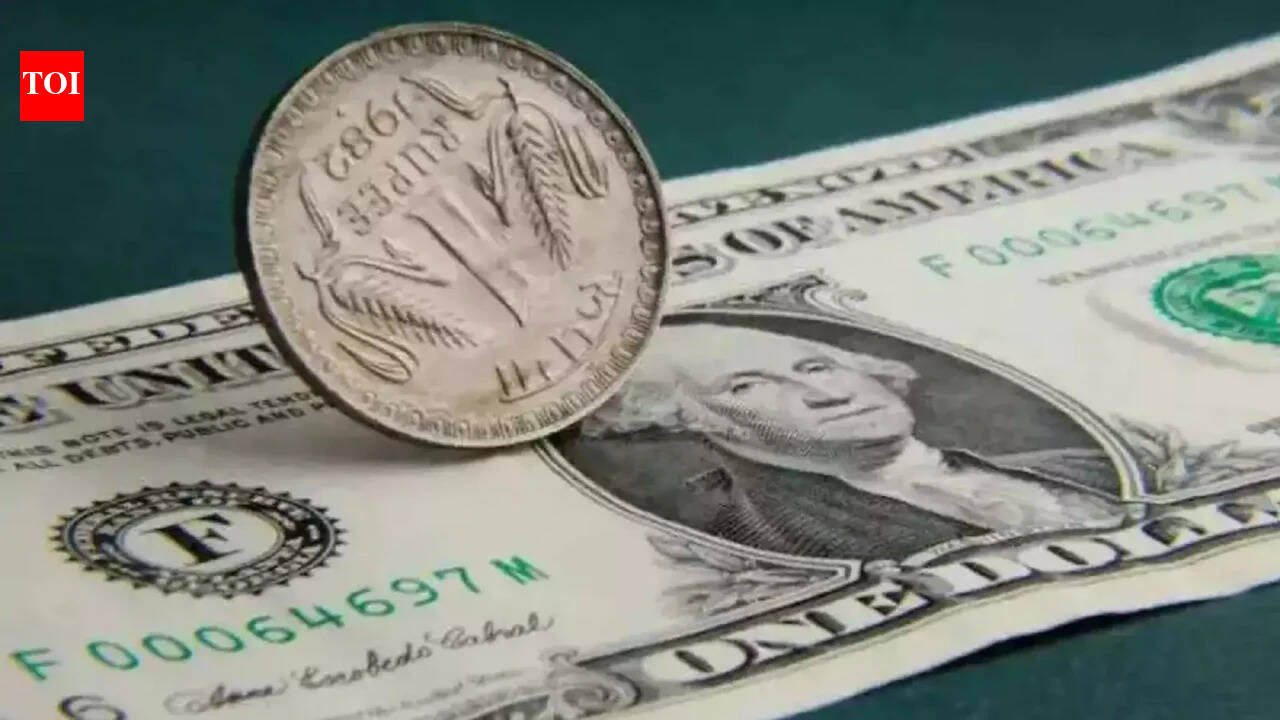
The Indian rupee opened the week on a weaker note, slipping 10 paise to 95.28 against the US dollar in early interbank trade on Monday, according to Business Today. The currency opened at 95.25 before weakening further from Friday's close of 95.18, erasing part of the 17-paise gain recorded in the previous session.
Market Context: Dollar Index and Geopolitical Jitters
The dollar index, which measures the US currency against six major peers, was trading 0.10% higher at 100.95, according to the source. This strength in the greenback, combined with uncertainty over the progress of US-Iran peace talks, kept market sentiment under pressure. Forex traders said that geopolitical risks continued to influence investor sentiment, outweighing positive cues such as a decline in global crude prices.
Brent crude futures, the global benchmark for oil, were down 0.58% at $71.70 a barrel, the article reported. Lower oil prices are typically supportive for the rupee, as India is a major crude importer.
Expert Analysis: Underlying Fragility
According to Amit Pabari, Managing Director of CR Forex Advisors, the rupee's inability to strengthen despite favourable global cues points to underlying weakness. "The message from last week is simple. When the rupee cannot rally on good news like falling oil and a softer dollar, it tells you the underlying mood is fragile," Pabari said.
He added that any fresh negative trigger could push USDINR towards the 95.80 to 96.00 zone, while support holds near 94.80 to 95.00. Pabari also noted that while weak US jobs data had kept pressure on the dollar index, the rupee failed to benefit: "The dollar index eased to around 100.90 as weak US jobs data continued to weigh on it. Normally, a softer dollar is exactly what the rupee needs to catch a breath. This time, it simply did not happen, and that is the part worth watching closely this week."
Equity Markets and Foreign Flows
Despite the rupee's decline, Indian equity markets began the week on a strong note. The BSE Sensex climbed 316.46 points, or 0.41%, to 78,080.37, while the NSE Nifty advanced 99.60 points, or 0.41%, to 24,381.00 in early trade, Business Today reported.
Exchange data showed that foreign institutional investors (FIIs) remained net buyers on Friday, purchasing equities worth Rs 1,355.33 crore. Forex traders indicated that the Reserve Bank of India (RBI) is expected to use any fresh foreign inflows to replenish the country's foreign exchange reserves rather than allowing the rupee to appreciate sharply.
Reserve Bank of India: Intervention and Reserves
The RBI's foreign exchange reserves data, released separately, showed a decline of $5.654 billion to $666.933 billion in the week ended June 26, according to the source. This followed an increase of $963 million in the previous reporting week, when reserves had risen to $672.587 billion. The reserves had earlier reached a record high of $728.494 billion in the week ended February 27.
The article noted that reserves later declined over several weeks after the onset of the Middle East conflict, which put pressure on the rupee and led the RBI to intervene in the foreign exchange market through dollar sales.
| Key Market Data | Value | Change |
|---|---|---|
| USD/INR (early trade) | 95.28 | -10 paise from 95.18 close |
| Dollar Index | 100.95 | +0.10% |
| Brent Crude | $71.70/barrel | -0.58% |
| BSE Sensex | 78,080.37 | +316.46 pts (+0.41%) |
| NSE Nifty | 24,381.00 | +99.60 pts (+0.41%) |
| RBI Forex Reserves (Jun 26) | $666.933B | -$5.654B |
For finance executives and treasury professionals, the rupee's weakness has direct implications for trade finance cost of capital and FX exposure management. A weaker rupee increases the cost of imports, particularly crude oil, and raises hedging costs for companies with foreign currency payables. The RBI's intervention via dollar sales, while stabilizing the currency, depletes reserves and signals a cautious approach to managing the exchange rate. The failure of the rupee to rally on positive cues suggests that ongoing geopolitical risks and structural outflows may continue to weigh on the currency, requiring active hedging strategies for firms with significant USD exposure.
Sources: