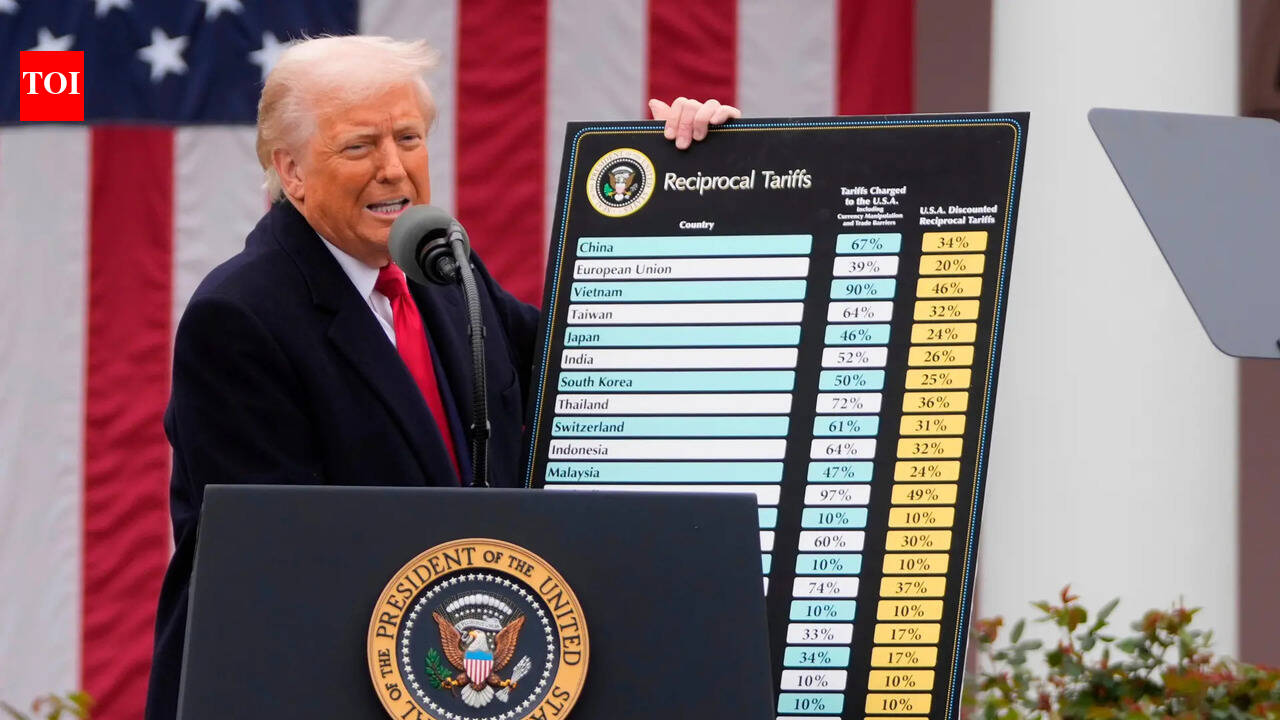
Donald Trump's tariff strategy is once again under legal scrutiny. Just as temporary 10% worldwide tariffs expired, two groups of small businesses headed to court to challenge the administration's latest trade measures, according to a report by the Times of India.
The lawsuits target the sweeping tariffs announced earlier this week, which impose double-digit levies on goods from 60 trading partners and cover 99% of US imports. The Trump administration has invoked Section 301 of the Trade Act of 1974, saying the tariffs are aimed at countries that have failed to prevent imports produced by forced labour. The challengers, however, argue that the new measures are effectively replacing the worldwide tariffs Trump imposed last year, which were struck down by the Supreme Court in February.
Lawsuits Filed
The first lawsuit was filed on Friday in the Court of International Trade by educational toy company Learning Resources and several other small businesses. Learning Resources was also among the plaintiffs in the earlier tariff case that ultimately succeeded in the Supreme Court. The second lawsuit has been filed by Burlap and Barrel, a New York-based spice company, and Collective Horology, a watch retailer based in Ventura, California. Both groups are represented by the Liberty Justice Center, a libertarian advocacy group.
Legal Arguments
Both lawsuits argue that the government failed to adequately establish its case against each individual economy. They also contend that the administration did not explain how the tariffs would eliminate the specific practice they are intended to address, as required under Section 301. The lawsuits argue that while the administration has justified the tariffs as a response to forced labour, the measures are instead being used to replace the worldwide tariffs that were struck down earlier this year.
“Forced labor is morally indefensible, but an important objective does not give the government permission to ignore the law,” said Sara Albrecht, chairman and CEO of the Liberty Justice Center. “The administration allowed one global tariff to expire and immediately replaced it with another under a different statute. Changing the statute doesn’t change the law.”
The White House did not immediately respond to a request for comment.
Tariff Comparison: Expired vs. New
| Aspect | Expired Worldwide Tariffs | New Section 301 Tariffs |
|---|---|---|
| Legal basis | Section 122 | Section 301 |
| Coverage | 10% on all imports | Double-digit levies on 60 trading partners, covering 99% of US imports |
| Target | Worldwide | Countries with alleged forced labour issues |
| Duration | Temporary (expired Friday) | Likely long-term |
| Court status | Struck down by Supreme Court in February | Under challenge |
Outlook from Experts
Legal experts believe the latest lawsuits could face a steeper challenge than earlier ones. Trump had relied on Section 301 during his first term to impose sweeping tariffs on China, and those measures survived court challenges. Experts say that history could make it more difficult to successfully challenge the latest tariffs.
Patrick Childress, a partner at Holland & Knight and a former US trade official, said the current duties are likely to remain in force for an extended period. Unlike the Section 122 levies that expired on Friday, “these tariffs will be with us for the long haul,” he said. Childress added that even if countries adopt the exact policies sought by the US, they would still have to prove to Washington's satisfaction that those measures are being enforced before the tariffs could be lifted. “This suggests that no short-term path for country-wide relief from the new Section 301 tariffs will be available.”
For import/export professionals and trade policy analysts, the key takeaway is that the new Section 301 tariffs are expected to remain in force for the foreseeable future, with no immediate relief even if targeted countries comply with US demands. The legal challenges face an uphill battle given the precedent of Section 301 surviving earlier challenges. Businesses should prepare for prolonged higher duties on a wide range of imports from 60 trading partners.
Sources: