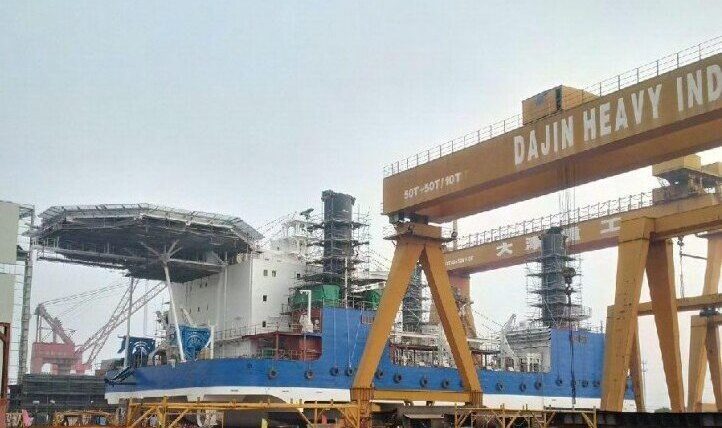
Taiwanese owner and operator U-Ming Marine Transport has signed for up to four newcastlemax newbuildings in China, a move that will add significant dry bulk capacity later this decade. The order, placed through U-Ming Marine Transport Singapore, is part of the company's broader dry bulk expansion plan and reflects ongoing investment in large bulk carriers despite global supply chain uncertainties.
Order Details
U-Ming has contracted Jiangsu Hantong Ship Heavy Industry for two firm 211,000 dwt bulk carriers, with options for two more, according to Splash247. Each ship is priced between $77 million and $80 million. The vessels are newcastlemax-class, the largest dry bulk carriers capable of transiting the Port of Newcastle in Australia, making them suited for long-haul iron ore and coal routes.
Expansion Plan
The latest deal forms part of a wider dry bulk expansion plan approved earlier this year. In May, U-Ming said its board had cleared the construction of four 210,000 dwt bulkers and four 64,000 dwt ultramaxes as part of its push to grow beyond 100 vessels and more than 10 million dwt. This signals a sustained commitment to fleet renewal and expansion in the dry bulk segment, which is a critical component of global commodity supply chains.
Fleet Composition
U-Ming currently operates a diversified fleet across capesize, panamax, post-panamax, and ultramax bulkers, as well as cement carriers, very large crude carriers (VLCCs), and very large ore carriers (VLOCs). The company has also moved into offshore wind support and LNG carrier tonnage. As of last month, including owned, jointly owned, and under-construction vessels, its fleet stood at over 80 ships with a combined capacity close to 10 million dwt.
| Vessel Type | Dwt Range | Current Count (approx.) |
|---|---|---|
| Capesize / Newcastlemax | 180,000+ | Expanding with newbuilds |
| Panamax | 60,000–80,000 | Part of existing fleet |
| Post-Panamax | 80,000–120,000 | Part of existing fleet |
| Ultramax | 60,000–65,000 | 4 on order |
| Cement carriers | Variable | Part of existing fleet |
| VLCC | 200,000+ | Part of existing fleet |
| VLOC | 300,000+ | Part of existing fleet |
Delivery Timeline
The four newcastlemax newbuilds (firm plus options) are expected for delivery in 2029 and 2030, according to Splash247. This long lead time means the capacity will not affect near-term supply-demand balances, but it indicates U-Ming's confidence in dry bulk fundamentals later this decade.
Implications for Bulk Shipping Operators
For freight forwarders and logistics managers in the dry bulk space, the U-Ming order adds to the orderbook for large bulk carriers. While current spot rates and charter hire levels are not discussed in the source, the addition of new tonnage could exert downward pressure on freight rates for newcastlemax and capesize vessels once these ships enter service in 2029–2030. However, given the long lead time, immediate operational impacts are minimal. Shippers of iron ore and coal should monitor the aggregate newbuilding pipeline, as a wave of deliveries could soften rates on key routes such as Australia–China and Brazil–China.
Operators should also note U-Ming's dual focus on both dry bulk and energy-related tonnage (LNG, offshore wind), which suggests a strategic pivot toward more diversified revenue streams. This may influence the availability of U-Ming's bulkers for traditional spot charters if the company allocates capacity to contract or project cargoes.
Watch List
- Orderbook for newcastlemax and capesize bulkers in 2029–2030 – any further orders by other owners could signal oversupply risk.
- Global steel demand and iron ore trade growth, which will determine utilisation rates for these new vessels.
- Scrapping rates of older bulk carriers, as retirement activity could offset newbuild deliveries.
- U-Ming's exercise of options for the remaining two vessels – a decision likely within the next 12–18 months.
While the source article does not provide freight rate benchmarks or port congestion data, the operational relevance for bulk logistics stakeholders lies in the forward capacity expansion signal.
Sources: