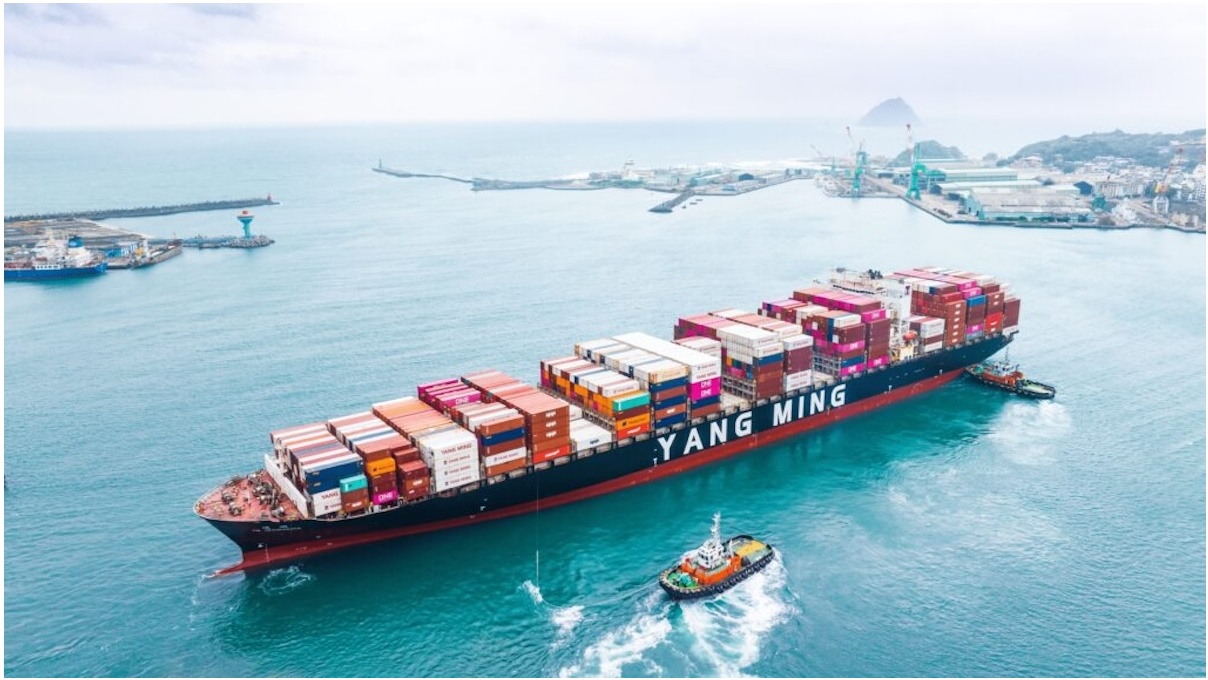
Yang Ming Marine Transport's second-quarter earnings rebound points to firmer trans-Pacific freight conditions, but the Taiwan-based carrier's caution on trade policy, Red Sea diversions and vessel supply signals a volatile second half, according to FreightWaves.
For the first half of 2026, Yang Ming reported consolidated revenue of US$2.62 billion, with the second quarter outperforming both the first quarter and the year-earlier period, FreightWaves reported. The carrier attributed the improvement principally to an early peak season, stronger cargo demand and firmer freight rates, with tariff uncertainty prompting cargo owners to advance shipments.
First-half results: revenue and profit rebound
FreightWaves reported that in Q1, Yang Ming recorded revenue of $1.2 billion, after-tax profit of $44.7 million and earnings per share of $0.013, citing softer freight rates than a year earlier and vessel-deployment effects linked to Middle East geopolitics.
| Metric | Q1 2026 | H1 2026 | FY 2025 |
|---|---|---|---|
| Revenue | $1.2 billion | $2.62 billion | $5.07 billion |
| After-tax profit | $44.7 million | — | $530.3 million |
| Earnings per share | $0.013 | — | $0.15 |
The first-half rebound also follows a more difficult 2025, when Yang Ming's full-year revenue fell to $5.07 billion and after-tax profit declined to $530.3 million, or $0.15 per share, FreightWaves said. Still, 2025 marked its sixth consecutive profitable year, underlining the carrier's ability to remain profitable despite a less favorable rate environment and substantial network disruption.
What drove the recovery
FreightWaves reported that Yang Ming credited three mutually reinforcing factors:
- Front-loading demand: Uncertainty surrounding tariff policy encouraged shippers to move cargo earlier, creating an unusually strong early peak-season pattern.
- Higher freight rates: Rate gains accompanied the cargo-demand increase and helped lift Q2 above both Q1 and the prior-year quarter.
- Effective-capacity constraints: Diversions away from the Red Sea around the Cape of Good Hope, port congestion and slower sailing speeds absorbed vessel time and reduced effective capacity, partially offsetting the delivery of new tonnage.
Network exposure and the outlook
According to FreightWaves, Yang Ming has a substantial North American presence concentrated in the trans-Pacific trade, with 10 weekly Asia-U.S. West Coast sailings and four weekly Asia-U.S. East Coast sailings among 21 named Asia–North America loops.
The carrier's outlook remains cautious. FreightWaves noted that Yang Ming identified trade protectionism, changing trade policies and geopolitical conflict — particularly in the Middle East and Red Sea — as enduring risks to trade flows and supply-chain reliability. Rerouting has reduced capacity on affected services and made transshipment arrangements more complicated, while also raising terminal-congestion risk, insurance costs and bunker expenses.
The supply-demand imbalance does not necessarily translate directly into weaker spot markets.
Yang Ming cited approximately 1.59 million container units of scheduled new ship deliveries in 2026. Based on Alphaliner data cited by the company, global fleet supply was expected to grow 3.8% in 2026, ahead of projected demand growth of 2.5%, FreightWaves reported. Yang Ming notes that tighter decarbonization standards may encourage slow steaming and retirement of older vessels, reducing usable capacity and absorbing some of the delivery wave.
Shipper and operator implications
For freight forwarders and shippers on the trans-Pacific, the data points to a market where early peak-season strength has already been captured and where the second half is hostage to policy and geopolitics. FreightWaves said Yang Ming will monitor trade flows and demand, adjust service networks and capacity deployment, improve service stability and maximize slot utilization. It also plans to replace older vessels gradually with more energy-efficient and smart ships while diversifying energy risk and maintaining environmental compliance.
Yang Ming named the 15,500-TEU LNG dual-fuel vessel YM Wayfinder in June for deployment on the Asia-North Europe FE3 service, according to FreightWaves.
Watch list
FreightWaves identified these factors as shaping the balance of the year:
- Trade policy: Tariff front-loading has pulled demand forward; any resolution or escalation could reshape booking patterns.
- Middle East and Red Sea risk: Geopolitical conflict continues to force diversions, reduce effective capacity and raise insurance and bunker costs.
- Newbuild deliveries: Approximately 1.59 million container units of scheduled new ship deliveries in 2026, with fleet supply growth of 3.8% versus 2.5% demand growth.
- Decarbonization standards: Tighter rules may encourage slow steaming and retirement of older vessels, absorbing some of the delivery wave.
- Network adjustments: Yang Ming's stated plan to adjust service networks and capacity deployment could alter trans-Pacific and Asia-North Europe schedules.
Sources: