
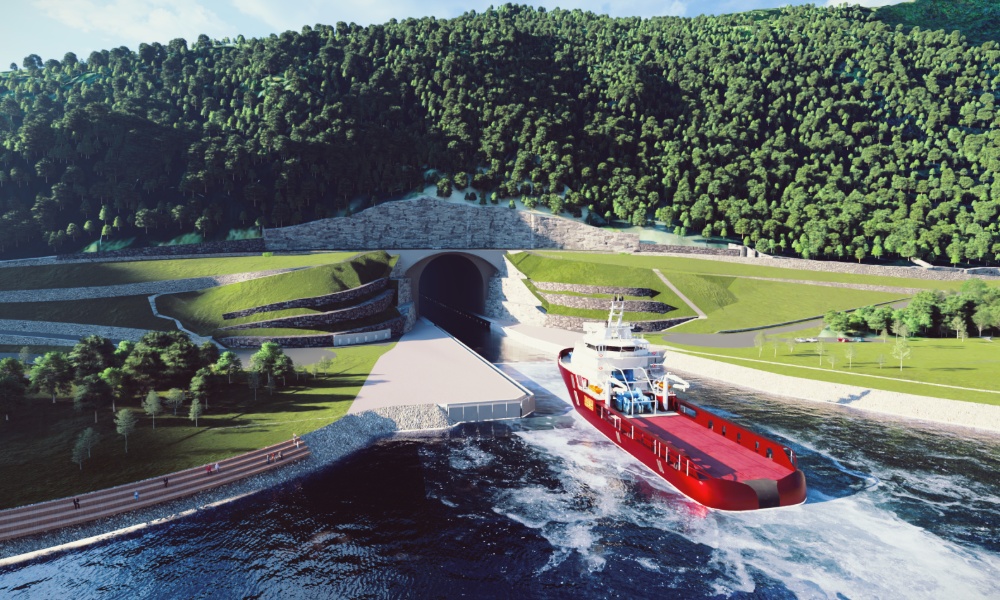
The Norwegian Coastal Administration has awarded a turnkey contract to AF Gruppen for the engineering and construction of the Stad Ship Tunnel, the world's first ship tunnel, according to Splash247. The project will create a fully equipped maritime tunnel that allows both freight and passenger ships to navigate directly between the Norwegian Sea to the north and the North Sea to the south while remaining within fjord waters. This will finally enable year-round safe passage for ships shuttling between Bergen and Alesund, two key Norwegian ports.
Project Details and Specifications
The tunnel will be 1.7 km long with a cross-section approximately 20 times that of a road tunnel. Its dimensions are 45 m high by 36 m wide, and it will accommodate ships with a draft of 12 m. The tunnel will be bored beneath a 645 m mountain. The contract value is estimated at NOK 5.6bn ($564.5m). AF Gruppen, together with its consultant Norconsult, developed the project in collaboration with the Norwegian Coastal Administration during the tender phase.
| Specification | Detail |
|---|---|
| Length | 1.7 km |
| Height | 45 m |
| Width | 36 m |
| Maximum draft | 12 m |
| Overburden | 645 m mountain |
| Cross-section | ~20x road tunnel |
| Contract value | NOK 5.6bn ($564.5m) |
| Construction start | Early 2027 |
| Construction period | ~5 years |
Operational Implications
For freight and passenger ship operators, the Stad Ship Tunnel will eliminate the need to navigate the hazardous waters of the Stadhavet peninsula, which is often subject to rough weather and strong currents. The tunnel provides a protected route within fjord waters, allowing year-round safe passage. This is expected to improve schedule reliability and reduce weather-related delays for vessels operating on the Bergen–Alesund corridor. The tunnel is designed for both freight and passenger ships, offering significant operational benefits.
Historical Context and Development
According to Splash247, the concept of a ship tunnel at Stad has been debated for more than a century, with the first mention in a newspaper article from 1874. More serious discussions began in 2013, when the concept moved into formal planning and was included in Norway’s National Transport Plan. The Scandinavian country officially announced plans to construct the Stad Ship Tunnel nearly a decade ago, in April 2017. The original plan was for construction to start in 2022 and end in either 2025 or 2026, with an expected cost of around $319m. The go-ahead for the project with state funding was given in March 2021.
Amund Tøftum, CEO of AF Gruppen, commented: “It is rare for us, as a design and build contractor, to have the opportunity to take on such a unique infrastructure project, attracting significant local, national, and international interest.” This quote from the Splash247 article highlights the project's significance.
Watch List
- Construction start: Early 2027. Delays or changes to the timeline should be monitored.
- Final cost: The contract value of NOK 5.6bn is higher than the earlier estimate of $319m. Any further cost revisions will affect budget expectations.
- Operational impact studies: As the tunnel nears completion, shipping lines may publish revised schedules and cost-benefit analyses for using the tunnel.
- Environmental and regulatory approvals: The project has already secured state funding, but any additional environmental challenges could emerge during construction.
- International interest: The world’s first ship tunnel may set a precedent for similar projects elsewhere, influencing maritime infrastructure investment globally.
Sources:


