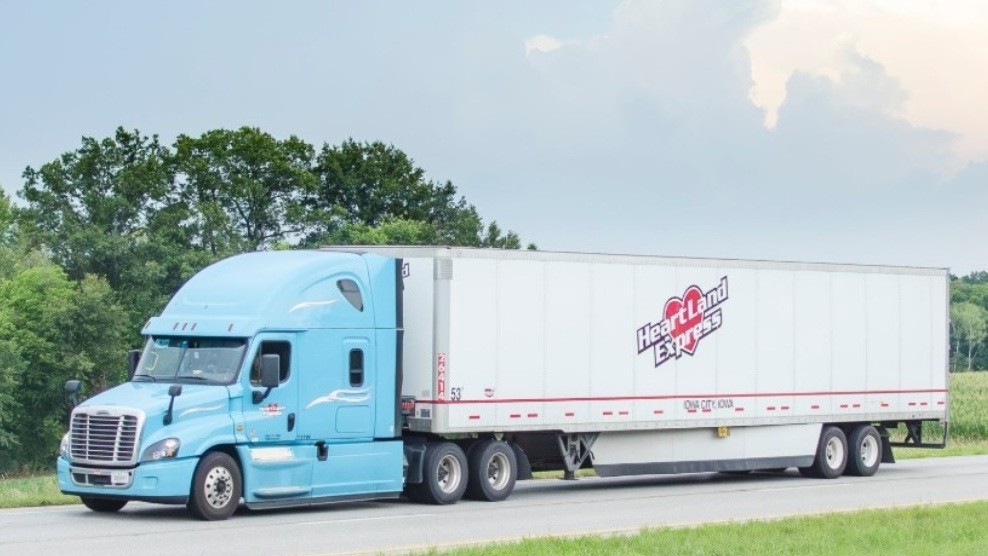
Gains from used-equipment disposals returned Heartland Express to profitability in the second quarter, but the truckload carrier's underlying operations remained under pressure, with an adjusted operating ratio near 103% when the asset-sale tailwind is stripped out, according to FreightWaves.
The North Liberty, Iowa-based carrier (NASDAQ: HTLD) reported net income of $10.6 million, or 14 cents per share, for the period, compared with a net loss of 14 cents per share in the year-ago quarter. FreightWaves reported that the turnaround was entirely tied to a $22-million year-over-year increase on gains from equipment sales — a 22-cent-per-share tailwind at a normalized tax rate.
Quarter at a glance
Revenue totaled $184 million in the quarter, a 13% year-over-year decline. Excluding fuel surcharges, revenue was down 18% year-over-year, according to FreightWaves. The company reported an 88.3% adjusted operating ratio — the inverse of operating margin — but the operating ratio was closer to 103% without the outsized gains.
| Metric | Q2 2026 | Year-Ago Quarter | Change |
|---|---|---|---|
| Net income | $10.6 million | Net loss | Return to profit |
| Diluted EPS | 14 cents | (14 cents) | +28 cents |
| Revenue | $184 million | Not disclosed | -13% y/y |
| Revenue ex-fuel surcharge | Not disclosed | Not disclosed | -18% y/y |
| Adjusted operating ratio | 88.3% | Not disclosed | ~103% excluding gains |
| Average tractor age | 2.3 years | 2.6 years | -0.3 years |
Fleet and equipment strategy
The company culled its fleet size by strategically disposing underutilized equipment. “We expect to continue to dispose of excess trailers within our fleet as used equipment market conditions improve,” the company said in a news release. CEO Mike Gerdin added: “The improved financial results delivered reflect stronger freight volumes and improved customer pricing resulting from ongoing industry capacity reductions along with reduced operating costs and strategic disposals of under-utilized assets.”
The average age of Heartland's tractor fleet fell to 2.3 years from 2.6 years in the year-ago quarter, reflecting the disposal of older units, according to FreightWaves.
Balance sheet and liquidity
Operating cash flows totaled $36 million in the first half of the year. Heartland reduced net debt by $33 million in the period to $73 million. It ended the quarter with $89 million available on an untapped revolving credit facility and was in compliance with financial covenants, according to FreightWaves.
Shares of HTLD were down 1.6% at 12:42 p.m. EDT on Friday, compared with the S&P 500, which was up 0.4%.
Implications for shippers and operators
FreightWaves noted that Heartland does not host a quarterly call, nor does it provide operating metrics for utilization and pricing, limiting visibility for shippers and analysts. The 103% adjusted operating ratio excluding gains shows that the core truckload operation is still being supported by one-time asset sale profits rather than sustainable pricing and volume gains.
For freight forwarders and 3PL operators, the 13% revenue decline and 18% drop excluding fuel surcharges underscore a soft demand environment in truckload. The company's continued disposal of excess trailers, tied to improving used-equipment market conditions, points to an ongoing reduction in carrier-owned capacity — a factor that logistics managers should monitor when procuring truckload services.
The story shows how impactful gains on asset sales can be on a truckload carrier's financial results, according to FreightWaves.
Watch list
- Used equipment market conditions: Heartland says it expects to continue disposing of excess trailers as conditions improve.
- Industry capacity reductions: CEO Mike Gerdin cited ongoing capacity reductions as a driver of stronger freight volumes and improved customer pricing.
- Freight volumes and customer pricing: The company cited both as improving in the quarter, though revenue still declined sharply.
- Liquidity and covenant compliance: Heartland ended the quarter with $89 million on an untapped revolver and in compliance with financial covenants.
Sources: