AI dispatch agents have become skilled at finding freight, but they still struggle to tell an operator whether that top-ranked load actually pays, according to FreightWaves. MapUp's launch of FuelGuru MCP aims to close that gap — the company calls it the first production Model Context Protocol (MCP) server built for fleet fuel purchasing, tolls and commercial truck routing.
The server lets any AI agent, load board, dispatch tool or TMS copilot ask MapUp's engine what a trip will really cost for a specific truck on a specific day under a fleet's own rules. "While these AI agents are already helping to pick a good load, the next level of intelligence is defining what is a good load," MapUp CEO Katie Mahlawat told FreightWaves. "Right now the good definition is time and cost and how that trade-off plays out."
The $1,800 load that is not what it seems
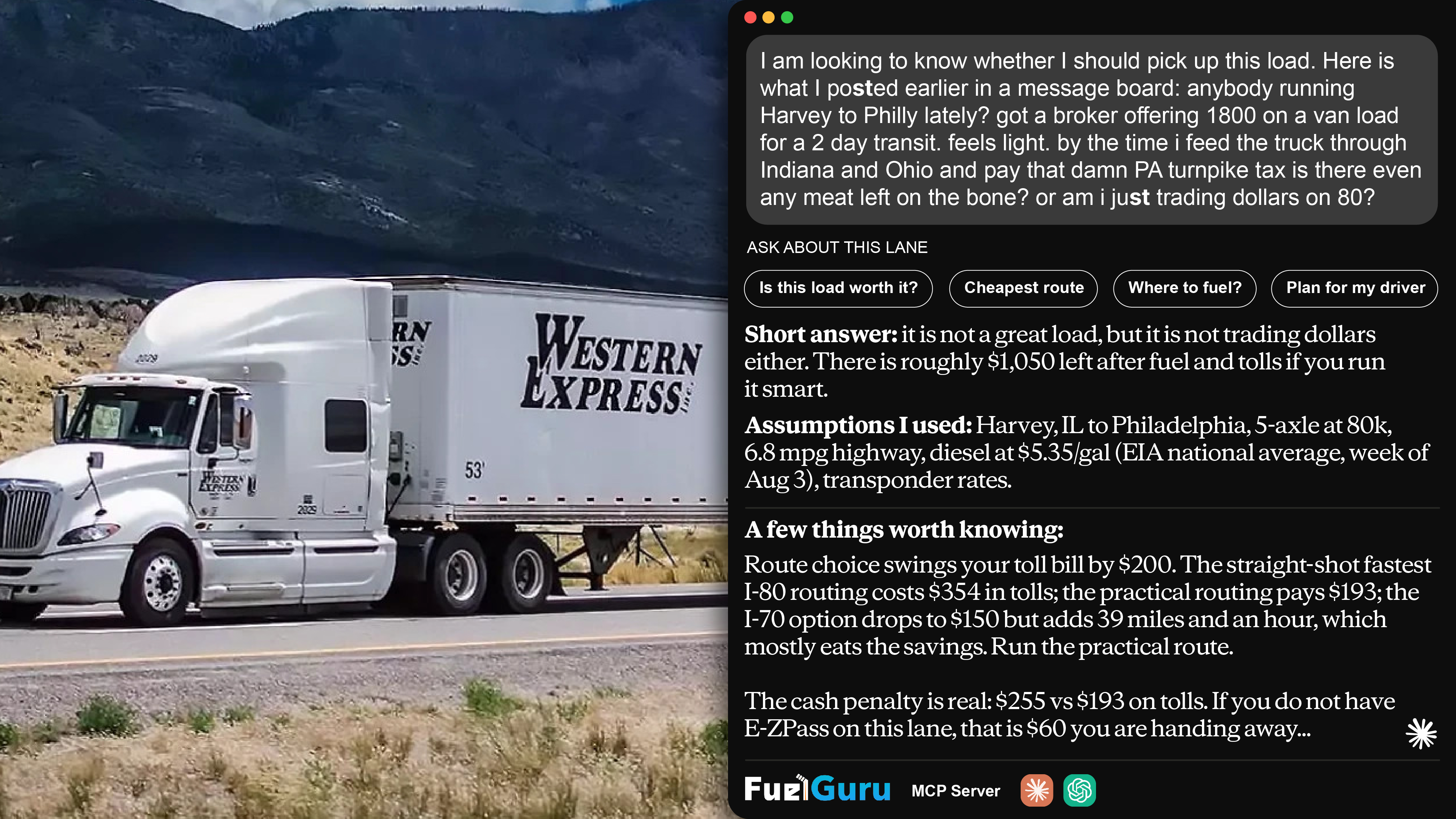
Mahlawat used a concrete example. A broker posts $1,800 all-in for a five-axle dry van from Harvey, Illinois, to Philadelphia. On the 773-mile practical route, that works out to about $2.33 a mile. The posted rate alone says nothing about what remains after route-specific fuel, tolls and time.
In an August 2026 FuelGuru analysis, MapUp priced three commercial routes for the same trip:
| Route option | Distance & drive time | Fuel & tolls | Remaining of $1,800 rate |
|---|---|---|---|
| Practical I-80 | 773 miles, 11h49m driving | Fuel $554.58 + tolls $192.97 | $1,052.45 |
| Fastest (I-80 + PA Turnpike) | Arrives 23 min sooner than practical | $144 more in combined fuel and tolls than practical | $908.91 |
| Cheapest (I-70) | Adds 39 miles and 62 min vs practical | Tolls $150.36; combined fuel and tolls $22.77 less than practical | — |
The practical I-80 route exceeds what a solo driver can legally run without a 10-hour break, according to the analysis. The fastest option leaves only $908.91 — meaning the operator pays $144 in extra fuel and tolls to buy back 23 minutes, a marginal tractor hour priced at $374. FreightWaves reported that very few fleets in North America treat a marginal hour of driver time at that rate; many simply price all-in or chase a target rate per mile, so the truck takes the faster route because nobody priced the alternative before it rolled.
The cheapest line punishes the opposite instinct. At a $54-an-hour loaded driver cost, the extra hour on I-70 costs about $56 to save $22.77 in combined fuel and tolls — a net loss before it threatens the delivery window.
"This is why 'avoid tolls' is bad policy and 'always take the toll road' is worse," wrote MapUp co-founder and Chief Technology Officer Maneesh Mahlawat in the company's launch note. "Neither is a decision. Both are habits."
A universal power adapter for freight math
FuelGuru first launched last year at FreightWaves' F3: Future of Freight Festival, where FirstFleet Chief Information Officer Austin Henderson demonstrated it alongside NavGuru, MapUp's commercial navigation product. It originally shipped as an API, so every platform that wanted the engine had to build a custom integration.
"MCP is like a universal power adapter," Katie Mahlawat said. "You could say you want to connect your own phone to anyone else's speaker. How do you like them to talk to each other? That's it."
Now the integration is largely a credential. "Get an API key from us, plug it in your Claude configuration, it gets added as a skill," she said. "Now you have an agent which is a FuelGuru brain." An agent hands over the load, truck position, equipment, appointment windows, tank level, fuel economy, card pricing and fleet rules. FuelGuru returns practical, fastest, cheapest and alternate routes with drive time, vehicle-specific tolls, fleet-net fuel cost and other inputs.
What this means for logistics and procurement leaders
The timing of the calculation is what carries the operating value, according to Nick Brooks, vice president of technology and marketing at Western Express: "Being able to come back with the real fuel cost and the real toll cost at the time you are going to incur it is infinitely valuable. As toll routing gets more complicated, it is going to make profitability happen quicker."
For CSCOs and logistics directors, the MapUp example quantifies the cost of not pricing route alternatives. The same $1,800 load leaves $143.54 more on the practical route than the fastest path before driver pay, equipment and fixed costs — and the "cheapest" toll option is a net loss once driver time is included. That spread is the difference between a load that contributes to overhead and one that quietly erodes margin.
The MCP integration also changes the implementation effort: instead of building a custom API integration, a fleet can add FuelGuru as a skill in an existing Claude configuration with an API key, according to MapUp's CEO. For procurement teams evaluating TMS copilots and AI dispatch agents, the takeaway is that load-finding intelligence is only half the decision — the profitability math behind each route, calculated under the fleet's own fuel card pricing and equipment rules, is now available at the point of dispatch.
Sources: