Freight brokers operate on trust. The entire business model depends on knowing that the carrier assigned to a load is who they say they are, that the truck is moving, and that the freight will arrive intact and on time. Given that fraud has become a persistent threat and carrier verification remains a largely manual, reactive process, that trust is increasingly hard to earn, but still easy to lose, according to FreightWaves. Numeo AI is an infrastructure layer that makes that trust scalable.
Continuous Verification, Not a One-Time Check
The carrier verification problem is well-documented in freight. Bad actors exploit email systems, impersonate legitimate carriers, and intercept loads before the fraud is detected. Brokers who place a carrier on a Do Not Use list may never fully understand what happened, and the legitimate carrier whose identity was compromised bears the reputational cost, FreightWaves reported.
Numeo's approach to this problem is built into the platform's core architecture. Because the company's AI agents are actively engaged with carriers on a day-to-day basis — communicating via email, processing rate confirmations, tracking proof-of-delivery scans, and conducting voice interactions with drivers — the platform has a continuous, real-time picture of each carrier's activity. “We don’t just perform a one-time verification,” said Akmal Paiziev, Co-Founder and CEO of Numeo AI, according to FreightWaves. “Our platform continuously builds trust by validating the operational signals generated as carriers use Numeo to find, book, and manage freight. That ongoing context helps us identify inconsistencies while protecting both brokers and legitimate carriers.” For brokers, that means the capacity available through Numeo comes with an active verification layer and not just a static credential check.
What Verified Capacity Looks Like in Practice
The practical application of that verification infrastructure is clear in how Numeo handles the track-and-trace problem, one of the most persistent friction points in carrier-broker relationships, FreightWaves noted. Brokers routinely require drivers to install third-party tracking applications as a condition of load assignment. The challenge: different brokerages often require different apps, and owner-operators working across multiple relationships can find themselves managing a fragmented set of tools they may use infrequently, incorrectly, or not at all. The result is that brokers end up making phone calls anyway, undermining the efficiency the technology was supposed to deliver.
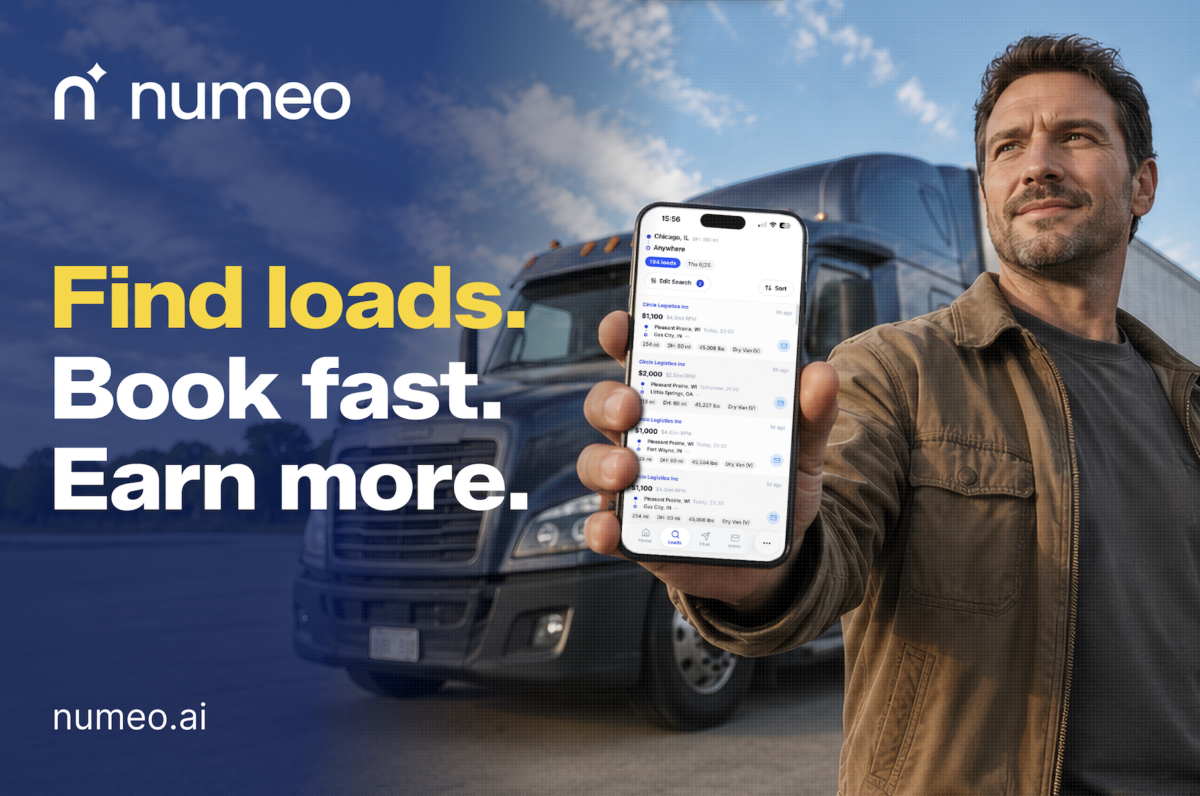
Numeo sidesteps this problem by making the driver’s existing behavior the source of visibility. Because owner-operators are already using the Numeo mobile app daily to find and manage loads, brokers can access real-time truck location data through a platform the driver is already incentivized to use — without requiring any additional installation or onboarding. “Owner-operators are using our app already,” Paiziev said, as quoted by FreightWaves. “That’s a benefit to both the driver and broker. It ensures that the broker can retain more visibility organically.” Numeo also maintains integrations with broker-side platforms including Parade and Happyrobot, giving brokers who already use those tools a familiar entry point for accessing Numeo’s carrier network.
The Carrier Side: Speed, Selection, and Revenue
While the broker-facing value proposition centers on trust and visibility, the carrier-side benefits are equally critical, according to FreightWaves. Numeo’s AI-powered dispatch automation enables carriers and owner-operators to find and book loads more quickly, reducing downtime. The platform also helps carriers manage their operations more efficiently, potentially increasing revenue per truck. By providing a single, daily-use app that handles both load booking and tracking, Numeo reduces the administrative burden on drivers who might otherwise juggle multiple systems. This stickiness benefits brokers, who gain access to a large, active carrier network that is already verified.
Implications for Brokers and Shippers
For freight brokers, the practical outcome is a reduction in fraud risk and an improvement in load visibility without imposing additional technology on carriers. Shippers benefit indirectly through more reliable service and fewer disruptions. FreightWaves reported that Numeo’s continuous verification model represents a shift from static, one-time checks to dynamic, ongoing validation. Brokers evaluating capacity sources should consider whether the carrier network they use is verified only at onboarding or constantly through operational signals. Numeo’s approach suggests a future where trust is built into the platform rather than being a manual overhead.
Sources: