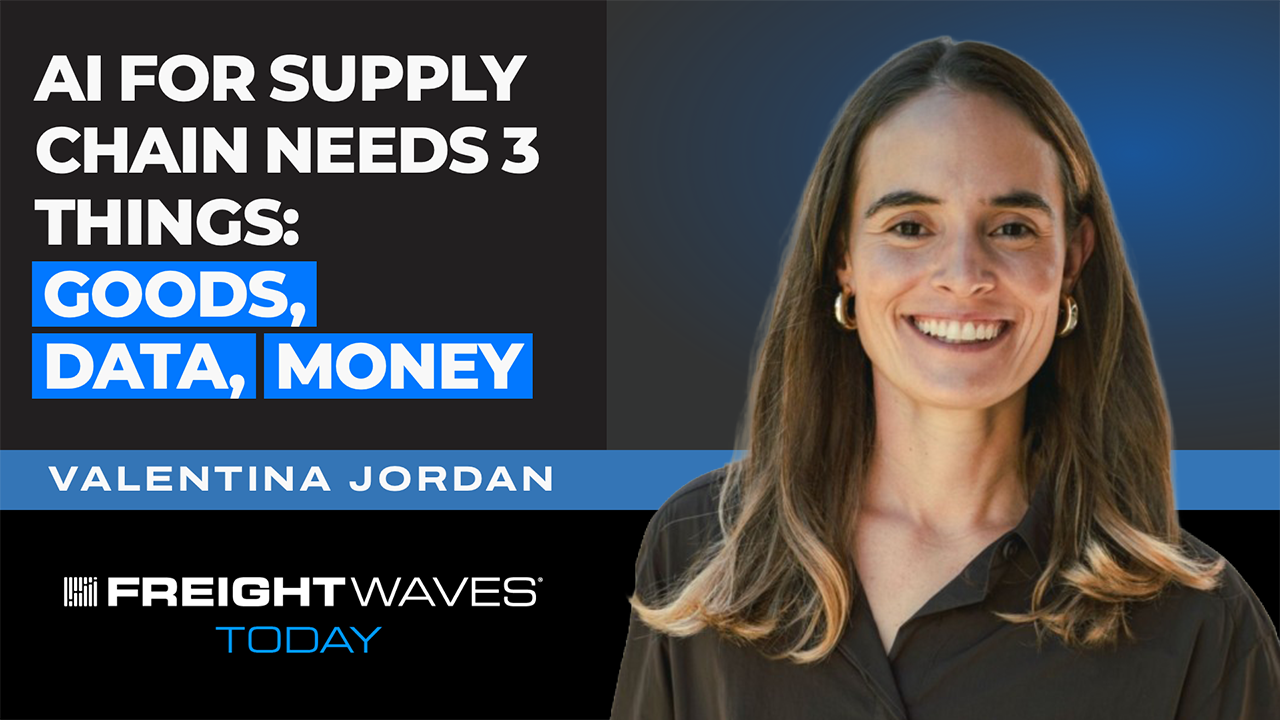
Nauta CEO Valentina Jordan expects AI agents to be commoditized within months; the durable advantage in supply chain AI, she told FreightWaves, sits in the data foundation underneath them. That thesis now has the backing of four global industrial venture funds — BMW i Ventures, Bosch Ventures, Hitachi Ventures and Yamaha Motor Ventures — which joined Nauta's strategic funding round, according to FreightWaves. The AI-native operating system for global trade is deploying the capital toward global expansion, operating in more than eight countries with 8,000 suppliers and reach across 60 countries through its clients.
Data First, Agents Second
Jordan, CEO and co-founder of Nauta, was direct about her competitive thesis in a crowded AI-for-supply-chain market:
"We think that agents are going to be commoditized — I'm not going to say weeks, but probably months. The real challenge here is the data underneath those agents, and especially in supply chain and global trade, that data needs to be all about the context, knowledge, and experience that operators have built over decades."
She added: "We do not start agent first. We start data first, output first, and then comes the agent." According to FreightWaves, Nauta's platform — which Jordan calls an "operational brain" — connects to a company's existing ERP, TMS, WMS and OMS systems, plus unstructured sources such as email, Microsoft Teams and spreadsheets, where operators conduct 80 to 90% of their work. The brain continuously ingests contracts, arrival notices, payment terms, and external signals ranging from weather events to port disruptions, building a layered model of how each company operates. As an example, Jordan cited a recent earthquake in Colombia affecting local ports as one of the macro-level signals the system monitors.
The Strategic Raise and Global Footprint
The funding round brings together industrial and automotive venture arms with global footprints — BMW i Ventures, Bosch Ventures, Hitachi Ventures and Yamaha Motor Ventures — reflecting what Jordan described as a shared recognition that fragmented data is blocking AI adoption at scale. Nauta's customers span food and retail distribution, manufacturing, and consumer brands including New Balance, L'Oréal and Moët Chandon. Jordan said the data problem is consistent across all of those verticals:
"There's more similarities between a food distributor and a furniture or chemical business than there is between two food distributors, because every company operates differently."
Jordan traces Nauta's operational credibility to her co-founder, Rafa, a third-generation Spanish immigrant to Puerto Rico whose family operated a 123-year-old food distribution business. That firsthand experience with logistics pain points shaped the company's conviction that visibility platforms alone cannot solve the underlying data problem. Jordan herself comes from a tech background spanning 13 years, including stints at Amazon and Rappi, a last-mile delivery company. She framed the round as both a validation of Nauta's data-first thesis and a launchpad for international growth.
Where the "Operational Brain" Pays Off
| Metric | Detail |
|---|---|
| Strategic backers | BMW i Ventures, Bosch Ventures, Hitachi Ventures, Yamaha Motor Ventures |
| Operational footprint | More than eight countries, 8,000 suppliers, reach across 60 countries via clients |
| Connected systems | ERP, TMS, WMS, OMS, email, Microsoft Teams, spreadsheets (80–90% of operator work) |
| Invoice matching savings | $300,000–$500,000 in incorrectly invoiced amounts identified per client |
| Active use cases | Three- and four-way invoice matching, overage/shortage/damage claims, freight audit, inventory management |
| Customer verticals | Food and retail distribution, manufacturing, consumer brands |
On top of that data infrastructure, the company deploys task-specific agents. One high-value use case is three- and four-way invoice matching for accounts payable reconciliation; according to FreightWaves, the system proactively identifies between $300,000 and $500,000 in incorrectly invoiced amounts per client. Other active use cases include overage, shortage, and damage claim building, freight audit, and inventory management focused on reducing stockouts and overstock to improve cash-to-cash cycles.
What This Means for Procurement and Supply Chain Executives
For chief supply chain officers and procurement directors, the core takeaway from the FreightWaves interview is that AI agents will soon be a commodity; the differentiator is the quality and context of the data feeding them. Operators still conduct 80 to 90% of their work in email, Microsoft Teams and spreadsheets, according to Jordan, which means the first implementation hurdle is wiring those unstructured sources into a structured, layered model of the company's operations. The invoice-matching use case shows a concrete payout: per-client savings of $300,000 to $500,000 on incorrectly invoiced amounts, before addressing stockouts, overstock and cash-to-cash cycle improvements. Nauta's investor lineup — all large industrial and automotive conglomerates — signals that fragmented data is now viewed as the blocker to enterprise-wide AI adoption in supply chain, not a shortage of agent technology.
Sources: