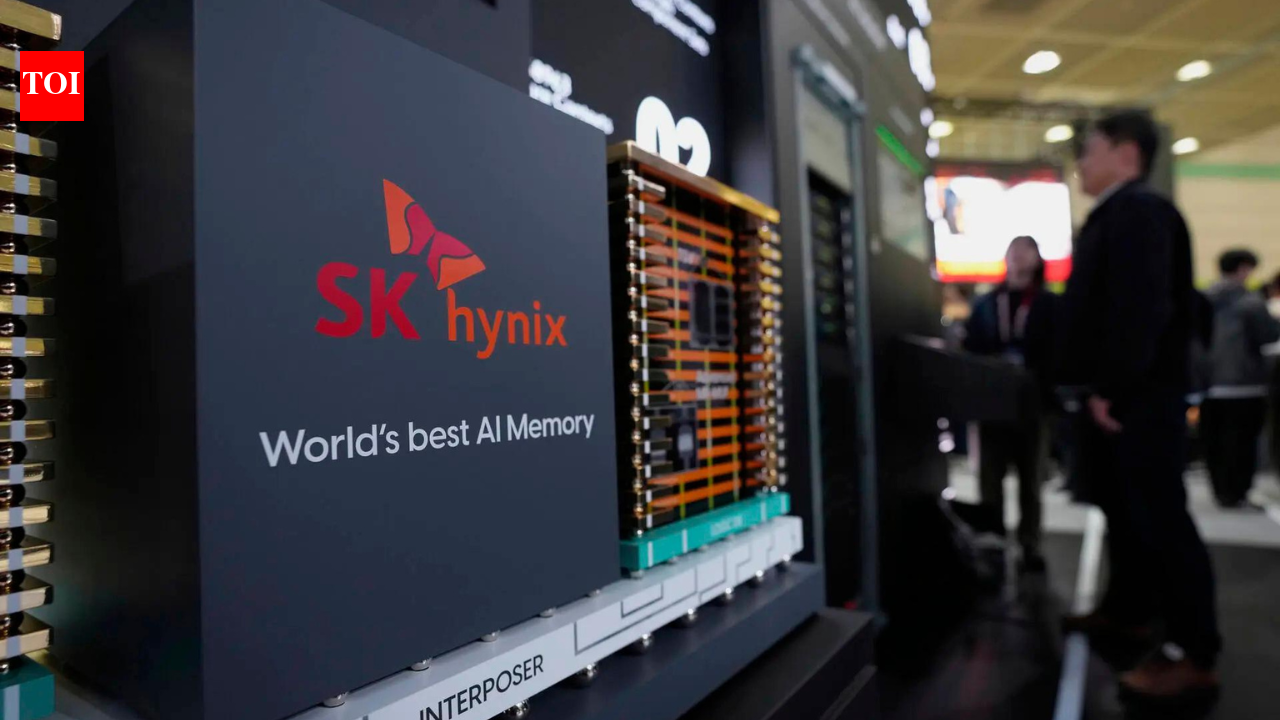
SK Hynix overtook Samsung Electronics to briefly become South Korea's most valuable listed company, a result of a 14-year bet on high-bandwidth memory (HBM) chips that critics once dismissed as a costly gamble, according to a Reuters report cited by Business-Today.
The HBM bet and the AI boom
SK Group acquired Hynix Semiconductor in 2012 in a deal that drew scepticism because Samsung was then worth more than 10 times SK Hynix and dominated the global DRAM market. Seeking to differentiate, SK Hynix focused on HBM chips, which transfer data at much higher speeds than conventional memory. The company launched the world's first HBM chip with AMD in 2014 but struggled with its second-generation products, allowing Samsung to regain the lead in the late 2010s.
According to Reuters, the setbacks sparked internal discussions on whether to abandon HBM altogether. Instead, the company chose to invest even more aggressively, expanding production capacity and redesigning its technology in anticipation of growing demand from Nvidia, then primarily known for graphics processors.
"It was a headache back in 2019," Shim Dae-yong, who led HBM development at SK Hynix, told Reuters. "It was obsolete."
The turning point came in late 2022 when OpenAI's ChatGPT triggered a global AI investment boom. Demand for HBM chips surged as Nvidia's AI accelerators became the preferred hardware for training and running artificial intelligence models, making SK Hynix Nvidia's biggest HBM supplier. "No one expected the HBM market would post such explosive growth," Shim said. "But we were ready in terms of performance and capacity."
| Year | Milestone |
|---|---|
| 2012 | SK Group acquires Hynix Semiconductor |
| 2014 | World's first HBM chip with AMD |
| 2019 | Internal debate to abandon HBM; instead increased investment |
| 2022 | ChatGPT triggers AI boom; HBM demand explodes |
| 2023 | SK Hynix posts operating loss of 7.73 trillion won |
| 2024 | Record operating profit |
| 2025 | Briefly becomes world's largest DRAM maker |
A company rebuilt after crises
Founded in 1983 as Hyundai Electronics, the company survived multiple crises before becoming part of SK Group. It narrowly avoided bankruptcy in 2001 after a collapse in memory chip prices and was rescued by creditor banks. Several attempts to sell the company, including to Micron Technology in 2002, failed before SK Group completed its acquisition a decade later.
The purchase also attracted criticism from credit rating agencies because of the semiconductor industry's cyclical nature and heavy capital investment requirements. Explaining the strategy in a book published earlier this year, SK Group Chairman Chey Tae-won said: "What I really wanted to accomplish when we acquired Hynix was to transform it from a commodity memory producer into a mainstream semiconductor company whose products are indispensable."
Former HR executive Hyun Sun-yeop said the company's status as an underdog shaped its strategy. "We believed that it would be impossible to overcome Samsung in commodity DRAM products," he said. "We were desperate to change the market dynamics. We needed a breakthrough."
Reshaping the semiconductor race
The company's HBM strategy also helped it recover faster than Samsung after the global memory downturn. Although SK Hynix posted an operating loss of 7.73 trillion won in 2023, it rebounded with a record operating profit in 2024 and briefly became the world's largest DRAM maker in 2025.
"No one would ever have imagined that SK Hynix would overtake Samsung," said Shin Jae-yong, a business administration professor at Seoul National University, as quoted by Reuters. "It is almost impossible for a runner-up to catch up with the market leader in this capital-intensive industry, which requires massive investment. HBM was the powerful driver behind how they turned the tables."
Sources: