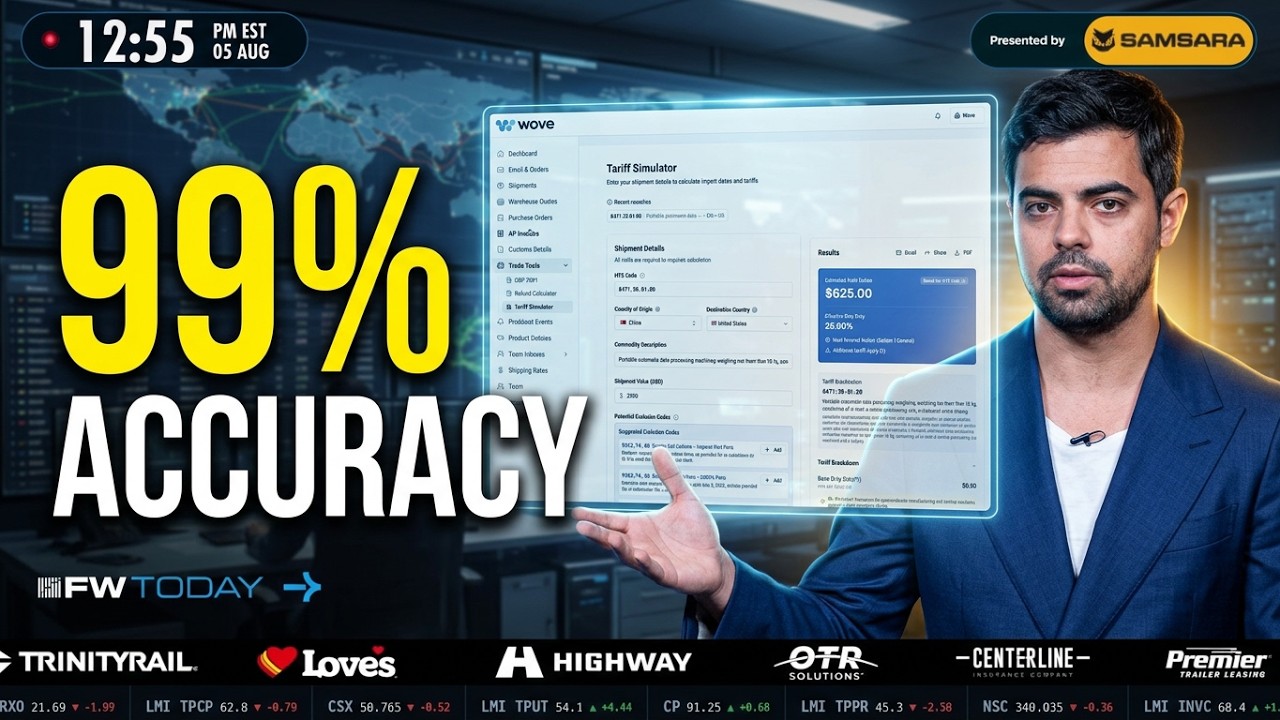
Keeping up with U.S. tariff changes and manual data entry has become a full-time job for freight forwarders and customs brokers, FreightWaves reported. Wove, an agentic orchestration platform for global trade, aims to change that: it can process a 2,000-line commercial invoice or packing list into CargoWise in roughly 30 seconds — work previously handled entirely by hand, according to FreightWaves.
2,000 Lines in 30 Seconds
FreightWaves reported that Wove's core automation platform handles shipment registration, customs entry writing, and one-off quote creation inside CargoWise. Jay Edlin, co-founder and CEO of Wove, told FreightWaves: "In this business, if you quote faster, you're probably going to win the business." Wove serves two primary customer segments: logistics service providers — freight forwarders and customs brokers — and, more recently, shippers through a tariff intelligence product.
The speed advantage matters because even a licensed customs broker can spend many hours parsing a document of that length, FreightWaves reported. Wove's platform converts that time into minutes for importers and their service providers.
Tariff Engine Built From Invoice Parsing
Wove's ingestion engine was originally built to handle unstructured data such as commercial invoices and packing lists, FreightWaves reported, and was repurposed for the U.S. Harmonized Tariff Schedule. According to FreightWaves, Wove has ingested more than 45 HTS revisions since last year, building a database of roughly 3.2 million rules covering Chapter 99 exclusions, inclusions, and effective dates. Edlin called it a "tariff time machine" that importers are using to run historical audits via API.
Edlin told FreightWaves that a recent Federal Register notice for new Section 301 tariffs — released about 12 hours before they went into effect — was 431 pages long. Wove's tariff engine ingested it in about an hour:
The Federal Register notice from last week for the new Section 301 tariffs, which came out about 12 hours before they went into effect, was 431 pages long. And with the technology that we have under the hood of our tariff engine, we were able to understand and ingest the 431-page notice in about an hour.
When a new Federal Register notice drops, an automated Slack alert triggers an AI agent to ingest the changes, with corrections from licensed customs broker partners turned around in minutes, according to FreightWaves.
From Weekend Side Project to Revenue
The free tariff calculator at tariffs.wove.com grew out of a weekend side project late last year, after a competitor — also a customs broker, according to Edlin — restricted access to its own free tool, FreightWaves reported. Wove's version drew thousands of users per week within a few months. The platform has since expanded into a premium tier and an API licensing business, with essentially zero customer acquisition cost, Edlin told FreightWaves.
Wove also white-labels its tariff data for customs brokers that want a branded calculator on their own websites, and offers a product catalog module allowing importers to bulk-upload SKU data and run real-time tariff exposure simulations, according to FreightWaves. Fortune 500 companies and academic researchers are among current users, Edlin said.
Business Results and Funding
FreightWaves reported that Wove grew its annual recurring revenue sevenfold over the past year. Edlin declined to disclose absolute ARR figures but confirmed the 7x growth. The company has raised less than $500,000 to date and remains largely bootstrapped, according to FreightWaves. The Chattanooga appearance marked Edlin's return since the 2022 F3 conference.
| Metric | Value |
|---|---|
| Invoice/packing list processing time | ~30 seconds per 2,000 lines |
| Federal Register notice ingestion | ~1 hour for 431 pages |
| HTS revisions ingested since last year | 45+ |
| Tariff rule database | ~3.2 million rules |
| Total funding raised | Less than $500,000 |
| ARR growth over past year | 7x |
Human Expertise Remains
On the question of whether AI tools like Claude could replace customs brokers entirely, Edlin pushed back, according to FreightWaves. The important work, he said, is helping customers interpret the latest tariff updates — not manually entering line items into a TMS. For enterprise technology buyers, Wove's documented throughput gains demonstrate how AI orchestration can shift trade-compliance teams from repetitive data entry to strategic interpretation of tariff policy, while keeping licensed brokers in the loop for final judgement.
Sources: