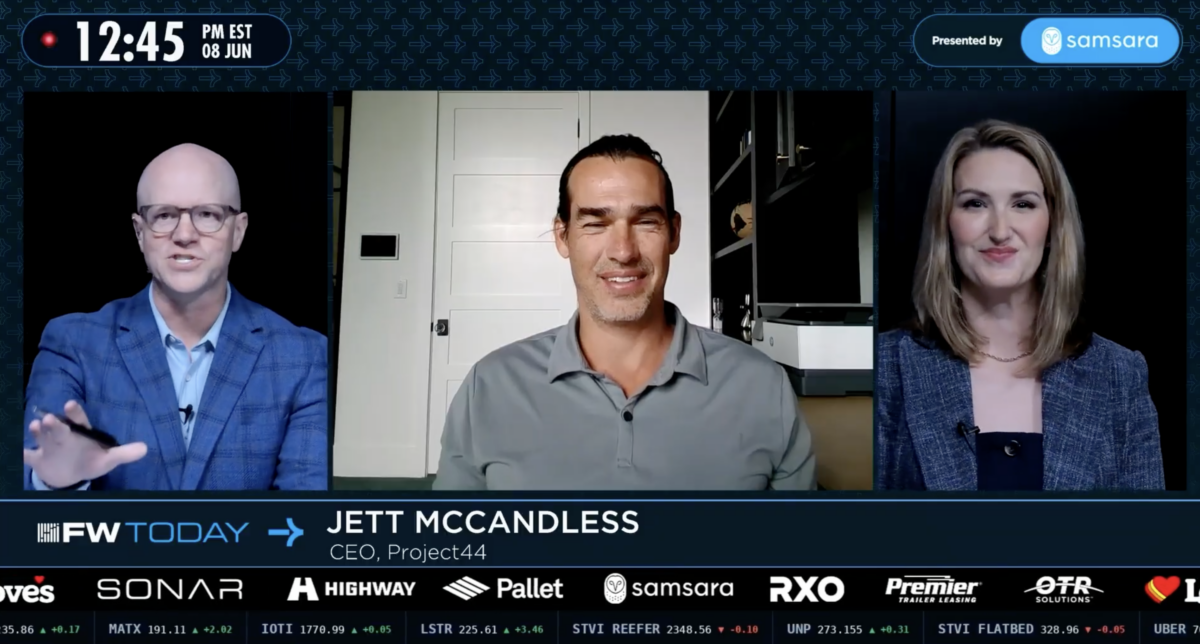
AI agents promise to automate logistics workflows, but without the right data they are just guessing faster. That is the core argument project44 CEO Jett McCandless made to FreightWaves CEO Craig Fuller on a recent episode of FW Today, as reported by FreightWaves. McCandless and Fuller discussed how the freight industry should approach AI: both as an internal efficiency lever and as a customer-facing product.
The Context Challenge
project44’s Agentic Workflow Manager and its underlying AI orchestration engine are built to solve data quality and operational automation problems without requiring customers to build anything themselves. According to McCandless, context is key. “AI agents without context are just guessing faster,” he said. “Shippers have found that there’s a lot of work to try to create context so that those agents can actually be effective.”
The kinds of contextual information that create a competitive moat include:
- Shipment-level data
- Carrier relationships
- Dispatch history
- Historical lane and carrier analytics
- Mode-specific workflows
Agentic Workflow Manager: Orchestrating Multiple Agents
project44’s engine orchestrates both first-party agents (acquired via LunaPath) and third-party agent providers (including Happy Robot and Vooma), layering them on top of the contextual data project44 already holds for its customers. The company ran multiple agent vendors side by side inside the engine for over a year, benchmarking performance across task types, languages, and communication channels. The finding: no single agent excelled at everything. “Some agents performed better at other tasks than others. Language made an impact,” McCandless said. “And so we focused again on providing the context. We have the distribution and the trust with the customers. When a customer plugs into project44, what they’re really interested in is the outcomes that we drive for them.”
For shippers and logistics service providers (LSPs), the AI layer is already embedded in the platform. “Because it’s already embedded in the platform and it’s clicks, not code, you don’t need prompt engineers. You don’t need to set up these databases because we already have the context. It’s really quite easy and adoption is quick,” McCandless said.
| Contextual Data Type | Description |
|---|---|
| Shipment-level data | Details on each shipment, including origin, destination, and timing |
| Carrier relationships | Contractual and operational connections with carriers |
| Dispatch history | Past dispatching patterns and outcomes |
| Historical lane & carrier analytics | Performance metrics by route and carrier |
| Mode-specific workflows | Processes tailored to LTL, FTL, parcel, etc. |
Practical Use Case: LTL Dispatch Reconciliation
Dispatch reconciliation is a key use case. When a company dispatches shipments to an LTL carrier, a portion of those shipments will not return a pro number the following day. Reasons include re-proes, capacity constraints, and pallet size changes at a prior stop. Traditionally, staff or outsourced teams make manual calls to carriers to track down missing information.
project44’s agents now handle that workflow automatically, triggered by API-level dispatch visibility. “We can simply dispatch agents to go and search for that pro number by calling the carrier,” McCandless said. “It’s a very easy solution, but it’s practical and useful quite often.”
The scale is significant. According to FreightWaves, project44 processes roughly 75,000 LTL dispatches per day, an estimated 8% to 15% of the market on any given day. On the day before the interview, agents had matched over 2,000 dispatches that would have otherwise required manual intervention.
Shippers vs. LSPs: Different Priorities
McCandless draws a clear distinction between what shippers and LSPs want from AI-driven intelligence. “When we look at the shippers, they’re not primarily interested in reducing the cost of the transportation team,” McCandless said. “That’s relatively small when you look at how much they spend on freight and the margins that they have overall.” The source notes that shippers tend to focus on broader outcomes, while LSPs may have different objectives.
“AI agents without context are just guessing faster.” – Jett McCandless, CEO of project44
The implication for CTOs and supply chain technology managers is that embedding AI into existing platforms with rich contextual data can deliver immediate automation without complex integration projects. project44’s approach demonstrates that the value lies not in the AI model alone, but in the data layer that gives it meaning.
Sources: