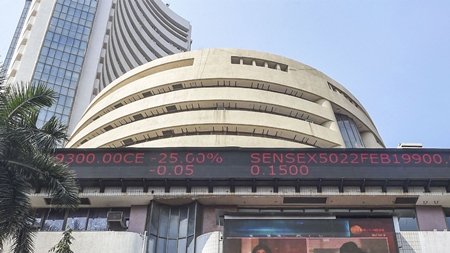
India's largest stock exchange and its biggest telecoms operator are both set to go public by the end of this year in what experts describe as landmark listings for the country's capital markets. Jio Platforms, the digital arm of billionaire Mukesh Ambani's Reliance Industries, and the National Stock Exchange (NSE) — the world's largest derivatives exchange and among the top three equity exchanges by trading volume — filed draft papers for their initial public offerings just days apart last month, according to the BBC.
Jio Platforms: A digital revolution incarnate
Jio is expected to raise around $4bn (£3.02bn) from the market at an estimated valuation of $120-160bn. Its belated entry into India's crowded telecom market in 2016 consolidated a highly fragmented industry of 17 operators into a virtual duopoly, sparking a fierce pricing war by offering virtually free data to hundreds of millions of new users, the BBC reported. Barely 200 million Indians used the internet a decade ago; that number is now approaching 1 billion, with Jio alone amassing 525 million subscribers. These subscribers use its data to make payments, watch web shows and shop online.
"These are unique businesses which don't get built often. NSE is a direct proxy of the 'financialisation' of Indian household savings into mutual funds and stocks, while Jio is the story of a company that single handedly ushered in a digital revolution, becoming a driving factor for several new-age Indian businesses," said Yatin Singh, CEO - Investment Banking at Emkay Global, as quoted by the BBC.
NSE: A bellwether for retail investing
NSE's issue will reportedly offer 6% equity for $3.3bn, valuing the bourse at $57bn. It is the backbone of India's $4.85tn stock market, now the fourth-largest globally. The rise of NSE mirrors the explosion of retail investing in India, as millions of mom-and-pop investors entered the stock market, a trend captured by the term 'financialisation' of household savings.
Broader economic shifts
The IPOs encapsulate sweeping changes in how Indians live, consume, invest and transact over the last decade, according to Singh. Key data points from the BBC report:
- India's United Payments Interface (UPI) went from near-zero digital payments to 228 billion transactions in 2025, according to brokerage Zerodha.
- Paid subscribers to OTT platforms jumped 40% between 2019 and 2026.
- "The monthly data bill of Indians quietly tripled, growing at 3x the rate of rural wages", according to a report from Kotak Bank, with people spending more time on video and social media.
Indians are now the largest consumers of mobile data globally, surpassing even developed markets like the US and China, driven largely by Jio's cheap tariffs that democratised smartphone use.
| IPO Metric | Jio Platforms | NSE |
|---|---|---|
| Expected Amount Raised | ~$4bn | $3.3bn (6% equity) |
| Estimated Valuation | $120-160bn | $57bn |
| Sector | Telecom/Digital | Stock Exchange |
| Key Driver | Digital revolution | Financialisation of savings |
Market significance
Beyond their unprecedented scale — which could take India's overall market capitalisation up by several notches — investors are closely watching these listings because they represent fundamental changes in the economy. Singh added, as quoted by the BBC: "Their listings could be seminal for the Indian markets in the way the marquee offerings of software companies became many decades ago."
Sources: