
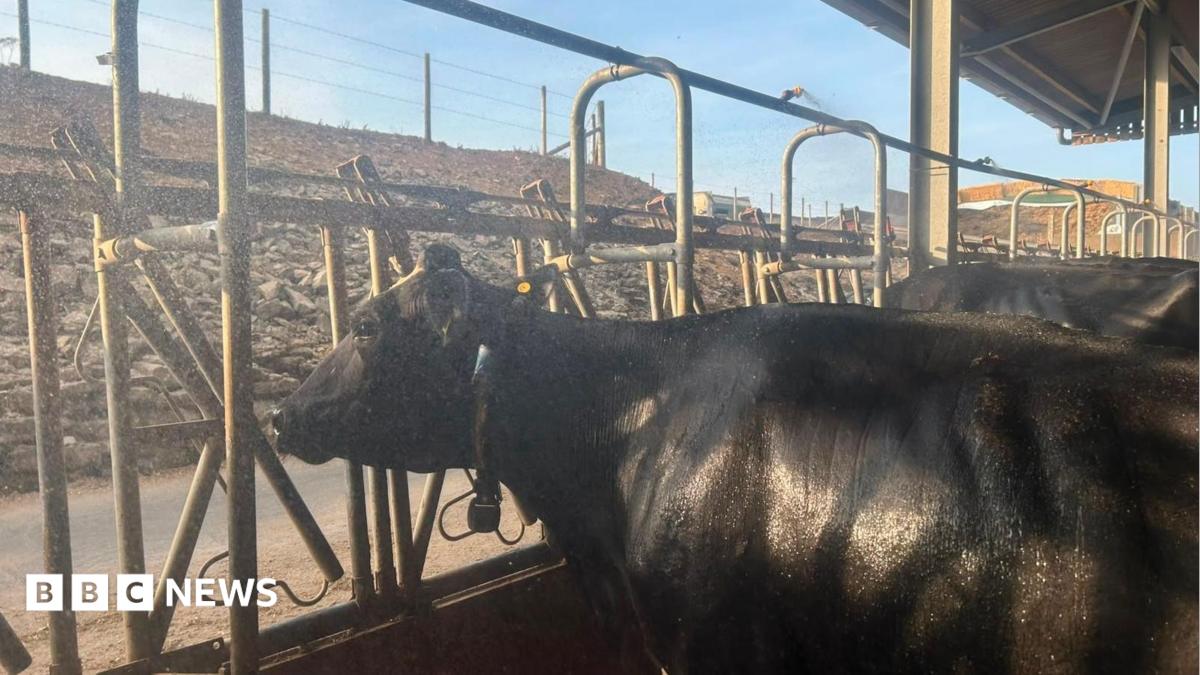
Dairy farmers across the UK are installing 'cow showers' and giant cooling fans as hotter, drier summers become more frequent. According to a BBC report, extreme heat has cut milk production by up to 20%, prompting farmers to spend thousands of pounds to keep their cattle cool and protect milk yields.
Heat Stress Cuts Milk Yields
Sam Woolford, a fifth-generation dairy farmer near Swindon, Wiltshire, described the situation: 'It's like a wind tunnel in here,' he said of the 10 industrial-scale fans installed in his milking parlour. The cows linger in the parlour, 'clearly cool and relaxed,' but the system cannot eliminate all effects of prolonged heat. Professor Nicola Cannon from the Royal Agricultural University (RAU) in Cirencester confirmed that 'milk production is down by 20%.' She explained that 'cows feel stressed just as humans feel stressed when it's really hot and, as a response to that, their milk productivity goes down.'
Farmers Invest in Cooling Systems
Sarah Godwin has invested £15,000 in a ventilation and sprinkler system at her farm near Chippenham, Wiltshire, to help her animals cope with what she called the 'nearly continuous heatwave we are living through.' Farmers are trying to help cows by installing big fans or sprinkler systems to cool animals down, according to Professor Cannon.
Drought Impacts Pasture Quality
Prolonged dry weather is now a regular challenge for dairy farms, leaving grass scorched and cattle heat-stressed. In Somerset, farmers have described this as the worst drought in 50 years, leaving crops struggling. Woolford showed a handful of thin grass, saying, 'There's no leaf to it, they don't get any nutritional quality from this rubbish.' His cows now return to barns by midday to shelter from the sun and eat feedstocks that should have been saved for winter. Last year this was news; this year, it is standard practice across West Country dairy farming.
Long-Term Climate Shifts
Mike Kendon, a climate scientist at the Met Office, stated, 'What we used to think of as extreme weather, we increasingly consider as normal.' Professor Cannon noted that soils are parched, with some areas reporting 38–39 days without rainfall. 'We call that permanent wilting point. Grass can't rebound after grazing, or after cutting for hay or silage,' she said.
Woolford and his family have seen a permanent change in the weather. 'We're praying it's not going to become the new norm, but it looks like it will recur,' he said. 'It's really tough. The cows don't enjoy it, we're down on milk production by 20%, we just need some rain for the grass.'
Sources:


