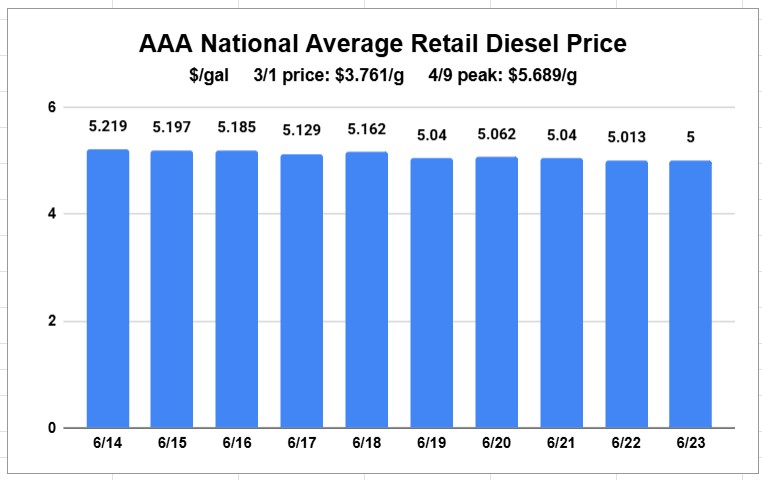
The benchmark U.S. diesel price has fallen below $5 per gallon for the first time since the Iran war began, according to a FreightWaves report. The Department of Energy/Energy Information Administration (DOE/EIA) weekly average retail diesel price, effective Monday and released Tuesday, stood at $4.832/gallon, a decline of 22.7 cents/g from a week earlier. This is the first reading below $5 since March 9 and the seventh consecutive weekly drop, with the slide totalling 80.8 cents/g over that period. However, the price remains roughly 94 cents/g above pre-war levels.
Price Decline Accelerates
Crude oil futures have been in freefall amid the gradual reopening of the Strait of Hormuz and other policy changes, FreightWaves reported. The fall in futures directly dragged down retail diesel. On the CME commodity exchange, ultra low sulfur diesel (ULSD) settled Monday at $3.0931/gallon, down almost 52 cents/g from a recent high of $3.6126/g on June 10. By 9:40 a.m. EDT Tuesday, ULSD was trading at $3.0530/g, a drop of 1.3% on the day. The highest ULSD settlement since the start of military action against Iran by the U.S. and Israel was $4.6084/g on March 20, FreightWaves noted.
| Price Metric | Value | Change |
|---|---|---|
| DOE/EIA retail diesel (week ended June 22) | $4.832/g | -22.7 cts/g week-over-week |
| ULSD futures settlement (June 22) | $3.0931/g | -51.95 cts/g from June 10 high |
| ULSD futures intraday (June 23, 9:40 a.m.) | $3.0530/g | -1.3% vs. prior settlement |
| AAA retail diesel (June 23) | $5.000/g | N/A (inconsistent with DOE/EIA) |
Market Resilience to Geopolitical Uncertainty
Even news over the weekend suggesting the peace deal to reopen the Strait of Hormuz might be in trouble failed to reverse the downward trend, FreightWaves reported. After a brief surge in Sunday night trading, ULSD and the broader oil complex quickly retreated. The market appears unfazed by warnings of eventual supply tightening from the extended closure of the Strait, which has caused the largest supply disruption on record.
Wall Street and IEA Forecasts
Bank of America Merrill Lynch (BOA) recently cut its Brent crude price forecast from $93/barrel to $82/barrel, citing the evolving supply picture, according to FreightWaves. With Brent averaging about $90/b in the first half of 2026, the BOA report stated: “this means that Brent would likely have to trade in the $70-80/bbl range for most of 2H26, but volumes lost over 100+ days top 1.3 billion barrels.” The report added: “Clearing mines and restoring flows to normal levels is likely to take months, not days, given the logistical challenges, implying that oil markets could remain in deficit until 4Q26. We estimate that production losses since the start of the war have averaged 11–14 mn b/d, with the supply gap being covered by demand rationing and inventory draws. These losses have made the Iran war the largest supply disruption on record, exceeding the Iranian Revolution in 1979 and the first Gulf War in 1991.”
"Clearing mines and restoring flows to normal levels is likely to take months, not days, given the logistical challenges, implying that oil markets could remain in deficit until 4Q26."
Even with these bullish factors, including the need to restock inventories, BOA expects Brent to average $70/b in 2027 if peace holds, FreightWaves reported. The research team echoed a recent International Energy Agency (IEA) report forecasting that the surplus that was expected before the war would reemerge next year at about 1 million barrels per day, though restocking needs would support prices around $70.
Implications for Traders and Analysts
For commodity traders and procurement teams, the sustained decline in diesel and crude prices signals a shift from war-driven scarcity to a potential oversupply scenario, albeit with lingering risks from the Strait of Hormuz reopening timeline. The sharp drop in DOE/EIA diesel — the basis for most fuel surcharges — directly impacts transportation and logistics costs. The inconsistency between DOE/EIA ($4.832) and AAA ($5.000) data remains a point of attention for analysts. With ULSD futures below $3.10 and Brent forecast at $70-82, the near-term bias is bearish, but the enormous volume of lost production (over 1.3 billion barrels) and slow mine clearance could trigger a sharp reversal. Key data to watch: weekly DOE/EIA inventories, Strait of Hormuz traffic updates, and IEA monthly reports.
Sources: