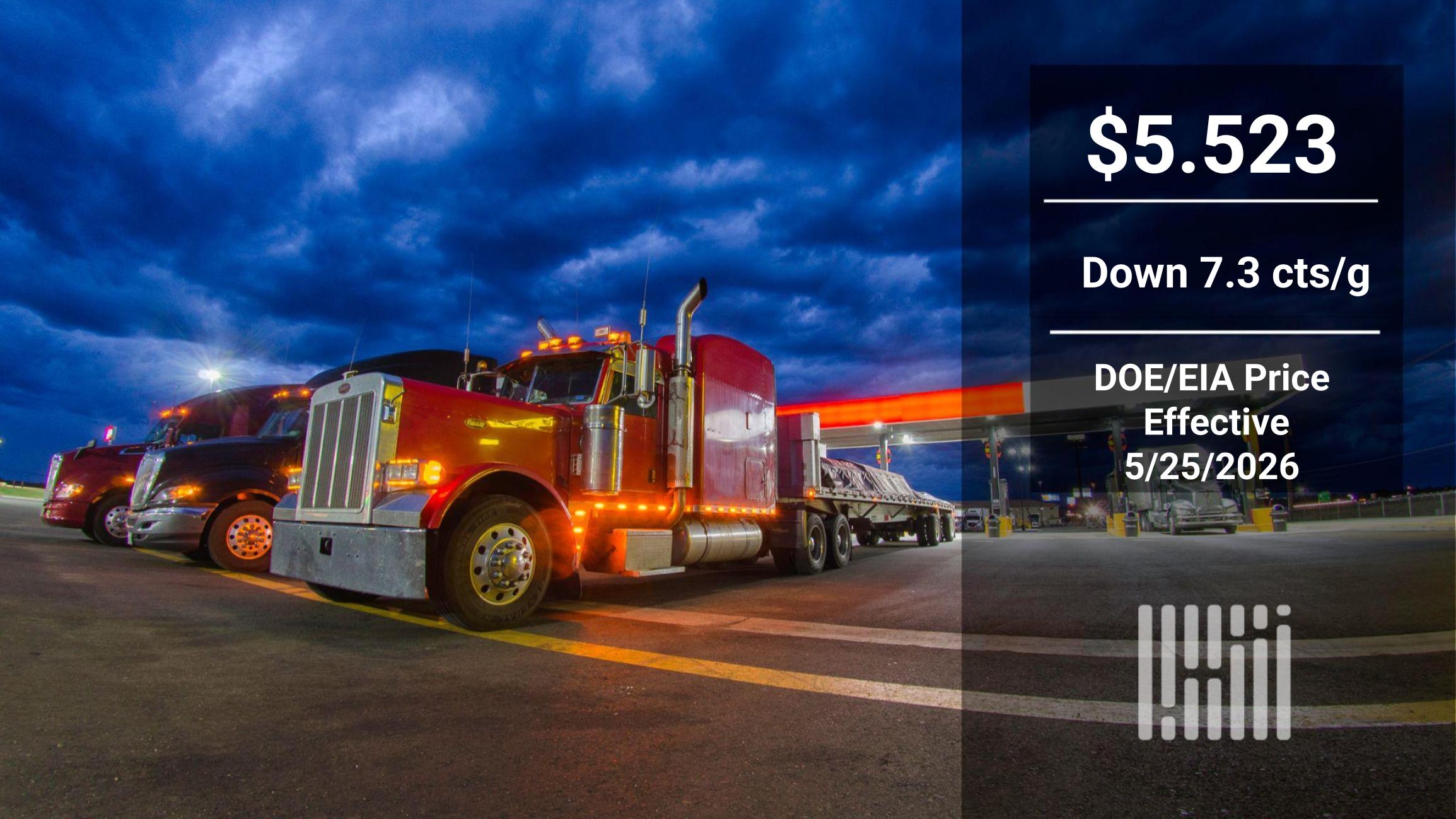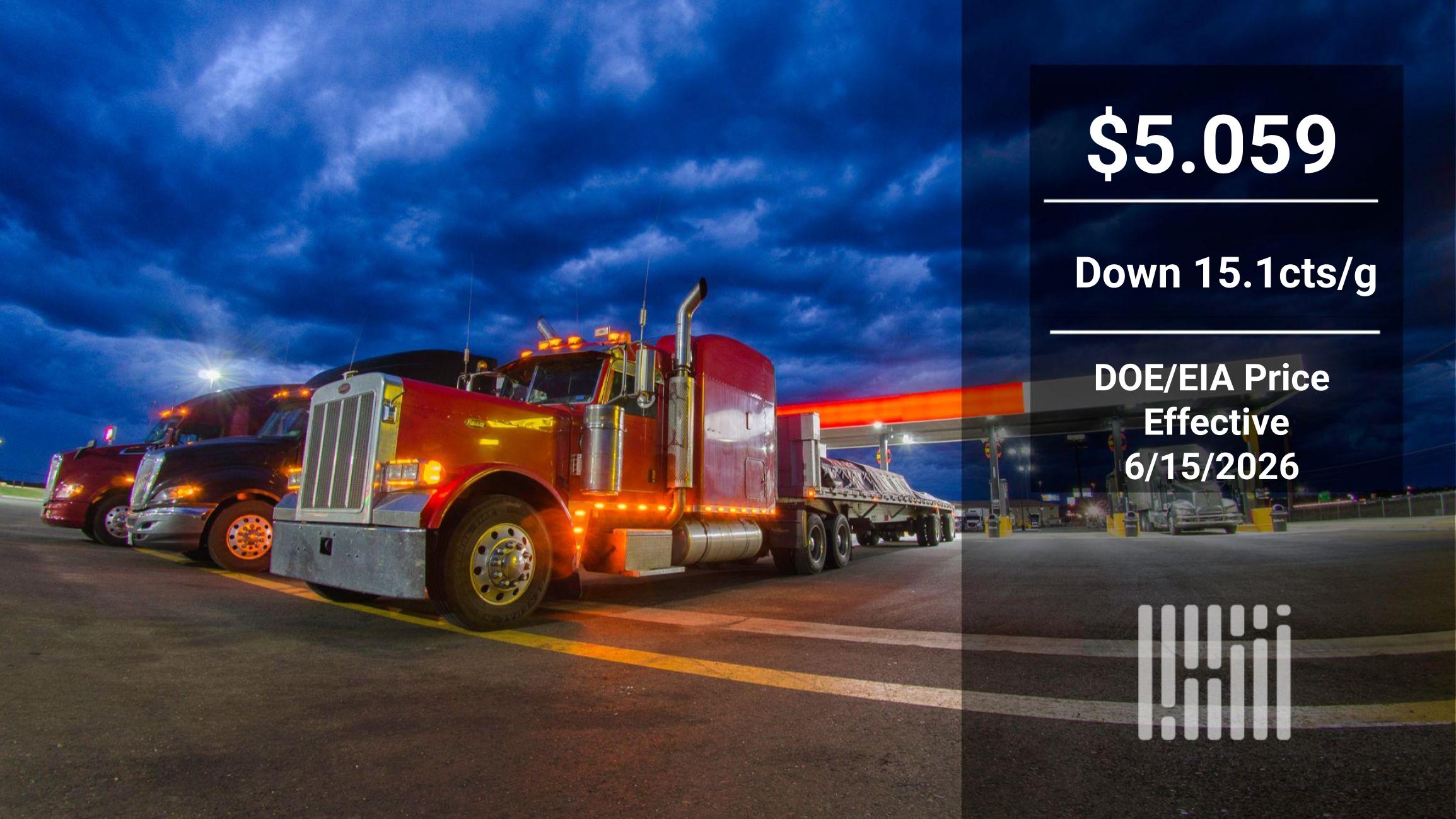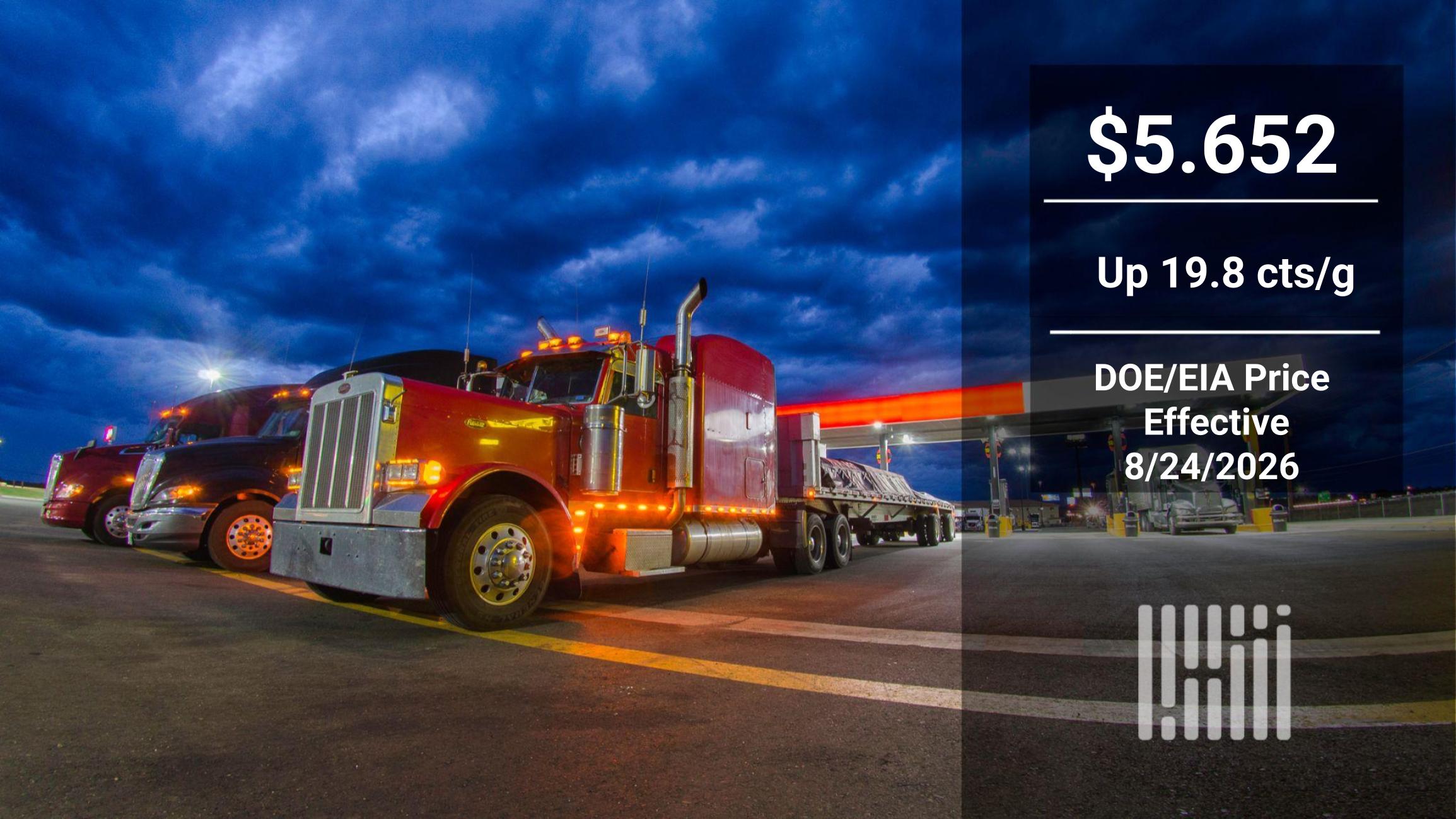
The benchmark diesel price behind most fuel surcharges has reached its highest level since military action against Iran began in early March, according to FreightWaves. The Department of Energy/Energy Information Administration (DOE/EIA) average weekly retail diesel price rose 19.8 cents/gallon to $5.652/g, effective Monday and published Tuesday, surpassing the previous war-era high of $5.643/g set April 6. The weekly increase is roughly 3.6% and brings the two-week advance to 39.5 cts/g.
Retail diesel vs. gasoline diverges
Diesel has strengthened at the retail level in recent weeks even as gasoline has barely moved, FreightWaves reported. The AAA average daily gasoline price Tuesday was $4.0969/g, slightly below its level a month ago of $4.1109/g. Retail diesel, according to AAA, was $5.6199/g Tuesday, up sharply from $5.2778/g a month ago.
| Metric | Latest | Comparison |
|---|---|---|
| DOE/EIA weekly retail diesel | $5.652/g | +19.8 cts/g week over week; +39.5 cts/g over two weeks |
| Previous war-era high | $5.643/g | Set April 6 |
| AAA retail diesel | $5.6199/g | vs. $5.2778/g one month ago |
| AAA retail gasoline | $4.0969/g | vs. $4.1109/g one month ago |
| CME/CMD ULSD settlement | $4.2677/g | -22.72 cts/g Monday |
ULSD futures in retreat
After rising in 12 of the past 13 trading days through Friday, ultra low sulfur diesel (ULSD) futures on the CME — the article also refers to the exchange as the CMD commodity exchange — declined Monday by 22.72 cents/gallon to settle at $4.2677/g, according to FreightWaves. At about 10 a.m. Monday, the contract was up slightly after being down about 6 cts/g earlier in the session.
Friday's settlement just under $4.50/g had pushed the contract closer to the March 20 settlement of $4.6084/g, the highest settle since military action against Iran began. The sudden downward turn began as soon as CME trading opened Sunday evening U.S. time, a move attributed to U.S. Treasury Secretary Scott Bessent saying the Trump administration will focus more on economic pressure on Iran rather than renewed military action.
Diesel-specific supply factors
Diesel markets have their own set of bullish factors that gasoline avoids, FreightWaves reported:
- Ukrainian strikes on diesel-oriented Russian refineries have cut supply.
- The physical qualities of Middle East crudes that are not getting to market tend to produce high quantities of diesel.
- Steady adoption of electric vehicles around the world has reduced demand for the marginal barrel of gasoline, though less so in the U.S.
Strait of Hormuz flow estimates in dispute
The last several days have seen wide swings in estimates of the amount of oil moving through the Strait of Hormuz, FreightWaves reported. Axios, citing unidentified U.S. officials, said a "stealth" transit led by the U.S. through the southern portion of the Gulf, meant to avoid Iranian attacks, has helped oil supply out of the Gulf rise to 10 million b/d — still only about half the pre-war level. That figure drew significant pushback on social media because the information came from Trump administration officials.
David Wech, chief economist at tanker-tracking firm Vortexa, gave CNBC a different picture. Without referring to the Axios report directly, he said the figure fluctuates depending on the period examined:
"Currently, where we are seeing it depends a lot on which time period you look at. On the average of the last month, we see six to seven million barrels per day of crude oil going through. There are peaks in our data on the seven-day moving average of up to close to 10 million barrels per day, and the best day we saw was 40 million barrels per day. So it depends really a lot what time period you're looking at."
Benchmark and market context
The new benchmark high underscores the importance of diesel as the reference for most fuel surcharges, according to the FreightWaves report. The piece also promoted three upcoming industry events: the Brokerage Compliance Symposium, the F3 Awards Dinner, and the F3: Future of Freight Festival.
Sources: