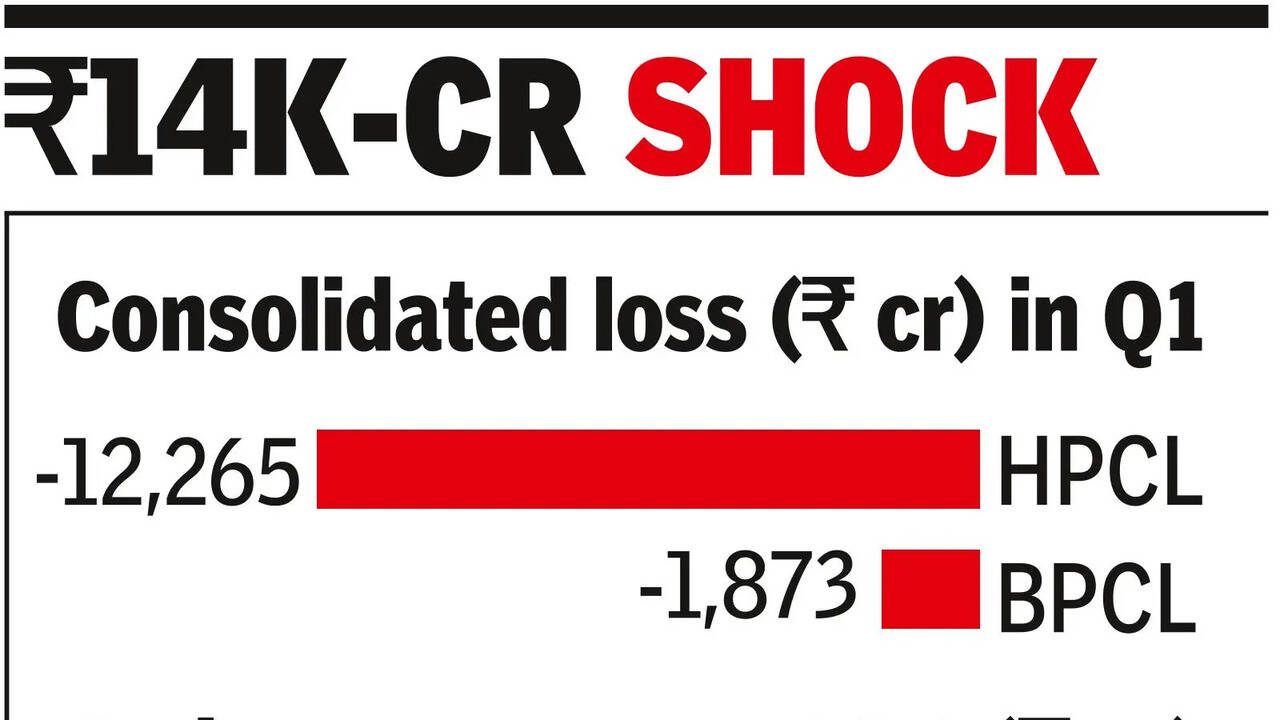
State-owned Bharat Petroleum Corporation Ltd (BPCL) reported a consolidated net loss of Rs 3,962.13 crore for the April-June quarter of FY2026-27, its first quarterly loss in 15 quarters, as elevated crude oil prices and regulated fuel prices eroded marketing margins, according to a stock exchange filing cited by Business-Today. The company had posted a net profit of Rs 3,333.97 crore in the corresponding quarter of the previous financial year.
Quarterly Financial Performance
BPCL's revenue from operations rose 23.1% year-on-year to Rs 1.59 lakh crore from Rs 1.35 lakh crore a year earlier, as per the filing. However, total expenses climbed 36% to Rs 1.66 lakh crore, driven by a 68.7% surge in raw material costs. The company did not disclose its gross refining margin (GRM) for the quarter.
| Metric | Q1 FY2026-27 | Q1 FY2025-26 | Change |
|---|---|---|---|
| Net Profit/Loss | -Rs 3,962.13 cr | +Rs 3,333.97 cr | -218.8% |
| Revenue from Operations | Rs 1,59,000 cr | Rs 1,35,000 cr | +23.1% |
| Total Expenses | Rs 1,66,000 cr | Rs 1,22,000 cr (est.) | +36% |
| Raw Material Costs | Surge 68.7% | — | — |
BPCL reported an LPG under-recovery of Rs 3,485.22 crore during the quarter, with unpaid LPG subsidy dues standing at Rs 12,318.52 crore as of March 31, 2026. The company received government compensation of Rs 1,898 crore for LPG losses, according to Reuters.
Crude Oil Price Surge and Marketing Margins
The sharp reversal followed a period where state-run fuel retailers—BPCL, Indian Oil Corporation (IOC), and Hindustan Petroleum Corporation Ltd (HPCL)—kept petrol, diesel and LPG prices below cost for much of the quarter despite a surge in global crude oil prices. Crude oil prices jumped more than 50% after the US and Israel attacked Iran on February 28 and Tehran retaliated, according to Business-Today. The three oil marketing companies did not raise petrol and diesel prices for nearly two-and-a-half months.
In the second half of May, the companies increased petrol and diesel prices by over Rs 7.50 per litre, but the hike was still insufficient to offset higher input costs. Similarly, the Rs 89 increase in the price of a 14.2-kg LPG cylinder covered only around one-fifth of the required increase, PTI reported.
Reuters, citing Jefferies analysts, reported that petrol and diesel marketing margins averaged negative Rs 10.6 per litre and negative Rs 18.4 per litre, respectively, during the quarter—meaning the cost of selling fuel exceeded earnings from retail sales.
Supply and Demand Dynamics
BPCL sold 13.62 million tonnes of petroleum products in the quarter, slightly lower than 13.86 million tonnes a year earlier. Its refineries processed 10.15 million tonnes of crude oil, down from 10.40 million tonnes in the year-ago quarter.
India’s overall fuel demand also weakened, with consumption falling 4.6% in April, 6.5% in May, and 3.1% in June compared with the same months last year, reflecting softer demand in the world’s third-largest oil importer and consumer, as reported by Business-Today.
Implications for Commodity Markets
The negative marketing margins reported by Jefferies underscore the financial strain on Indian oil marketing companies when regulated retail prices fail to pass through global crude cost increases. For commodity traders, this situation implies that India’s crude import demand could face headwinds if domestic refinery runs continue to decline due to suppressed margins. The government compensation of Rs 1,898 crore for LPG losses, while providing some relief, does not fully offset the under-recoveries. The combination of weak domestic demand and margin compression may lead to reduced crude throughput in the coming months, a key indicator for global oil balances.
Sources: