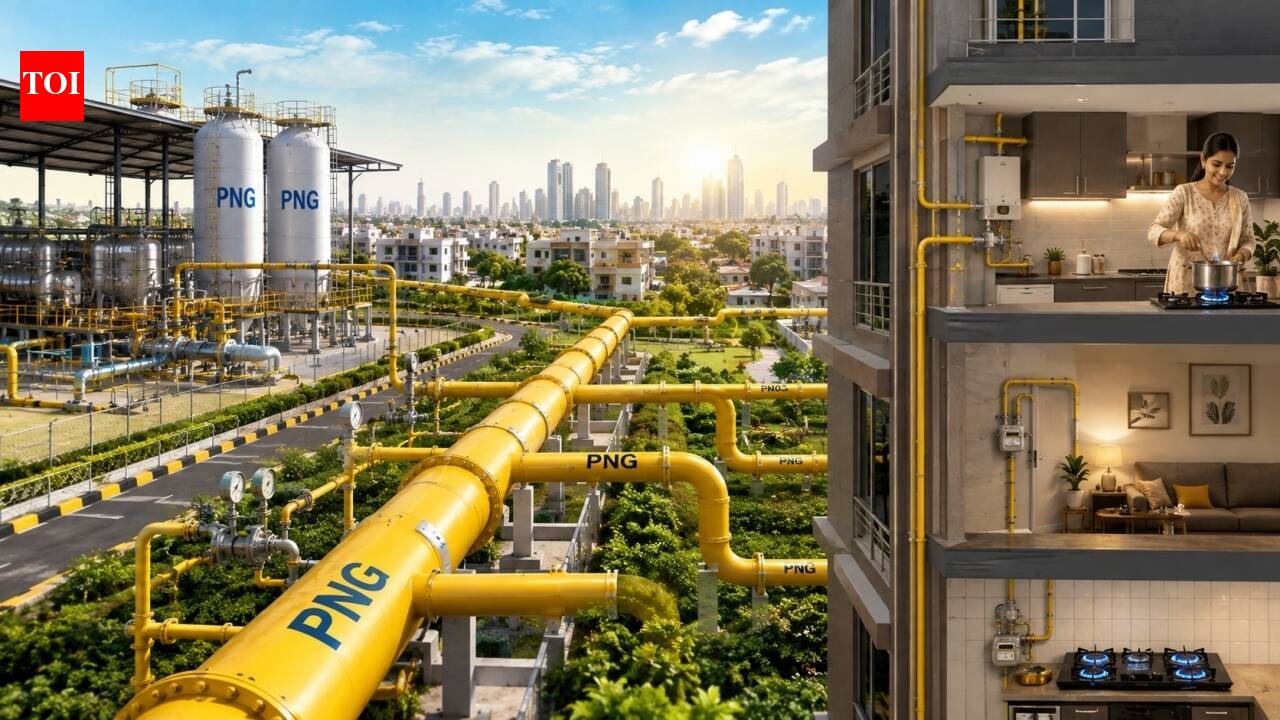
The Indian government has confirmed that household piped natural gas (PNG) prices remain stable despite rising global liquefied natural gas (LNG) prices caused by the West Asia crisis. In a written reply to a starred question in the Lok Sabha during the ongoing Monsoon Session of Parliament, the Ministry of Petroleum and Natural Gas stated, "Despite the Middle East crisis, leading to higher LNG prices, the measures undertaken by the Government have helped keep PNG (Domestic) prices relatively stable and affordable for household consumers."
Price Stability Measures
The government attributes price stability to several key measures. Domestic PNG continues to receive administered-price natural gas capped at USD 7 per MMBtu for FY2026-27. Additionally, since the third quarter of FY2023-24, the government has allocated domestic natural gas equivalent to 105 per cent of the previous quarter’s actual PNG consumption to support the expansion of household PNG connections. Household PNG also remains among the priority sectors for gas allocation under the temporary Natural Gas (Supply Regulation) Order, 2026, alongside CNG, LPG production, and fertiliser, to ensure "continuity of essential services, energy security and public welfare." The order was later withdrawn after the supply situation improved.
PNG Network Expansion
The PNG network continues to expand across the country. Entities authorised by the Petroleum and Natural Gas Regulatory Board (PNGRB) have been permitted to develop networks across 309 geographical areas covering 683 districts. As of May 31, 2026, they had provided over 1.70 crore domestic PNG connections and laid 6.71 lakh inch-km of pipeline. The government also launched National PNG Drive 2.0, which introduces digital registration, simplified connection processes, and consumer outreach programmes to encourage new connections.
| Metric | Data |
|---|---|
| Geographical areas authorised | 309 |
| Districts covered | 683 |
| Domestic PNG connections (as of May 31, 2026) | >1.70 crore |
| Pipeline laid | 6.71 lakh inch-km |
Government Allocation and Priority
While the question asked whether the government has prepared a roadmap to connect an additional 1.2 crore households to the PNG network by March 2027, the reply does not explicitly confirm such a target. Instead, it refers to National PNG Drive 2.0, infrastructure expansion, regular monitoring of city gas distribution projects, and review meetings with implementing entities and state governments. The ministry also clarified that the cost competitiveness of PNG versus LPG may vary across locations, as retail prices depend on factors including gas procurement costs, transportation charges, state taxes, subsidies, and distribution costs.
Implications for Commodity Traders
The stability of domestic PNG prices, decoupled from global LNG spot volatility, highlights the role of government intervention in insulating household consumers. For traders tracking Indian natural gas demand, the administered price cap and priority allocation reduce the risk of demand destruction from price spikes, while the ongoing network expansion signals sustained growth in domestic gas consumption. However, the absence of an explicit 1.2 crore household target may temper expectations of a near-term surge in gas demand from the residential sector. Key upcoming data releases include quarterly updates on PNG consumption and network expansion milestones from the Ministry.
Sources: