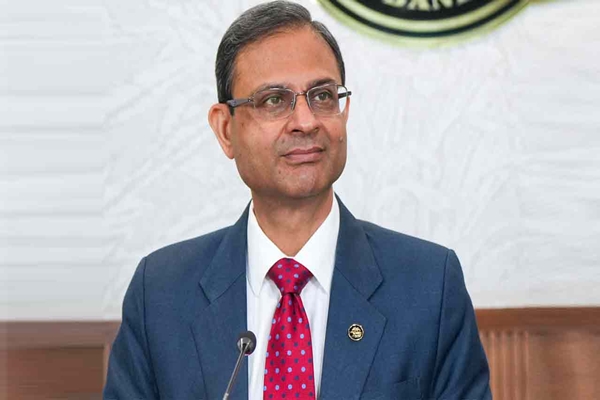
Reserve Bank of India Governor Sanjay Malhotra said on Tuesday that banks must keep humans accountable for decisions made with the help of artificial intelligence, warning that blaming an algorithm or a technology vendor for a bank's decision is never acceptable. Speaking at the annual Fibac event in the financial capital, Malhotra said lenders cannot outsource responsibility for their actions to models or vendors, and that meaningful human oversight must be designed into AI systems from the start.
Malhotra framed the RBI's approach to AI as seeing the technology as a capability that banks should responsibly harness rather than a risk to be contained. He urged lenders to embrace AI instead of remaining on the sidelines, but cautioned that greater reliance on algorithms could gradually weaken human judgement and accountability.
"For a bank's decision, the ultimate responsibility has to lie with the bank and not with the vendor or with the algorithm. We cannot say that it is the model who decided it. That can never be an acceptable answer, whether to the bank, to the customer, or to the regulator," Malhotra said.
"Meaningful human oversight, the ability to explain, to intervene, and where necessary to override, must remain a design principle and not an afterthought," he added.
Malhotra said AI must be "used to augment rather than merely to replace human judgement." He gave the example of a relationship manager equipped with an AI system that identifies the appropriate product and highlights relevant risk flags, allowing the manager to serve more customers efficiently. Indian lenders have increasingly adopted AI for functions such as credit underwriting and customer service, and some banks hope their dependence on human capital will decline over time, the governor noted. His remarks come amid wider concern over AI's effect on employment intensity across sectors.
Risks: cyber security, bias and herding
Malhotra highlighted several risks as banks expand AI use. Cyber security is one; he referred to a recent incident where AI itself attacked the system. He also warned of biases in AI models, which could develop preferences for or against particular geographies, occupations or communities. He cautioned against "herding" — if a small number of financial models or technology vendors supply platforms across the system, a bias could be perpetuated system-wide.
RBI demands model inventories and board-approved policy
Malhotra said the RBI should know which models are operating inside banks, and asked lenders to maintain a complete inventory of them. Banks should also have a board-approved AI governance policy establishing clear accountability for outcomes, rather than focusing only on technology procurement. He asked banks to treat data privacy as a responsibility going beyond legal requirements, and to strengthen management of AI-related risks while working with external partners. AI platforms should be capable of explaining why they recommend a particular decision on a proposal.
Key governance demands from the RBI governor:
- Complete inventory of AI models in operation within banks
- Board-approved AI governance policy with clear accountability for outcomes
- Data privacy treated as a responsibility beyond legal compliance
- AI platforms able to explain recommendations on proposals
- Human override capability at stages where errors could cause material harm
| Risk highlighted by RBI governor | Governor's guidance |
|---|---|
| Cyber security | Referred to a recent incident involving AI attacking the system |
| Bias in models | Models could favour or oppose certain geographies, occupations, communities |
| Herding | A few model or vendor platforms could spread bias across the banking system |
| Accountability | Banks, not vendors or algorithms, own the decision |
| Data privacy | Responsibility extends beyond meeting legal requirements |
What the guidance means for bank clients
For CFOs, treasury directors and corporate borrowers that rely on bank credit, the governor's demands for explainability and human oversight are directly relevant to how AI-assisted credit underwriting works. Since Indian lenders already use AI in credit underwriting and customer service, the requirement that AI platforms explain decisions and that humans can override them affects the lending process. Malhotra said meaningful human oversight must be retained at every stage where an error by an AI system could cause material harm to a customer or raise concerns about financial stability. For businesses that depend on bank credit, this means lenders must be able to demonstrate that a model's recommendation was reviewed by a person with authority to intervene before a decision affects the borrower.
Sources: