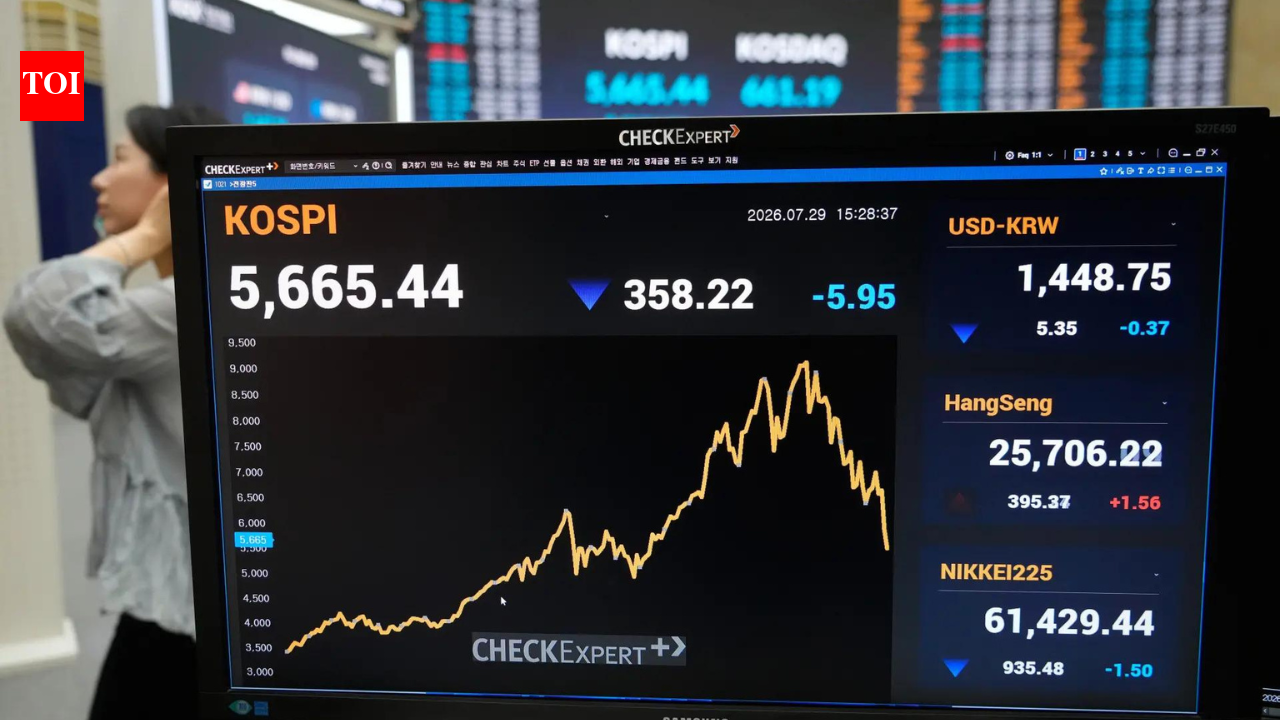
South Korea's benchmark Kospi index suffered its worst single-day drop of the year on Monday, tumbling 7% or 511 points to close at 6,964.76, according to Business Today. The sharp reversal pushed the index more than 25% below its June peak, firmly into technical bear market territory—a zone it had briefly entered last week.
Geopolitical Trigger: Strait of Hormuz Closure
The sell-off was ignited by Iran's claim that it had closed the strategically vital Strait of Hormuz, a chokepoint for about one-fifth of global oil transit, Business Today reported. The announcement sent crude prices sharply higher, with Brent crude rising 4.28% to $79.26 a barrel and WTI crude gaining 4.37% to $74.53 a barrel. The spike in energy costs revived fears of persistent inflation and strengthened the US dollar, pushing bond yields higher as investors increased bets that the US Federal Reserve could raise interest rates again. Markets are also awaiting Federal Reserve Chair Kevin Warsh's first testimony before Congress since taking office, scheduled for Tuesday.
Market Impact Across Asia
The weakness extended across broader Asian markets, with most major indices trading in the red around 9 am IST, Business Today noted. The table below summarizes the declines:
| Index | Change |
|---|---|
| Japan's Nikkei | -1.12% |
| China's Shanghai Composite | -1.49% |
| China's Shenzhen Composite | -2.53% |
| Singapore's Straits Times Index | -0.23% |
| Hong Kong's Hang Seng Index | -0.17% |
Sector Analysis: Tech and AI-Led Correction
Technology stocks led the fall in Seoul. SK Hynix plummeted 10%, while Samsung Electronics lost more than 6%. Together, the two companies make up nearly half of the Kospi's total market weight, amplifying the impact of the sell-off, according to Business Today. The correction has intensified concerns that valuations of AI-linked semiconductor companies had risen faster than their underlying fundamentals. South Korea's chipmakers have been among the biggest winners from booming demand for advanced AI hardware, but the latest sell-off highlights how quickly market sentiment can reverse when questions emerge over the longevity of that demand. The concentration of the Korean stock market in a handful of semiconductor companies has made the index especially sensitive to changing investor sentiment around the global AI trade. Last week, the market had dropped nearly 8% as investors became increasingly wary over whether the rapid pace of AI-related investment can be sustained.
Implications for Trade Finance and FX Exposure
For CFOs and treasury professionals tracking trade-affected markets, the Kospi crash carries several direct implications. The surge in crude prices strengthens the US dollar, increasing the cost of hedging currency exposures for South Korean exporters who receive revenue in dollars. Higher dollar-denominated debt servicing costs may pressure corporate balance sheets. Meanwhile, the expectation of a Federal Reserve rate hike raises the cost of capital for trade finance, as LIBOR and SOFR-linked lending rates typically rise in anticipation. South Korean manufacturers reliant on imported energy will face higher input costs, compressing margins, while oil-importing emerging markets may see widening trade deficits. The heightened geopolitical risk around the Strait of Hormuz also introduces supply chain disruption risks for industries dependent on Middle Eastern crude. Despite the steep correction, the Kospi remains the world's best-performing major stock index in 2026, having gained 63% so far this year, much of that rally driven by AI-related semiconductor stocks, Business Today reported. However, the speed of the reversal underscores the fragility of concentrated market gains and the need for active risk management in trade-related portfolios.
Sources: