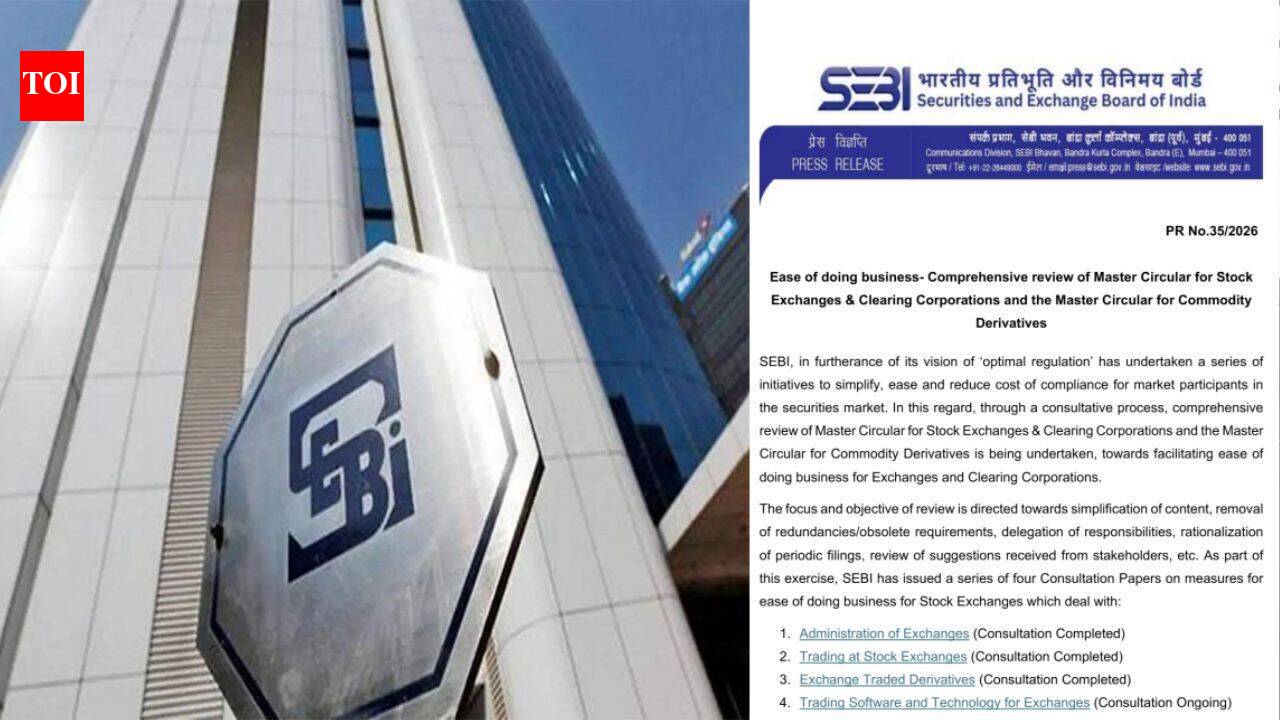
The Securities and Exchange Board of India (SEBI) has initiated a comprehensive review of regulations governing stock exchanges, clearing corporations, and commodity derivatives exchanges, according to a press release issued on Monday. The exercise aims to improve ease of doing business and reduce compliance burdens in the securities market, aligning with SEBI's vision of "optimal regulation."
Proposed Consolidation and Simplification
The regulator said the review covers the master circular for stock exchanges and clearing corporations as well as the master circular for commodity derivatives. A key proposal is the creation of a single consolidated master circular for exchanges by merging provisions applicable to stock exchanges and commodity derivatives exchanges. SEBI has also proposed separate master circulars for clearing corporations and a consolidated circular covering common information technology provisions applicable to market infrastructure institutions (MIIs).
According to SEBI, the proposed restructuring could reduce the size of the master circular for exchanges by nearly 50 per cent. The regulator emphasized that the focus is on "simplification of content, removal of redundancies/obsolete requirements, delegation of responsibilities, rationalization of periodic filings, review of suggestions received from stakeholders, etc."
Key Proposals at a Glance
| Proposal | Description |
|---|---|
| Consolidated master circular | Merge stock exchange and commodity derivatives exchange provisions into one circular |
| Separate circular for clearing corps | Dedicated master circular for clearing corporations |
| IT provisions circular | Consolidated circular for common IT requirements across MIIs |
| Report discontinuation | Several reports currently submitted to SEBI to be discontinued; oversight shifted to MII committees or public disclosures |
| Registration requirement change | End requirement for registration of investment managers providing direct market access facilities |
| Single-window for brokers | Introduce single-window registration for brokers offering smart order routing services |
| Framework review | Review system and network audit framework for MIIs, liberalise norms for liquidity enhancement schemes |
| Withdrawal of CTM norms | Withdraw close to money (CTM) norms for options in goods |
| Client code modification | Revise client code modification framework |
| Position limits | Clarify responsibility for monitoring position limits |
| Investor protection funds | Merge investor protection funds across equity and commodity segments |
Stakeholder Consultations and Timeline
As part of the review, SEBI has already released four consultation papers aimed at improving ease of doing business for stock exchanges. Consultations relating to exchange administration, trading at stock exchanges, and exchange-traded derivatives have been completed. Comments are still being invited on the consultation paper covering trading software and technology frameworks.
The regulator said the revised master circular for exchanges will be finalised after considering stakeholder feedback. Public comments on the technology-related consultation paper can be submitted until July 13, 2026, after which SEBI is expected to take a final view on the proposed changes.
Implications for Market Participants
For stock exchanges, clearing corporations, and commodity derivatives exchanges, the review promises a significantly streamlined regulatory framework. The consolidation of circulars and discontinuation of redundant reports will reduce compliance costs and free up resources for core business activities. Brokers stand to benefit from the proposed single-window registration for smart order routing and the removal of registration requirements for investment managers providing direct market access. The merger of investor protection funds across equity and commodity segments will simplify fund management for exchanges.
While the proposals are currently in consultation stage, the direction is clear: SEBI is moving toward a more principle-based, less prescriptive regime. Market infrastructure institutions should prepare for the new framework by reviewing their internal compliance processes and engaging with stakeholders on the remaining consultation paper. The July 13 deadline for comments provides a window for industry feedback that could shape the final regulations.
Sources: