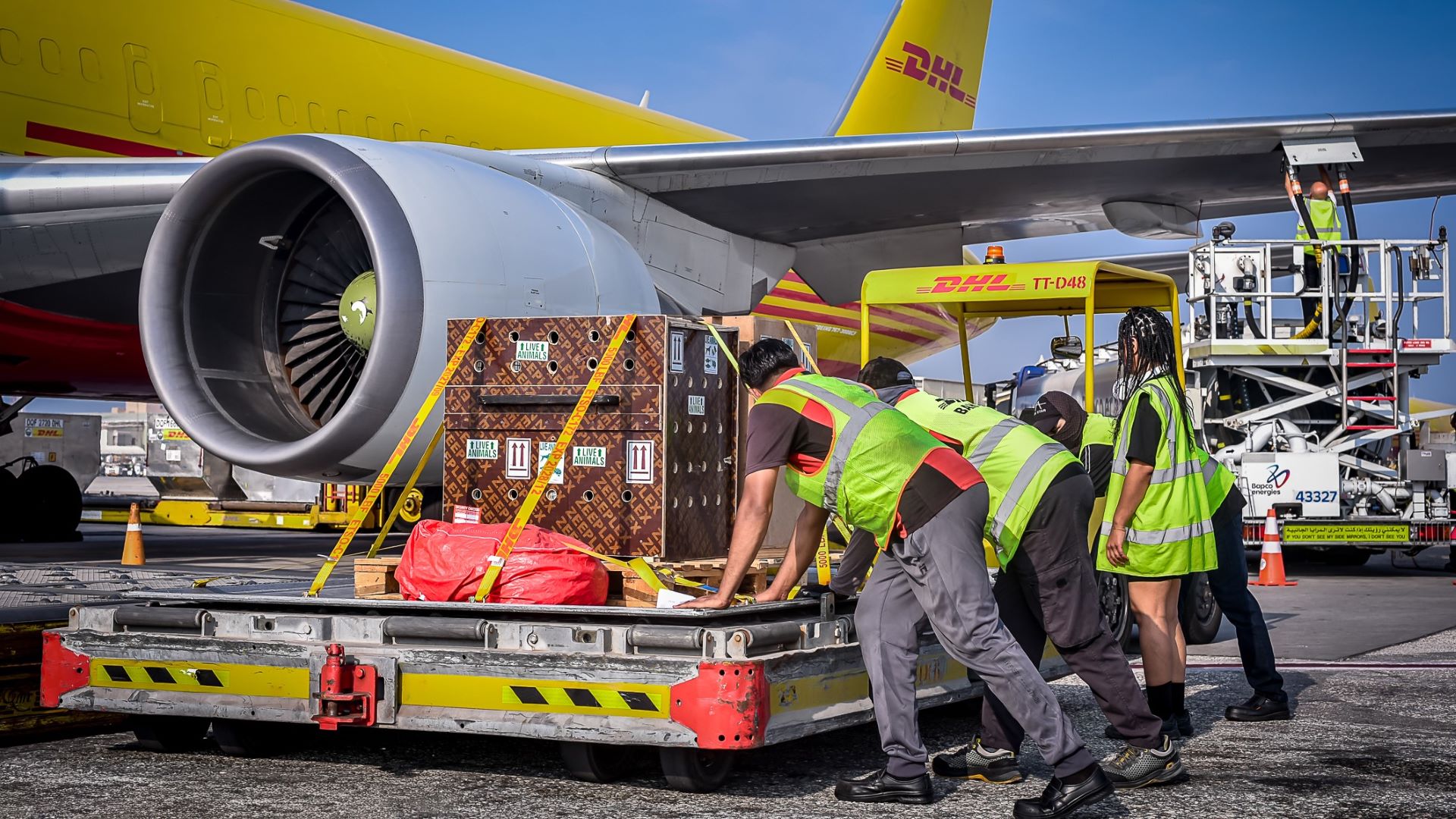
DHL Group's second-quarter operating profit jumped 30% on heavier air freight shipments, capacity constraints in the air cargo market and the pass-through of higher fuel costs through surcharge mechanisms, according to FreightWaves. The performance at DHL Express is diverting freight that would normally go to forwarders onto DHL's own overnight flights, tightening available air cargo capacity.
Profit Drivers: Heavy Shipments and Capacity Shortages
The quarter compared favorably with the same three-month period in 2025, which saw a pullback in international shipments after the United States sparked a wave of new tariffs and other restrictive trade policies, FreightWaves reported. DHL (FRA: DHL) on Wednesday reported net profit grew 24%, with revenue up 13% to the equivalent of $25.8 billion and earnings before interest and taxes (EBIT) of $2.2 billion. The operating profit margin improved 1 point to 8.3%.
| Metric | Q2 2026 Result | Change |
|---|---|---|
| Operating profit (EBIT) | $2.2 billion | +30% |
| Revenue | $25.8 billion | +13% |
| Net profit | — | +24% |
| Operating margin | 8.3% | +1 point |
| Cash flow | $655 million | +73% |
| Express operating income | — | +64% |
DHL raised its full-year forecast last month, guiding to an EBIT of $7.43 billion, according to FreightWaves. Cash flow increased 73% to $655 million, partly due to U.S. refunds of tariffs the Supreme Court ruled were illegally applied under emergency powers; the company said it is passing the refunds to customers as quickly as possible.
Express Outperforms: 64% Operating Income Growth
DHL Express operating income soared 64% as the company continued to benefit from increased weight per shipment — a core metric for assessing asset utilization — and from disciplined yield and cost management, FreightWaves reported. Weight per day for time-definite international shipments rose six points from the first quarter as the company targets more industrial customers. Temporary capacity shortages in the air cargo market, especially around the Middle East conflict area, had a positive earnings impact of about $172.6 million as volume that normally would have gone to forwarders ended up on overnight DHL flights.
CFO Melani Kries said express heavyweight "is not a cheap forwarding product in our premium network. It is a heavier shipment in an express network with express pricing where you take into consideration the cost to produce" and revenue drops quickly to the bottom line, according to FreightWaves.
Integrators Expand Share of Air Cargo
DHL Express, along with FedEx and UPS, continues to take a greater share of the general air freight market as the carriers realign capacity on their in-house airlines to carry heavier freight and move away from low-priced, light parcels as the post-COVID e-commerce boom normalizes, according to FreightWaves. Express carriers are now responsible for moving more than half of all international air cargo tonnage, DHL said. Boeing and Airbus long-range forecasts indicate express air business will grow at a faster clip than general air cargo over the next 20 years.
CEO Tobias Meyer told analysts that DHL Express is positioned to make significant gains in air freight market share because the network's scale, design and fuel-efficient freighters enable it to offer logistics companies better speed at affordable prices compared with regular commercial airlines.
It's the reliability, the speed and the predictability of the integrator model which is superior to the general air freight product. That is attractive not only for small spare parts, but also for bigger parts like turbines used in aviation or for power generation, and other complex, high-value products. — Tobias Meyer, CEO, DHL Group
In one recent case, DHL Express helped a manufacturer of racing-grade motorcycles ship units from China and distribute them across Europe, using Express air assets to move the heavy shipments with greater speed, control and visibility, FreightWaves reported.
Strategic Shift to B2B and Industrial Verticals
DHL, FedEx and UPS have each placed greater strategic focus on serving the B2B sector and key industrial verticals that require specialized logistics and command higher rates, while gradually relinquishing many low-margin, last-mile delivery relationships with online retailers, according to FreightWaves. DHL continues to expand capabilities in premium logistics categories such as life sciences and healthcare, next-generation energy — electric vehicles, wind and battery storage — and data centers, using a cross-divisional approach to support customers.
What Shippers and Forwarders Should Watch
- Capacity tightening: Integrator push into heavy air freight means more competition for lift, especially on routes affected by the Middle East conflict, according to FreightWaves.
- Tariff refunds: DHL is passing U.S. tariff refunds to customers, which could reduce some shipping costs, the company said.
- Guidance: DHL's full-year EBIT guidance of $7.43 billion signals sustained margin momentum.
- E-commerce normalization: The post-COVID boom normalization is pushing integrators away from low-priced light parcels toward heavier industrial freight.
- Integrator pricing: DHL, FedEx and UPS retreating from low-margin last-mile delivery means pricing will increasingly reflect premium service levels rather than commodity parcel rates, FreightWaves reported.
Operators should monitor these factors as the air freight market continues to consolidate around integrator networks.
Sources: