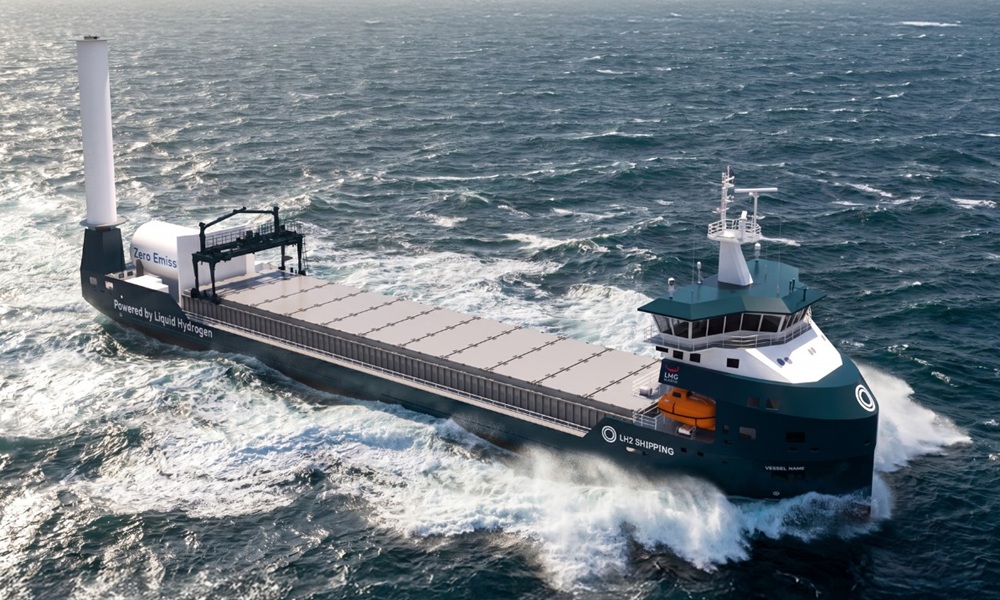
Norway is accelerating the commercial deployment of zero-emission shortsea shipping with fresh funding for a new generation of hydrogen-fuelled bulk carriers, according to Splash247. Norwegian developer LH2 Shipping has secured NOK344.3m ($36m) from state agency Enova to build two additional liquid hydrogen-powered bulk carriers, expanding its project pipeline to six vessels and pushing total public support for its hydrogen shipping programme beyond NOK800m ($74m).
The Bergen-based company, founded in 2023, draws on experience from developing MF Hydra, the world’s first liquid hydrogen-powered ferry. The latest award builds on previous Enova-backed projects and marks another step in Norway’s push to commercialise zero-emission maritime technologies.
Vessel specifications and efficiency
The two newbuildings are 7,700 deadweight tonne (dwt) shortsea bulk carriers, according to Splash247. Each vessel will measure 108.2 metres in length and 18.1 metres in beam. Key onboard systems include:
- A 17-tonne liquid hydrogen storage tank
- 3,400 kW of PEM fuel cells (proton exchange membrane)
- A 3 MWh battery pack
- Shore power capability
- A backup diesel generator capable of running on diesel or biodiesel
The company stated that the ships are designed to consume at least 30% less energy than conventional vessels of similar size, achieved through hull optimisation, propulsion efficiency measures, and advanced energy management. Solar panels fitted to cargo hatch covers are expected to contribute further energy savings.
Deployment and fuel supply
The vessels will be deployed in shortsea trades between Norway and continental Europe and the Baltic region. Around half of their port calls are expected in Norway, with roughly 65% of sailing time in Norwegian waters. Bunkering is planned through hydrogen producer Gen2 Energy’s facility in Mosjøen.
| Specification | Value |
|---|---|
| Deadweight tonnage | 7,700 dwt |
| Length | 108.2 m |
| Beam | 18.1 m |
| LH2 storage | 17 tonnes |
| Fuel cell power | 3,400 kW |
| Battery capacity | 3 MWh |
| Energy savings vs conventional | ≥30% |
Industry and policy context
The project forms part of LH2 Shipping’s strategy to move hydrogen-powered shipping beyond pilot projects into commercial operations. Elin Ulstad Stokland, Enova’s head of hydrogen and ammonia initiatives, said: “If we are to succeed in the transition to low and zero-emission solutions in the maritime sector, we depend on players who dare to go first.”
The two newbuildings are part of the Strandbulk project, where LH2 Shipping acts as project owner and developer. The company believes that tightening emissions regulations, including the EU ETS (Emissions Trading System) and FuelEU Maritime framework, will increasingly improve the business case for zero-emission vessels over the coming decade.
Implications for shortsea operators
For freight forwarders and logistics managers operating on shortsea routes between Norway, continental Europe, and the Baltic, these developments signal a growing regulatory push toward zero-emission tonnage. While the vessels are not yet in service, shippers should monitor the Strandbulk project as it may introduce new capacity with different cost structures—potentially higher charter rates due to capital-intensive technology, but offset by lower fuel costs and carbon compliance savings under EU ETS. Operators relying on conventional shortsea bulkers may face future emission-related surcharges or route restrictions as regulators tighten rules.
Sources: