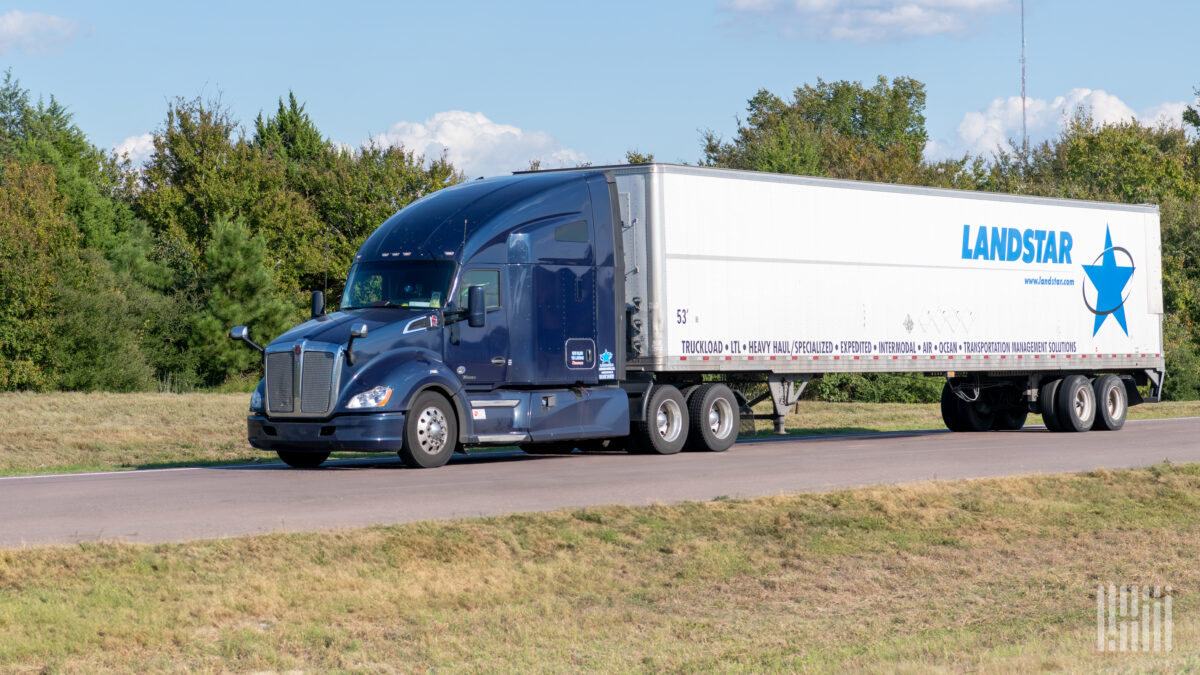
Landstar System expects its larger scale and long safety record to become more attractive to shippers following the Supreme Court’s Montgomery v. Caribe Transport II ruling, which widened liability exposure for freight brokers found negligent in driver hiring practices, according to FreightWaves.
Q2 Financial Results and EPS Miss
Landstar reported second-quarter earnings per share of $1.44, which was 24 cents higher year over year but 4 cents below the consensus estimate of $1.48 as of 90 days before the print, per Yahoo Finance. Consolidated revenue of $1.43 billion was 18% higher year over year and ahead of the $1.34 billion consensus estimate, according to FreightWaves. The company attributed $10.5 million (23 cents per share) in unfavorable developments on prior-year claims as a headwind to EPS.
Business Capacity Owner (BCO) Segment
Revenue generated by Landstar’s business capacity owners (BCOs) increased 22% year over year to $563 million, as loads were up 10% and revenue per load was up 11%, FreightWaves reported. BCOs are owner-operators who haul almost exclusively for Landstar. The number of trucks provided by BCOs increased 68 units sequentially to 8,544 units in the second quarter — the largest increase since the 2022 first quarter. The tractor count is up another 49 units so far in July. BCO turnover improved 310 basis points year over year to 28.3% as utilization improved 12% year over year.
| Metric | Q2 2026 | YoY Change |
|---|---|---|
| BCO revenue | $563M | +22% |
| BCO loads | — | +10% |
| BCO revenue per load | — | +11% |
| BCO trucks (end of Q2) | 8,544 | +68 seq. |
| BCO turnover | 28.3% | -310 bps |
| BCO utilization | — | +12% |
BCO revenue per mile — Landstar’s preferred metric for truckload pricing as it excludes diesel fuel fluctuations — was up 11% year over year on dry van shipments and up 10% year over year on flatbed shipments, according to the source.
Truck Revenue and Yield
Total truck revenue jumped 19% year over year to $1.33 billion as loads increased 2% and revenue per load surged 17%, FreightWaves reported. Higher diesel fuel prices along with higher TL rates drove the yield increase. Management said both truck volumes and revenue per load outpaced normal seasonal patterns in the quarter. In July, truck loads and yields are above typical sequential seasonal trends — 5% and 26% higher year over year, respectively.
In the second quarter, dry van loads increased 5% year over year, with revenue per load up 16%. Flatbed loads grew 2%, with yield up 20%.
Carrier List Reduction and Post-Montgomery Positioning
Landstar has culled its approved carrier list from over 100,000 in 2022 to 64,600 in the recent quarter, according to FreightWaves. The approved truck brokerage carrier list was down another 7% year over year in the second quarter after falling 19% in the first quarter. The company originally started the exercise to weed out cargo theft. Management sees the BCO capacity segment potentially growing faster following the Montgomery ruling, which widens liability exposure for brokers that are negligent in driver hiring practices. Landstar is also having success courting small brokers looking to partner with brokers with better tech, vetting protocols, and insurance programs. The company recently inked a deal with a Midwest broker to become a Landstar agent; that broker generates approximately $18 million in annual revenue, much larger than most new Landstar agents, which have less than $5 million in revenue.
Implications for Shippers and Operators
For freight forwarders and logistics managers, Landstar’s reduced carrier list and focus on safety and scale may signal a tightening of available capacity from smaller brokers, especially those unable to meet higher insurance and vetting standards post-Montgomery. Shippers working with Landstar may benefit from more reliable capacity and lower turnover risk. The firm’s improving BCO utilization and fleet growth suggest owner-operators are increasingly favoring large, established brokers. The 11% and 10% year-over-year increases in BCO revenue per mile for dry van and flatbed indicate firming pricing in the truckload spot market, which may continue if the Montgomery ruling further constrains broker capacity. Third-party logistics operators should monitor whether other large brokers follow Landstar’s lead in paring down carrier lists, potentially driving a bifurcation in the market between well-capitalized brokers and smaller players facing higher liability costs.
Sources: