iGEN
Visit IGEN World Explore IGEN Expo
EXPLORE UPGRADE PLANS
BREAKING
CMA CGM and Stonepeak Launch United Ports LLC in $2.4 Billion Terminal Joint Venture UPS shift away from Amazon shows bigger payoff Lanesurf: 62% of Loads Get Vetted Carrier Offers Before Brokers Arrive India-China Border Trade Via Lipulekh Resumes Aug 1; China Permits 20 Traders Geopolitics Drives CMA CGM Q2 Profit Surge of 42% as Volumes and Rates Climb Benchmark Diesel Price Rises Third Week as Futures Plunge; Spread Hits Record Indian Government Limits Sugar Dealers to 400 Tonnes Stock Until November to Curb Hoarding Tenants signing longer leases for larger warehouses as 3PLs lock in capacity US stock market flat as S&P 500 and Dow barely move, Nasdaq slides over 1% on chip rout TruAlt Bioenergy Q1 Net Zooms to ₹59.27 Crore on Higher Revenues, Capacity Expansion CMA CGM and Stonepeak Launch United Ports LLC in $2.4 Billion Terminal Joint Venture UPS shift away from Amazon shows bigger payoff Lanesurf: 62% of Loads Get Vetted Carrier Offers Before Brokers Arrive India-China Border Trade Via Lipulekh Resumes Aug 1; China Permits 20 Traders Geopolitics Drives CMA CGM Q2 Profit Surge of 42% as Volumes and Rates Climb Benchmark Diesel Price Rises Third Week as Futures Plunge; Spread Hits Record Indian Government Limits Sugar Dealers to 400 Tonnes Stock Until November to Curb Hoarding Tenants signing longer leases for larger warehouses as 3PLs lock in capacity US stock market flat as S&P 500 and Dow barely move, Nasdaq slides over 1% on chip rout TruAlt Bioenergy Q1 Net Zooms to ₹59.27 Crore on Higher Revenues, Capacity Expansion
Home ›› Logistics ›› Shipping Freight ›› Shipping Lines ›› After Montgomery Decision, Industry Scrambles for Reliable Carrier Safety Ratings

After Montgomery Decision, Industry Scrambles for Reliable Carrier Safety Ratings

The Supreme Court's unanimous decision in Montgomery v. Caribe Transport II eliminated a key procedural defense for brokers in negligent selection lawsuits, forcing the industry to confront the lack of dependable carrier safety data. A FreightWaves analysis argues that FMCSA's Safety Measurement System (SMS) is not reliable for judging carrier safety, as even the agency itself warns against drawing conclusions from the data. Brokers and carriers are now pushing for a federal safety standard and modernization of safety fitness determinations.

iG
iGEN Editorial
June 23, 2026
After Montgomery Decision, Industry Scrambles for Reliable Carrier Safety Ratings

The Supreme Court's recent unanimous ruling in Montgomery v. Caribe Transport II has removed a long-standing procedural shield that let many brokers avoid deep scrutiny of carrier safety, according to a Contributed Content analysis on FreightWaves. The decision leaves the transportation industry facing the same fundamental problem: there is no dependable way to gauge a motor carrier's safety at the moment of selection.

The Montgomery Decision: What Changed

The Court did not create a new duty of care or make brokers automatically liable, the analysis stresses. It resolved a circuit split on whether the Federal Aviation Administration Authorization Act (FAAAA) preempts state-law negligent selection claims. The Ninth Circuit had held that the FAAAA's safety exception preserves those claims; the Seventh Circuit had disagreed. The Supreme Court unanimously sided with the Ninth Circuit.

What changed is the procedural landscape. In roughly half the country, courts had treated FAAAA preemption as a complete defense, allowing brokers to get negligent selection suits dismissed early. That defense is now gone. Claims that survive a motion to dismiss will proceed into expensive discovery and potentially to trial, because ordinary care is a question of fact for a jury.

Aspect Pre-Montgomery Post-Montgomery
FAAAA preemption defense Available in many circuits to dismiss suits at pleading stage No longer a complete defense; cases go to discovery
Broker exposure Lower risk of litigation costs Higher risk of costly discovery and potential jury trial
Carrier vetting incentive Minimal, because of easy dismissal Stronger incentive to vet carriers thoroughly

As the analysis puts it: "That's not nothing."

The SMS Data Problem

The article is sharply critical of the rush to rely on FMCSA's Safety Measurement System (SMS) data as a solution. It notes that FMCSA itself has posted a disclaimer on its SMS website stating that the scores are "performance data the agency uses to decide whom to monitor," that a flag is "not intended to imply any federal safety rating" under 49 U.S.C. 31144, and that readers "should not draw conclusions about a carrier's overall safety condition" from the data.

"A reliable signal, built on the wrong foundation" – FreightWaves analysis on the use of SMS data for safety ratings.

The analysis also criticizes FMCSA's safety fitness determinations from compliance reviews and focused audits, calling them among the least trustworthy measures. The skepticism is rooted in the agency's own admission and a 2011 settlement with three trucking associations that challenged the public display of CSA data.

Industry Response and Next Steps

In the wake of the Montgomery ruling, industry groups are pressing for change:

  • The Transportation Intermediaries Association (TIA) has petitioned FMCSA for a federal carrier selection standard and a public list of high-risk carriers.
  • The Truckload Carriers Association (TCA) has urged the agency to modernize how it determines safety fitness.
  • Opportunists from within and outside the industry are pitching paid "solutions" to fill the information gap, according to the analysis.

The article, however, warns against relying on the two most commonly floated tools: SMS data and safety fitness determinations. It argues that the industry needs a fundamentally different approach, not just a repackaging of flawed data.

For logistics managers and 3PL operators, the immediate implication is clear: broker due diligence processes must be strengthened to withstand negligence claims, and the data sources currently used to assess carrier safety may not hold up in court. As the analysis concludes, the Montgomery decision did not change the substantive law of negligence, but it did remove the "procedural exit ramp" that allowed many in the industry to avoid thinking too hard about carrier selection.


Sources: FreightWaves
Keep Reading

Recommended Stories

FMCSA Revisits Dormant Rule to Test Truck Safety Knowledge Before Granting Authority Logistics

FMCSA Revisits Dormant Rule to Test Truck Safety Knowledge Before Granting Authority

FMCSA is revisiting a rule dormant since 2009 that would require new motor carriers to demonstrate safety knowledge before receiving operating authority, rather than after. The agency targets November 2026 for a supplemental advance notice of proposed rulemaking, potentially reversing a long-standing practice where audits follow months after carriers start hauling freight.

July 26, 2026
MCSAP Bang-for-Buck Rankings: California Leads With Cheapest Inspections, Faces Funding Withhold Logistics

MCSAP Bang-for-Buck Rankings: California Leads With Cheapest Inspections, Faces Funding Withhold

Analysis of federal MCSAP grant data shows California performs the most inspections at the lowest cost per inspection. However, the state faces over $198 million in withheld funding due to disputes over English proficiency enforcement and CDL issuance, threatening its inspection program.

July 7, 2026
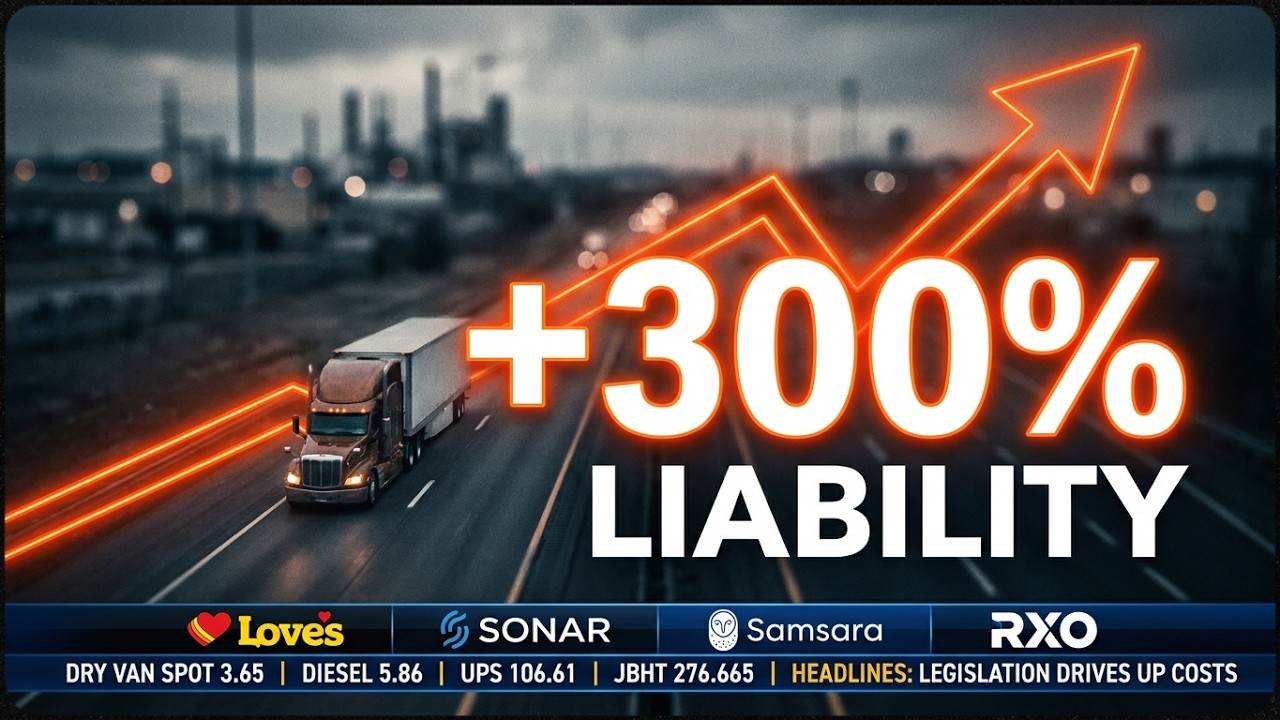
Liability in Trucking: How Bad Legislation and Nuclear Verdicts Drive Up Costs for Brokers and Carriers Logistics

Liability in Trucking: How Bad Legislation and Nuclear Verdicts Drive Up Costs for Brokers and Carriers

The trucking insurance market is in turmoil due to 'nuclear verdicts' and legislative changes. Cover Whale's CRO Myles Oppenheimer highlights how poor legislation and underwriting discipline create a 'self-inflicted wound' that traditional insurers cannot handle. A recent SCOTUS decision unraveling federal preemption adds further cost pressures for brokers and carriers.

July 1, 2026
North Carolina Trucking Group Investigates Wave of Unexpected FMCSA Safety Audits Following SafeSpect Glitch Logistics

North Carolina Trucking Group Investigates Wave of Unexpected FMCSA Safety Audits Following SafeSpect Glitch

A glitch in FMCSA's SafeSpect platform misidentified long-established trucking companies as new entrants, triggering safety audit notifications. The North Carolina Trucking Association is investigating and has alerted carriers. At least 400 carriers in North Carolina were added to the audit queue overnight, and the issue may extend beyond the state.

June 24, 2026