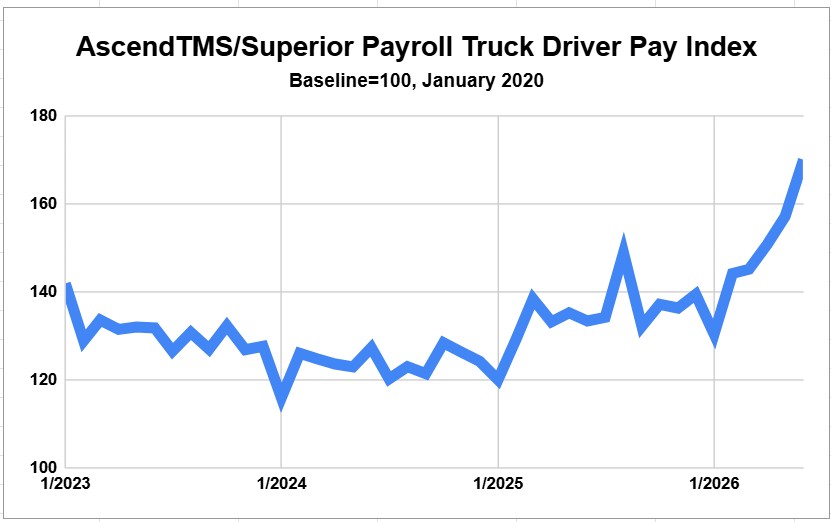
Driver pay levels in the U.S. trucking industry have soared to a record high, according to a joint index produced by AscendTMS and Superior Trucking Payroll Services. The Truck Driver Pay Index reached 170.04 in June 2025, a 13.5% increase in just two months and the highest reading since the index was launched in 2020. The surge signals rising cost pressures for freight operators and shippers who rely on truckload capacity.
How the index works
The index, set with a January 2020 baseline of 100, is built from payroll data processed by AscendTMS and Superior Trucking Payroll Services. Tim Higham, CEO of AscendTMS, explained that his company's transportation management system (TMS) handles payroll settlements for carriers, then electronically sends the data to Superior, which makes the payments to drivers. The resulting database captures actual driver compensation, excluding back-office or executive pay. Superior president Mike Ritzema noted that the index is based strictly on employee drivers (though some 1099 contractors are included) and does not include independent contractors. “It takes out the shop people and the office people and the president of the company who pays himself either $1 per year or $8 million per year,” Ritzema said. He added that Superior pays “thousands of drivers every week, of all different shapes and sizes, from companies with one truck to 500 trucks,” including “flatbedders and reefer haulers and all in between.”
Recent surge in detail
After reaching a post-pandemic low of 115.9 in January 2024, the index began climbing. It hit 132.18 in September 2024, then jumped to 144.18 between December 2024 and January 2025. By April 2025, the index stood at 150.83, and by June 2025 it had surged to 170.04. The two-month gain from April to June was the largest in the index's history, according to Ritzema. For context, index movements before this period were typically small: “goes up 2%, goes down 3%, went up 4%,” Higham said. Ritzema contrasted the recent jump: “I have never seen it jump like it jumped from May to June.” He noted that the index usually fluctuates only three points between those months, with June often showing a modest gain over May due to the Memorial Day slowdown. “Basically everybody’s running the whole month,” he said of June operations.
| Month | Truck Driver Pay Index |
|---|---|
| Jan 2023 | 141.9 |
| Jan 2024 | 115.9 |
| Sep 2024 | 132.18 |
| Dec 2024 | 130.42 |
| Jan 2025 | 144.18 |
| Apr 2025 | 150.83 |
| Jun 2025 | 170.04 |
Implications for shippers and operators
Ritzema has compared the index movements to spot freight rates and sees a lag of roughly four to six months between higher spot rates and driver pay increases. The current surge suggests that spot rate gains from earlier in 2025 are now flowing through to driver compensation. For freight forwarders and logistics managers, this means higher trucking costs are likely to persist and may eventually feed into contract rates. Carriers facing steeper driver payroll expenses will need to pass those costs along to shippers, potentially squeezing margins for 3PLs and brokers. The index's all-time high also underscores the tightening of the driver labor market, which could constrain capacity, especially in spot market lanes that rely on flexible owner-operators.
Watch list
Spot freight rate trends: If spot rates continue to rise, driver pay could follow with the typical lag, pushing the index even higher. Conversely, a softening in the spot market might slow the pace of increases. Summer peak season: June's full-running month contributed to the jump; July and August volumes will indicate whether the surge is sustained. Contract rate negotiations: Shippers should prepare for upward pressure on contract rates as carriers factor in higher driver pay. Winter slowdown: Historically, driver pay dips in January, as seen in 2024; the index's reaction to any seasonal softening will be telling.
Sources: