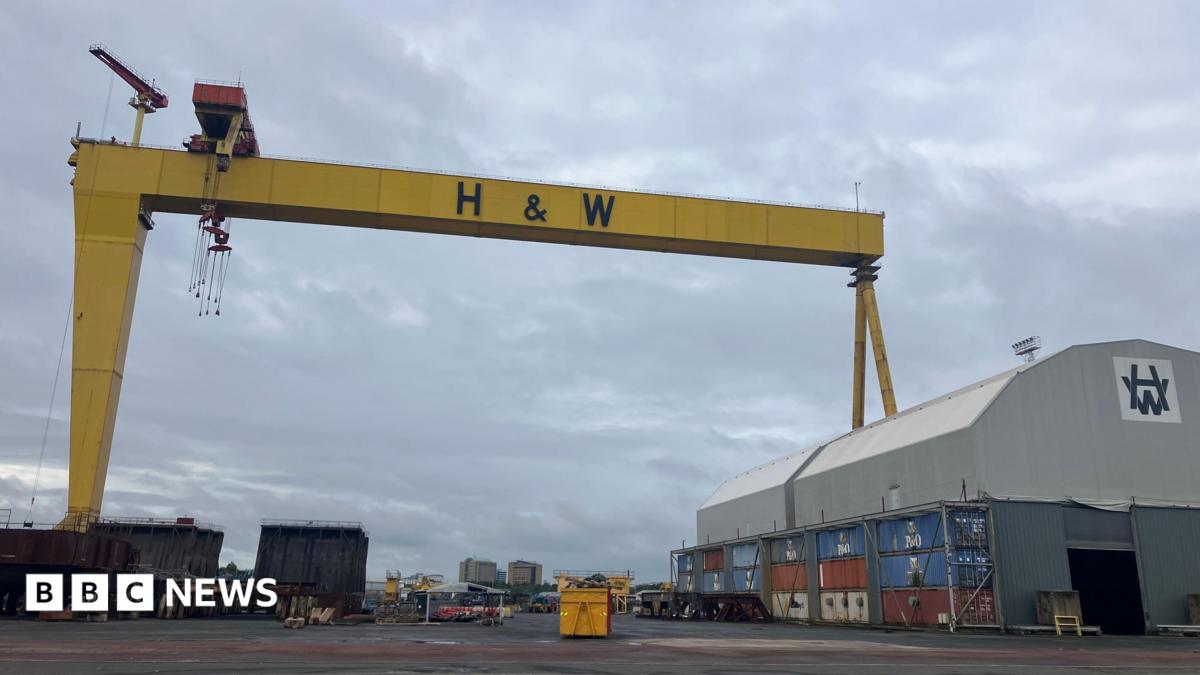
Harland & Wolff's Belfast shipyard is spending £3m to refurbish its famous yellow cranes, Samson and Goliath, as part of a near-£100m investment ahead of a major Royal Navy defence contract, according to BBC Business. The overhaul is part of preparations for the Fleet Solid Support (FSS) programme, for which the yard is the integration and final assembly site for three Royal Navy support ships.
Ownership and Investment
The yard has been owned by Navantia, Spain's state-owned shipbuilder, since January 2025, BBC Business reported. Navantia has already made substantial investments in Belfast, including an expansion to the fabrication hall and installing plasma cutting equipment. The £3m crane refurbishment is part of a wider investment of almost £100m at the yard as it prepares for the defence contract.
Crane Overhaul Details
The cranes, Samson and Goliath, dominate the east Belfast skyline. Their engines will be overhauled and other key components replaced, according to BBC Business. Carlos Lopez Carregado, General Manager at Harland & Wolff, said the overhaul would treat the cranes "with utmost respect," and added:
"We know that the city is proud of them, and this major mechanical, electrical, hydraulic and fabric maintenance project will restore them to their absolute best. We will be replacing parts, updating technology and testing them to see that they can lift at full capacity."
The full-capacity testing is directly linked to the heavy-lift demands of the FSS final assembly work, which will involve integrating large ship blocks at the Belfast yard.
Fleet Solid Support Programme
Work on the FSS project is well underway at other Navantia sites in Spain and Devon, according to BBC Business. The ships are being constructed in blocks which will be taken to Belfast by barge for final assembly. Blocks for the first ship, RFA Resurgent, are due to arrive in Belfast in early 2027.
The programme involves the construction of three Royal Navy support ships, with Belfast serving as the integration and final assembly hub. The barge transport of blocks from Spain and Devon to Belfast represents a scheduled, cross-border maritime logistics chain that will bring outsize project cargo to the Port of Belfast.
Logistics Implications for the Port of Belfast
The FSS programme creates a defined logistics pipeline linking Navantia's construction sites in Spain and Devon with the Port of Belfast. Ship blocks will be moved by barge for final assembly, with the first deliveries for RFA Resurgent due in early 2027. This timeline gives freight forwarders and port operators advance notice of heavy-lift activity at the Belfast quayside.
For cargo handlers and ocean carriers, the barge movements require coordination of berth availability and crane capacity. The crane overhaul is designed to restore Samson and Goliath to full lifting capability, a critical requirement for mounting the ship blocks. Lopez Carregado's statement, reported by BBC Business, confirms that the mechanical, electrical, hydraulic and fabric maintenance project will "restore them to their absolute best." The investment in the fabrication hall and plasma cutting equipment at the yard also points to expanding pre-assembly capabilities on site.
Key Facts at a Glance
| Metric | Detail |
|---|---|
| Crane refurbishment cost | £3m |
| Total investment package | Almost £100m |
| Cranes | Samson and Goliath |
| Owner | Navantia (since January 2025) |
| Programme | Fleet Solid Support (FSS) |
| Vessels | Three Royal Navy support ships |
| First vessel | RFA Resurgent |
| Block arrival in Belfast | Early 2027 |
Watch List
- Arrival of blocks for RFA Resurgent in Belfast in early 2027.
- Ongoing FSS block construction at Navantia sites in Spain and Devon.
- Completion of the crane overhaul and full-capacity load testing.
Sources: