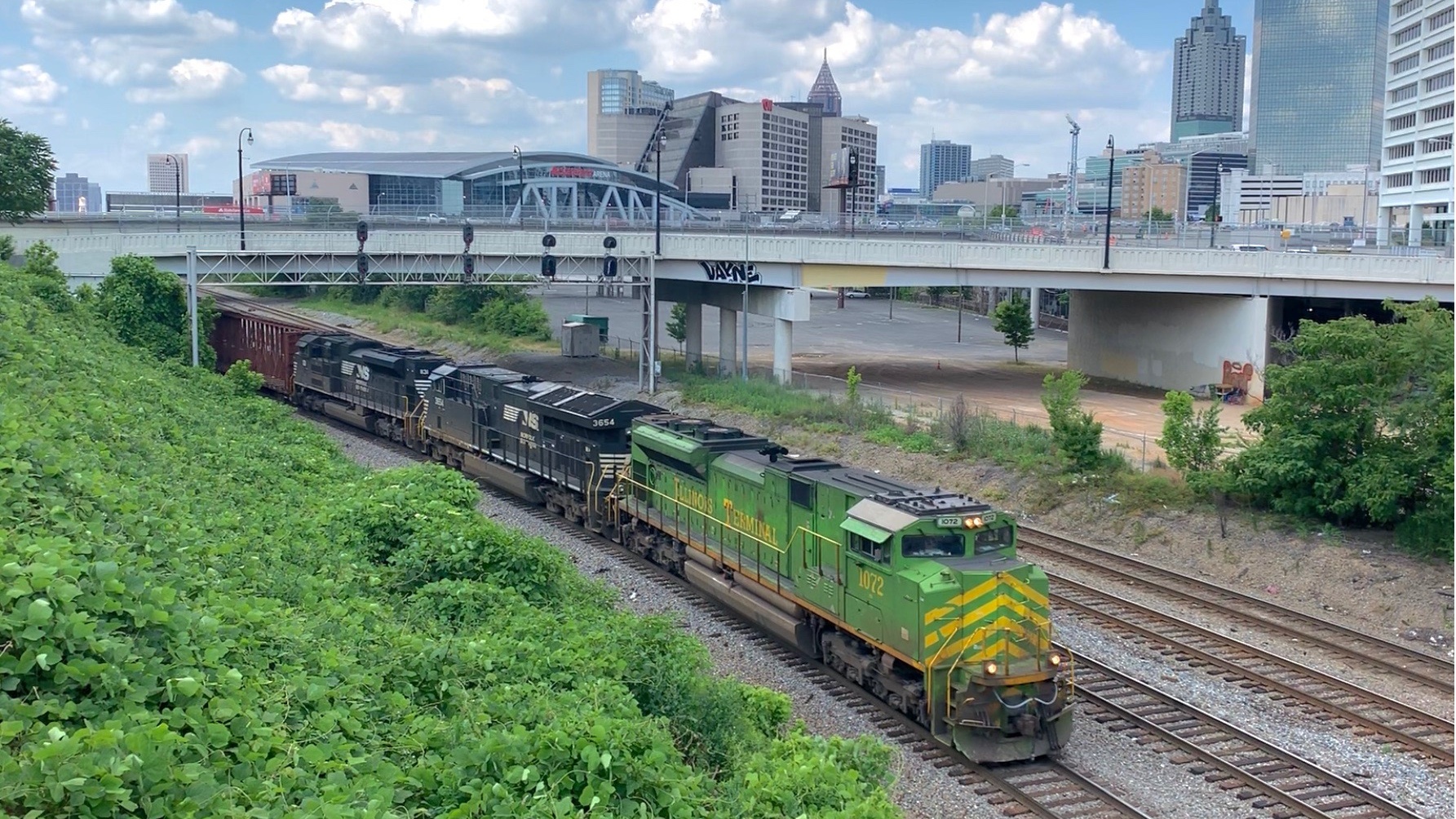
The proposed $85 billion merger of Union Pacific (NYSE: UNP) and Norfolk Southern (NYSE: NSC) — which would create the first transcontinental railroad — is reviving a plan to route freight trains around Atlanta and free up track for expanded passenger service, a move that could also improve trucking fluidity in the city, according to FreightWaves.
The Surface Transportation Board (STB) is currently evaluating the consolidation and isn't expected to rule until 2027, FreightWaves reported. The tie-up has attracted detractors who claim the monopolistic effects of shrinking the number of U.S. Class I carriers will raise rates and degrade service for shippers, according to the report. Other stakeholders see a once-in-a-generation opportunity to leverage local support and transform the Atlanta metroplex passenger rail network, FreightWaves said. Canadian National (NYSE: CNI) recently did just that in an access agreement that would expand its operations to the Mexican border while giving UP-NS access to a route around the congested hub of Chicago.
The Atlanta bypass plan
It is precisely that "belt line" bypass an embryonic coalition wants to bring to Atlanta, which would free up hundreds of miles of track for passenger trains and help thin out the city's legendary traffic jam, FreightWaves reported. Like the I-285 interstate, the idea first envisioned a decade ago by Mark Hitchcock of Jacobs Engineering would divert freight trains that currently run through the heart of Atlanta onto existing track operated by NS and CSX (NASDAQ: CSX) in a U-shape route around the city. If 80% of freight trains were diverted, it would open up capacity for 14 commuter rail lines, Hitchcock said in an interview with the local Saporta Report, as cited by FreightWaves.
The merger process could help establish an operating agreement between NS and CSX and kickstart construction of about 12 miles of new track in Atlanta's southeastern region needed to complete the bypass, said Hitchcock, a member of the nonprofit Atlanta Design Roundtable backing the project.
The trucking angle
Shifting thousands of commuters from road to rail will improve the fluidity for freight logistics in and around Atlanta, a business crossroads of the South, FreightWaves reported. Hitchcock admits it is no small lift and compared development to building Atlanta's Hartsfield-Jackson International Airport, with a price tag of as much as $6 billion. That's a bargain compared to the $90 billion price tag a Georgia State House committee estimated last week the state would need to spend on roads by 2050 to keep up with growing truck volume and highway repairs.
"We are going to double the amount of freight between now and 2050," Hitchcock said, according to FreightWaves. "I don't think we can build our way out of it. Right now, if there's no change, 86% of all freight will be going by truck."
Hitchcock called the effort "a 50-year vision," and compared it to the Georgia Road Improvement Plan (GRIP) launched in 1989, which is 72% complete. "Leadership would have to come from the state," he said. Mayor Andre Dickens has expressed interest in the bypass and connected the nonprofit with a regional commission for further discussions, FreightWaves reported. Political support could be cultivated after Union Pacific in its merger applications said it plans to move more than 500 management jobs from NS headquarters in Atlanta to its own base in Omaha.
| Item | Cost / scale | Details |
|---|---|---|
| UP-NS merger | $85 billion | Ruling expected 2027 |
| Atlanta bypass | up to $6 billion | Comparable to building Hartsfield-Jackson |
| Georgia road needs by 2050 | $90 billion | State House committee estimate |
| New track required | ~12 miles | Southeastern Atlanta segment |
| Commuter rail lines if 80% diverted | 14 | Plan by Mark Hitchcock / Jacobs Engineering |
What to watch
- Sept. 4 deadline: Stakeholders must sign on to the merger evaluation process with the Surface Transportation Board, FreightWaves reported.
- 2027 ruling: The STB is not expected to rule on the $85-billion consolidation until 2027.
- Freight train diversion: If 80% of freight trains are diverted, the city could gain 14 commuter rail lines, freeing up capacity for both passengers and freight.
Sources: