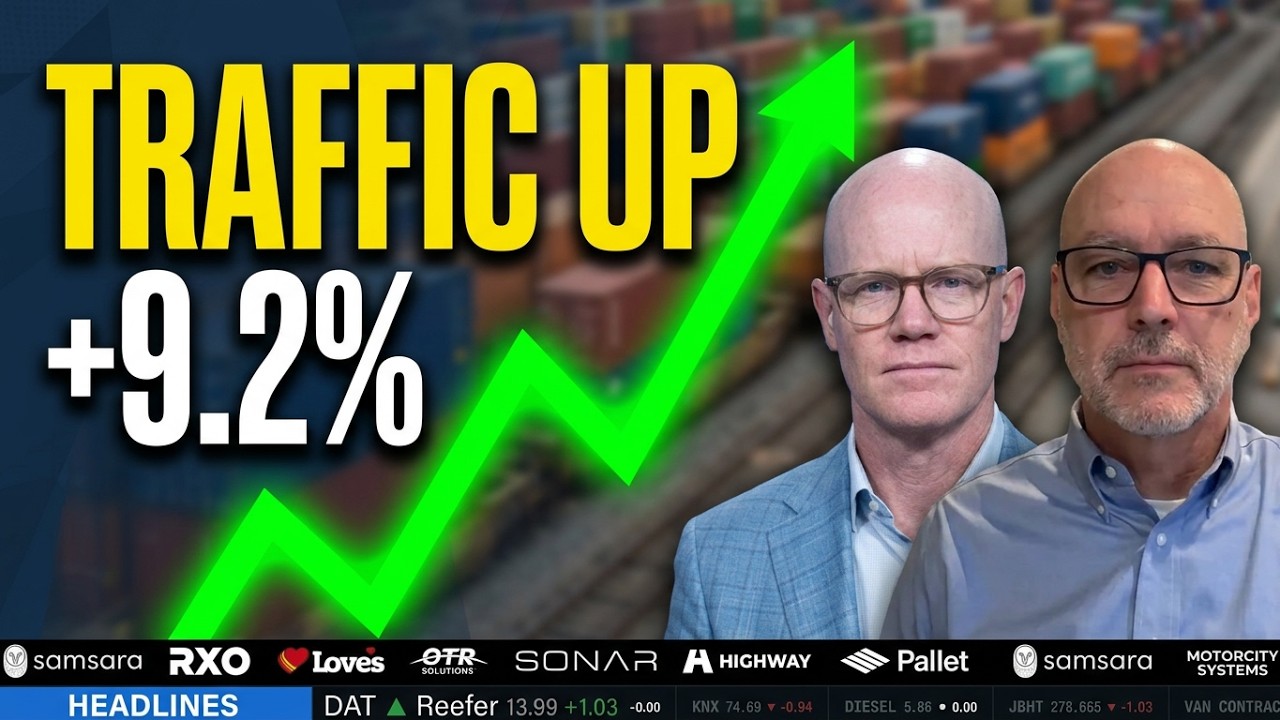
Stronger-than-expected U.S. rail carloads excluding coal — up 2.1% in week 30 and 4% year to date — signal a resilient industrial economy even as headline traffic growth decelerated from the prior four-week average, according to the latest Association of American Railroads (AAR) data reviewed by FreightWaves.
U.S. rail traffic rose 2.5% in week 30, but the headline number understates underlying industrial strength once coal is stripped out, FreightWaves reported. Total North American rail traffic increased 2.5% for the week, with intermodal up 4.3% and carloads up just 0.5%. That marks a deceleration from the prior four-week trend, when total North American traffic was rising at just over 4%.
Commodity breakdown: steel surges, chemicals dip
In the U.S., seven of the 10 commodity groups tracked by the AAR posted gains, according to the data. Carloads overall fell 0.4% — compared with a four-week trend of just under positive 1% — while intermodal rose 4.8%, below the 6.4% pace of the prior four weeks.
Steel-related commodities were standout performers: metallic ores jumped 16% for the week and scrap iron and steel surged 20%, both running above their prior four-week trends. Grain was up 4%, in line with its recent trend. Chemicals, typically the second-largest traffic segment, slipped 2.2% for the week, though they remain up 2.4% year to date. Bill Stephens, editor of Trains Magazine, told FreightWaves the dip could reflect noise in the numbers or modest softening, with oil-price volatility a potential input-cost factor.
On a year-to-date basis, U.S. carloads are up 2.7%, total units up 3.8%, and total traffic up 3.3% — with coal the only segment in negative territory, the AAR data show.
| U.S. rail metric | Week 30 | Prior 4-week trend | Year-to-date |
|---|---|---|---|
| Total North American traffic | +2.5% | just over +4% | — |
| U.S. carloads | -0.4% | just under +1% | +2.7% |
| U.S. carloads ex-coal | +2.1% | — | +4% |
| U.S. intermodal | +4.8% | +6.4% | — |
| Metallic ores | +16% | above trend | — |
| Scrap iron and steel | +20% | above trend | — |
| Grain | +4% | in line | — |
| Chemicals | -2.2% | — | +2.4% |
As Stephens put it:
The carload numbers really closely track with industrial production. And industrial production doesn't really — it's not a hockey stick, right?
Stephens said the 4% year-to-date carload growth ex-coal represents a genuinely strong economic signal.
Merger watch: UP-NS held in abeyance
The proposed Union Pacific–Norfolk Southern merger is being held in abeyance at the Surface Transportation Board (STB) while regulators review more than 400 pages of supplemental information the two carriers filed a week ago Monday, FreightWaves reported. Stephens noted that Canadian National recently dropped its opposition after reaching a deal with Union Pacific granting CN access to St. Louis and Kansas City in exchange for UP receiving improved Chicago access over CN lines — and potential CN access to Mexico.
Whether UP and NS can secure similar agreements with remaining opponents remains an open question as the STB sets its procedural schedule. Port of Los Angeles Executive Director Gene Seroka, appearing on FreightWaves the prior day, expressed support for the merger, arguing that single-railroad intermodal service from the West Coast to Midwest and Northeast markets would benefit shippers routing cargo through LA. Stephens said the deal could shift the competitive balance between East and West Coast ports, giving West Coast gateways an advantage in reaching interior markets such as Detroit, Pittsburgh, Cincinnati, and Buffalo that currently sit on the eastern side of the Class I east-west divide.
Shipper and operator implications
For shippers routing cargo through Los Angeles, the proposed single-railroad intermodal service could strengthen access to Midwest and Northeast markets, according to Seroka's remarks reported by FreightWaves. The potential shift in competitive balance between East and West Coast ports is a factor for forwarders and 3PLs to monitor as the STB moves forward. On the commodity side, the surge in steel-related rail traffic — metallic ores up 16% and scrap iron and steel up 20% in week 30 — indicates sustained input demand for manufacturers, a relevant signal for logistics managers handling industrial freight.
Watch list
- STB procedural schedule for the Union Pacific–Norfolk Southern merger; remaining opponents and whether UP can secure agreements similar to the CN deal.
- Chemical traffic trend: whether the week's 2.2% dip is noise or softening, with oil-price volatility a potential input-cost factor, per Stephens.
- Coal remains the only negative segment year to date; any further weakness could pull down headline carload numbers.
- The America 250 locomotive celebration later this month at the North Carolina Transportation Museum in Spencer, North Carolina, where approximately three dozen locomotives painted in red, white, and blue liveries will be on display alongside bicentennial units from 1976, including the Norfolk and Western 1776.
Sources: