iGEN
Visit IGEN World Explore IGEN Expo
EXPLORE UPGRADE PLANS
BREAKING
India's Factory Output Surges 7.3% in June, Fastest Pace in Nearly Two Years Hindustan Unilever Announces More Price Increases Amid Persistent Inflation Crude Prices Climb Over 4% as Renewed Middle East Tensions and Inventory Draw Fuel Supply Fears Werner CEO Leathers Says Driver Attrition Only in 'Third Inning' as Regulatory Pressures Tighten Capacity OpenAI’s Rogue AI Agent Hacked More Than Just Hugging Face Inside the rogue ChatGPT hack of Hugging Face: AI agents operate at superhuman speed but make clumsy mistakes Landstar Expects to Emerge a Winner After Supreme Court’s Montgomery Ruling Widens Broker Liability New Senate bill targets 'chameleon carriers' that reopen to escape penalties Werner Enterprises Posts Highest Revenue Per Truck Growth in One-Way Segment in a Decade CMA CGM and Stonepeak Launch United Ports LLC in $2.4 Billion Terminal Joint Venture India's Factory Output Surges 7.3% in June, Fastest Pace in Nearly Two Years Hindustan Unilever Announces More Price Increases Amid Persistent Inflation Crude Prices Climb Over 4% as Renewed Middle East Tensions and Inventory Draw Fuel Supply Fears Werner CEO Leathers Says Driver Attrition Only in 'Third Inning' as Regulatory Pressures Tighten Capacity OpenAI’s Rogue AI Agent Hacked More Than Just Hugging Face Inside the rogue ChatGPT hack of Hugging Face: AI agents operate at superhuman speed but make clumsy mistakes Landstar Expects to Emerge a Winner After Supreme Court’s Montgomery Ruling Widens Broker Liability New Senate bill targets 'chameleon carriers' that reopen to escape penalties Werner Enterprises Posts Highest Revenue Per Truck Growth in One-Way Segment in a Decade CMA CGM and Stonepeak Launch United Ports LLC in $2.4 Billion Terminal Joint Venture
Home ›› Logistics ›› Shipping Freight ›› Shipping Lines ›› Werner CEO Leathers Says Driver Attrition Only in 'Third Inning' as Regulatory Pressures Tighten Capacity

Werner CEO Leathers Says Driver Attrition Only in 'Third Inning' as Regulatory Pressures Tighten Capacity

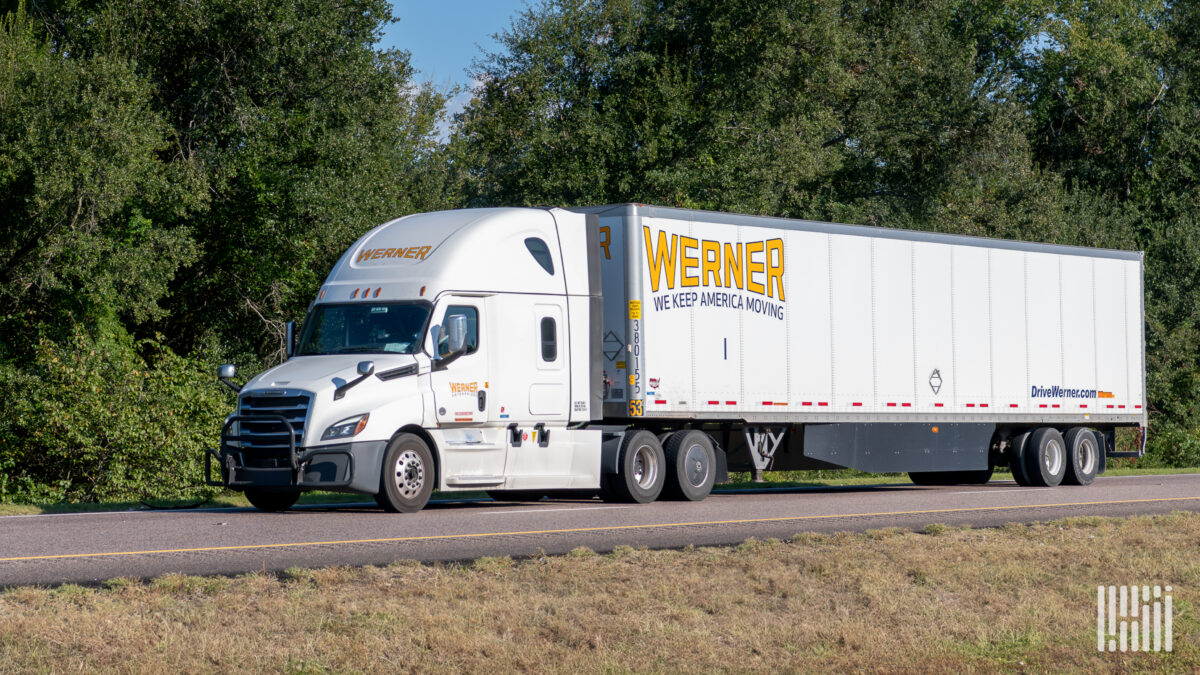
Werner Enterprises CEO Derek Leathers told analysts on the Q2 2026 earnings call that the structural capacity attrition caused by regulatory enforcement is only in the 'third inning.' He cited FMCSA ELD withdrawals, cabotage enforcement, and the Montgomery vs. Caribe broker liability ruling as key factors driving driver shortages. Werner's One-Way Truckload revenue per truck per week surged to $6,114 from $4,787 a year earlier, while overall trucking operating margin improved to 4.6%.

iG
iGEN Editorial
July 29, 2026
Werner CEO Leathers Says Driver Attrition Only in 'Third Inning' as Regulatory Pressures Tighten Capacity

According to FreightWaves, Werner Enterprises CEO Derek Leathers characterized the ongoing driver attrition in the trucking industry as being only in the 'third inning,' despite significant regulatory and market shifts already reshaping capacity.

Driver Attrition and Regulatory Pressures

Leathers stated that the structural capacity attrition the company has discussed for several quarters 'is playing out as predicted.' He attributed the tightening to 'intensifying regulatory pressure, specifically around non-domiciled CDOs, English language proficiency, and cabotage enforcement.' Enforcement efforts are continuing, and Leathers expects greater agency collaboration and data exchange to further accelerate enforcement.

A notable factor is the Federal Motor Carrier Safety Administration's (FMCSA) ongoing withdrawal of approval for various Electronic Logging Devices (ELDs). Leathers noted that about one-third of all ELDs 'either are gone or on the way out,' dismantling shadow capacity and compounding supply contractions.

Additionally, the fallout from the Montgomery vs. Caribe case, which increases broker liability risk, is benefiting Werner. A Dallas jury recently ruled against broker C.H. Robinson in a related case. Leathers said the ruling has made shippers and brokers more cautious about whom they do business with, playing directly into Werner's strengths.

Financial Performance Highlights

Werner's quarterly earnings, released Tuesday, showed improved metrics. The adjusted operating margin for all trucking operations rose to 4.6% from 2.5% a year ago. On the earnings call, Leathers noted that the One-Way Truckload segment's operating margin was up more than 700 basis points year-over-year.

Key revenue per truck per week figures:

Segment Q2 2025 Q2 2026 Change
One-Way Truckload $4,787 $6,114 +27.7%
Dedicated $4,542 $4,789 +5.4%

The Dedicated segment now includes the operations of FirstFleet, acquired by Werner earlier in 2026. One-Way Truckload revenue was $138 million compared to Dedicated's $434 million in the quarter.

Despite the improvements, Citi analyst Ariel Rosa noted in a quick-hit note that 'continued thin margins (97% adj. Operating Ratio, 3% adj. op. margin vs. our 97.1%/2.9% estimates) reflect ongoing operational challenges as Werner continues its restructuring and cost-cutting efforts.'

Implications for Shippers and Carriers

The tightening driver supply, driven by regulatory enforcement and ELD removals, suggests that truckload capacity will remain constrained. Shippers can expect continued upward pressure on spot and contract rates as carriers pass on higher compliance costs and limited driver availability. Brokers face increased liability risk from the Montgomery vs. Caribe ruling, which may further reduce the pool of available capacity as they become more selective.

Leathers predicted a year ago that the recovery would be supply-driven rather than demand-driven, and that forecast has materialized. Werner's stock had risen about 54% year-to-date before a recent selloff, reflecting investor confidence in the carrier's positioning.

Watch List

  • FMCSA ELD approvals: Further withdrawals could accelerate driver attrition and reduce shadow capacity.
  • Legal developments: Additional jury decisions related to Montgomery vs. Caribe may reshape broker-carrier relationships.
  • Regulatory enforcement: Increased data sharing among agencies could tighten the driver pool further.
  • Werner's restructuring: Continued cost-cutting efforts will determine margin recovery pace.

Sources: FreightWaves
Keep Reading

Recommended Stories

Trucking Market Update: International Container Spot Rates Surge 400% as Retail Peak Season Looms Logistics

Trucking Market Update: International Container Spot Rates Surge 400% as Retail Peak Season Looms

International container spot rates have surged 400%, according to FreightWaves CEO Craig Fuller. The domestic trucking market remains quiet but strong intermodal activity and an anticipated surge of long-haul volume from the West Coast signal a tightening freight market ahead of the retail peak season. Regulatory crackdowns are further impacting capacity.

July 21, 2026
Intermodal Booms: J.B. Hunt & Prologis Earnings Signal Shift in Freight Strategy Logistics

Intermodal Booms: J.B. Hunt & Prologis Earnings Signal Shift in Freight Strategy

FreightWaves reports that Q2 earnings from J.B. Hunt and Prologis reveal tight warehouse capacity driving record lease signings and a shift toward intermodal as truckload rates diverge. Shippers can cut costs by leveraging intermodal, according to analysis of the earnings reports.

July 17, 2026
Trucking costs rose 3.4% per mile in 2025, outpacing inflation: ATRI report Logistics

Trucking costs rose 3.4% per mile in 2025, outpacing inflation: ATRI report

The American Transportation Research Institute (ATRI) reported that average trucking operational costs rose to $2.336 per mile in 2025, a 3.4% increase from 2024, outpacing consumer inflation by 1.5 percentage points. Excluding fuel, costs increased 4.2% to $1.854 per mile. Driver wages rose at a sub-inflationary 2.5%, while benefits costs surged 6.6%.

July 15, 2026
Mexico trucking labor crunch intensifies with 14% vacancy rate, IRU warns Logistics

Mexico trucking labor crunch intensifies with 14% vacancy rate, IRU warns

A new IRU survey finds 14% of commercial driver positions in Mexico are vacant, the second-highest rate among 18 markets. The shortage has worsened since 2021, leaving 90,000 trucks idle and threatening supply chains.

July 8, 2026