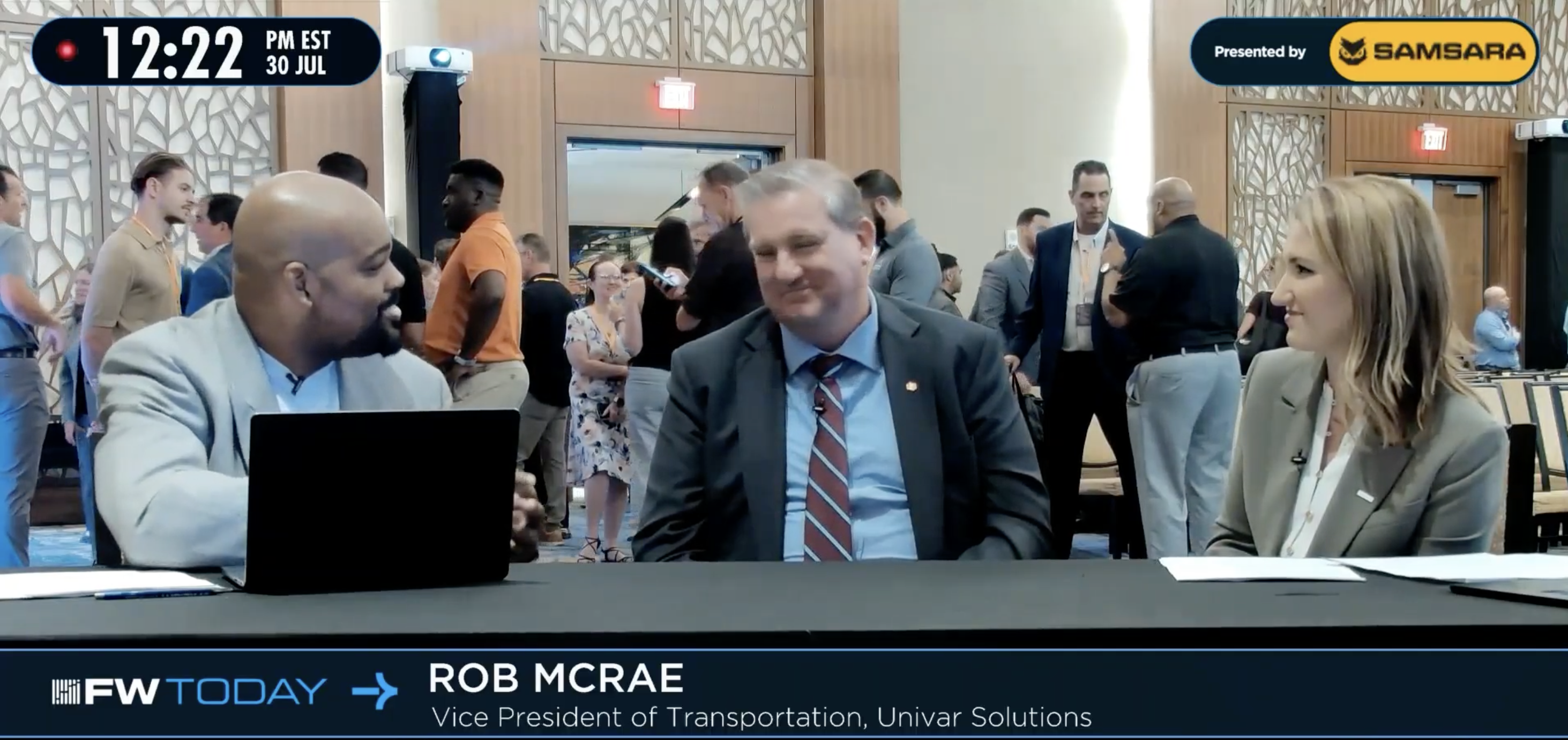
FreightWaves Today broadcast live from the Westin in downtown Chattanooga, Tennessee, for Univar Solutions' annual Carrier Kickoff, where roughly 100 transportation providers and more than 200 attendees gathered alongside Univar Solutions' procurement and operations leadership. The message, according to FreightWaves' coverage: relationships, not just rates, win freight when trucks get scarce.
The Niche: Liquid Bulk Hazmat
Rob McRae, Vice President of Transportation, North America at Univar Solutions, hosted the event and made the case. Roughly 90% of Univar Solutions' volume moves in the liquid bulk hazmat (hazardous materials) space, a niche that dramatically shrinks the pool of qualified carriers before any wider capacity crunch.
"It's a very small niche of the registered DOT carriers," McRae said. "It gets very competitive to get those assets."
That scarcity shapes procurement. About half of Univar Solutions' freight moves through third-party carriers by design, allowing the company to reach customers outside its private fleet's delivery zones while keeping personal familiarity, McRae said. That structure keeps assets available when demand spikes.
A Network Built as an Extension of Brand
McRae compared the approach to small parcel delivery, where consistency of a familiar face on a route is the model. "For us, being able to know who you're talking to, for us as well as the carrier, makes it like you're talking to a friend," McRae said. "Putting faces to names makes it easier to get that asset when other companies, our competitors, aren't necessarily investing in the carriers."
"We view our carrier partners as an extension of our brand," he said. "We want them to say, 'Oh yeah, it's James, he's with Univar Solutions.'"
The approach has won recognition: Univar Solutions was the first chemical distributor to win FreightWaves' Shipper of Choice award and has earned it for three consecutive years. "We did not seek this award whatsoever," McRae said. "Don't try to get it; just do the right things and follow the right processes."
Carriers Confirm the Model Is Working
Brad Hadley, Vice President of National Accounts at Saia, described the payoff in less-than-truckload (LTL) volumes. Saia posted its best tonnage quarter on record in the same period, and Hadley traced that to truckload capacity draining out of the market.
"Capacity's tightened, truckload prices have increased," Hadley said. "Shipments that might have been half loads that were cheaper for customers to move via truckload have now shifted back to the LTL side."
The volume shift is colliding with a carrier base trying to recapture margin after years of taking on freight below cost, according to Hadley. The balance of leverage has moved.
Market Conditions: After the Freight Recession
| Indicator | Status according to FreightWaves |
|---|---|
| Freight cycle | Four-year freight recession that hollowed out capacity |
| Tender rejections | Climbing again |
| Insurance costs | Spiraling |
| Univar Solutions volume in liquid bulk hazmat | Roughly 90% |
| Freight moved via third-party carriers | About half, by design |
| Saia tonnage | Best quarter on record in the same period |
The provider mix at the kickoff reflected the modal breadth of the operation: liquid bulk, truckload, less-than-truckload, rail, air, and parcel providers were all represented under one roof, according to FreightWaves.
What Shippers Should Take Away
FreightWaves' interviews with carriers and brokers at the event made clear that the companies which invested in carrier relationships during the downturn are the ones that will keep trucks moving now that the market has turned. Soft-market leverage doesn't last forever, the article reported — and some shippers are learning that the hard way.
For logistics managers, 3PL operators, and freight forwarders, the takeaway is grounded in the specifics reported at the event: tender rejections are rising, insurance is more expensive, and shippers who treated carriers as partners rather than vendors are being served first. McRae's quote captures the operational logic — knowing who you're talking to makes it easier to get the asset when competitors aren't investing in carriers. In a niche like liquid bulk hazmat, where the registered DOT carrier pool is small, that familiarity becomes a capacity hedge.
Sources: