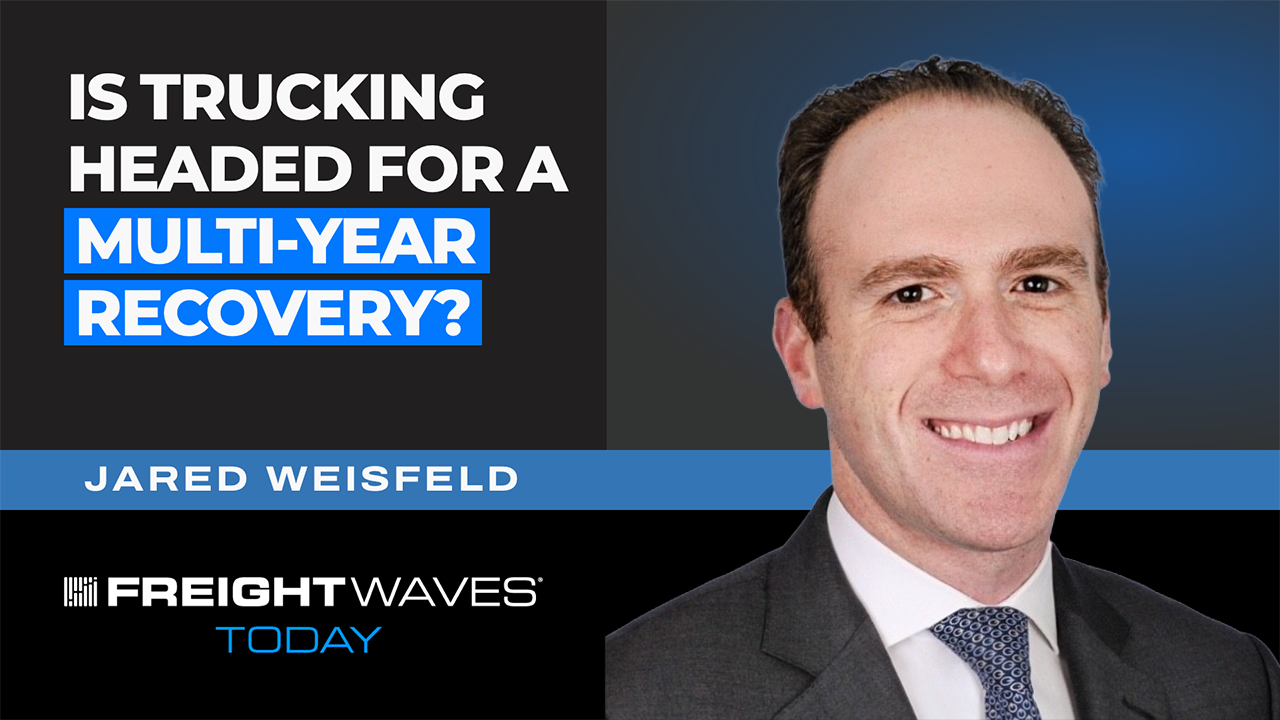
The for-hire truckload market is entering the early stages of a multi-year recovery driven by structural, government-enforced capacity reduction, with 20–25% of the supply base likely to exit, according to RXO Chief Strategy Officer Jared Weisfeld in a FreightWaves interview.
Weisfeld said enforcement actions around non-domiciled CDLs (commercial driver's licenses), English language proficiency, CDL mill crackdowns, ELDs (electronic logging devices) and cabotage rules have been ongoing for roughly 12 months. He called this "the largest structural change to occur in the market since deregulation in 1980." Spot rates are already reacting: depending on the week, they are running 30% to 50% higher year over year despite muted freight demand, and tender rejections — the rate at which carriers turn down contracted loads — hit 17%–18% around the July 4th holiday before easing to approximately 13%, still a multi-year high.
Supply-Side Correction: 20–25% Capacity Exit
Weisfeld estimates that as much as 20% to 25% of the for-hire truckload market's supply base is likely to exit, a figure he called "far from trivial." The supply-driven correction is fueled by ongoing government enforcement and rising operating costs, according to FreightWaves. He argued that prior cycle analysis might no longer apply because the carrier population pool is structurally lower given recent government actions.
"The framework in which we need to evaluate cycles needs to fundamentally change when you have a capacity situation that has structurally changed in a way that we haven’t really seen in 50 years," Weisfeld said. "Prior cycle analysis, while interesting, may not be completely relevant in the context of a population pool that is structurally lower given recent government actions."
Rates, Rejections and the Cost-to-Operate Gap
The cost-to-operate gap is a key data point underscoring the recovery's durability, Weisfeld said. Even as all-in rates including fuel approach parity with the first-half 2022 peak, operating costs — insurance, tires, maintenance — have risen approximately 26%, making rapid capacity re-entry economically difficult. Higher capital costs compound that barrier: with 30-year mortgage rates near 7%, financing new fleets or starting new carriers or brokerages is far more expensive than in the prior cycle.
| Metric | Value | Period / Note |
|---|---|---|
| For-hire truckload capacity exit estimate | 20–25% | Weisfeld estimate |
| Spot rates year-over-year change | +30% to +50% | Depending on week |
| Tender rejections peak | 17–18% | Around July 4th |
| Tender rejections at interview | ~13% | Multi-year high |
| RXO spot volume share of mix | ~42% Q2, ~50% July | Climbed 900 bps sequentially, 1,500 bps YoY |
| Spot premium over contract rates | ~20% Q2, mid-teens at interview | RXO Curve data |
| Operating cost increase | ~26% | Insurance, tires, maintenance |
Broker Consolidation and RXO's Position
FreightWaves reported that large shippers are actively consolidating freight with fewer, larger brokers in response to federal enforcement risk and carrier compliance concerns. Weisfeld said the top 10 brokers currently represent about half the brokerage market, and predicted that longer term the top five could command more than half, driven by shipper-led consolidation. RXO, which completed its acquisition of Coyote, now ranks as the third-largest provider of broker transportation in North America and maintains a network of more than 120,000 carriers.
At the company level, RXO reported that spot volume as a share of its overall mix climbed roughly 900 basis points sequentially and 1,500 basis points year over year in the second quarter, reaching approximately 42%. That figure rose further to about 50% of the mix in July alone, an additional 800-basis-point gain, as shippers turned to the broker amid routing guide failures. During Q2, RXO's proprietary Curve data showed spot rates running at an average premium of roughly 20% above contract rates; Weisfeld said that premium had moderated to the mid-teens by the time of the interview.
Shipper Actions: Lock In Capacity Now
Weisfeld advised shippers to lock in capacity partnerships now. He expects the market to tighten through the end of September, and warned that any improvement in consumer demand on top of already-constrained supply could rapidly erode routing guides and spike freight rate volatility. It is too early to call the strength of peak season, but shippers should prepare for increased volatility.
Watch List
- Peak season: Weisfeld said it's too early to call the strength of peak season.
- Late September: Market expected to tighten through the end of September.
- Consumer demand: Any improvement on constrained supply could spike volatility.
- Capacity re-entry: High operating costs (~26% increase) and near-7% mortgage rates make re-entry expensive.
Sources: