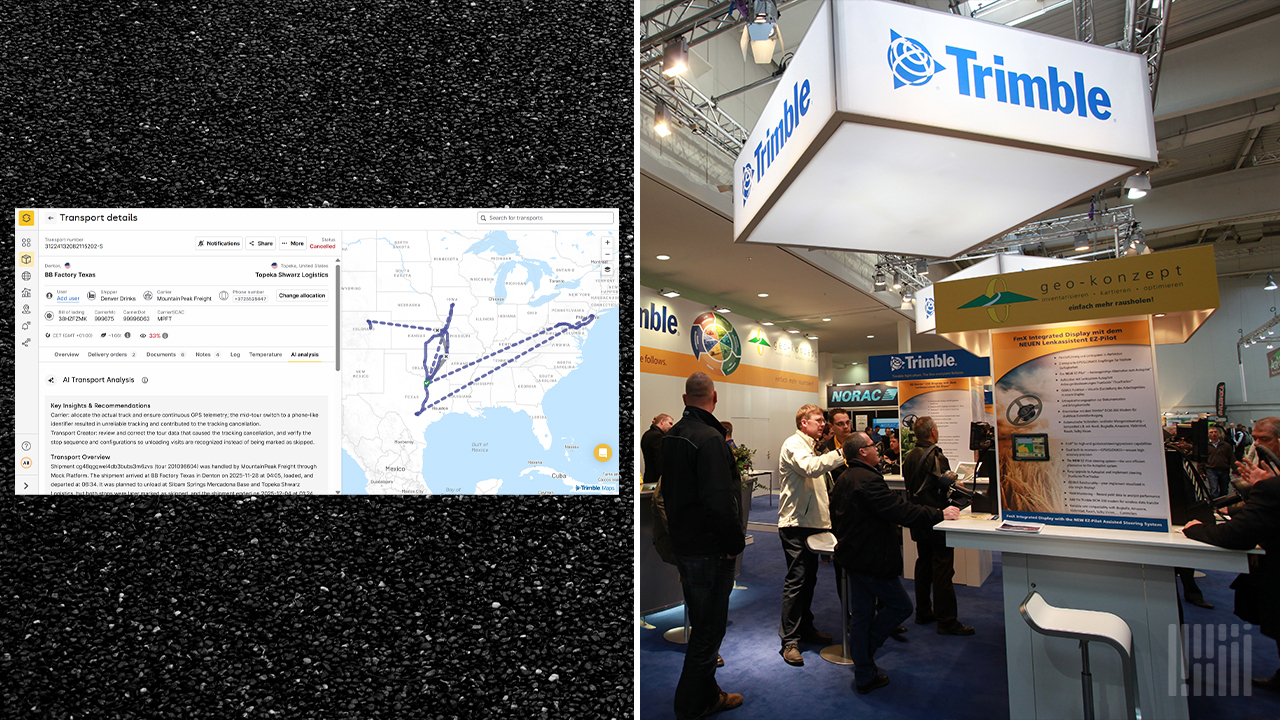
Trimble is expanding its logistics software portfolio with a new transportation management system aimed at U.S. shippers, directly deriving from its 2022 acquisition of Europe's Transporeon. The product, named Trimble TMS for Shippers, follows last year's launch of Trimble Freight Marketplace and represents the company's strategy to converge two ecosystems into a common platform.
Background and Acquisition Context
Trimble acquired Transporeon in 2022 for just under $2 billion, according to FreightWaves. At the time, Transporeon CEO Stephan Siebert noted that what had been "missing for Transporeon as a stand-alone entity" was a large carrier network in the United States. Since then, two major initiatives have emerged: TMS for Shippers and the Freight Marketplace — both focused on the shipper side. The new TMS is described by Trimble as "an agile, AI-integrated transportation management system that combines automation and real-time visibility in one core bundle," per a prepared statement cited by FreightWaves.
Product Features and Modular Design
The TMS for Shippers integrates capabilities from both platforms, including CoPilot and the PC*Miler route planner, as noted by Chad Greene, sales engineering manager at Trimble, who came over from the Transporeon acquisition. Greene explained in an interview with FreightWaves that the product represents "a convergence of both ecosystems, the Transporeon platform and Trimble's TMS platform." The shipper TMS can integrate with Trimble's existing carrier-focused TMS network.
A key differentiator is its modular, "a la carte" offering. Shippers can choose features such as freight procurement, rate management, and carrier tendering on an as-needed basis, "and you only pay for what you need," Greene said. This allows for a lower cost of entry and a predictable commercial model that can scale with the business. The strategy, Greene added, is to "coexist with other TMS's" rather than force a rip-and-replace.
Market Strategy and Customer Segments
While designed primarily for shippers, the TMS can also be modified to serve 3PLs, for example, a broker with its own fleet. Greene noted that the modularity allows a brokerage's existing TMS to be supplemented with specific features from the new product. He also described a recent visit to the Houston area where potential oil and gas clients expressed reluctance to "rip out" their current TMS due to cost and time, but were open to adding modular functions like freight procurement or rate management.
| Feature | Benefit |
|---|---|
| Modular design | Lower cost of entry, pay only for needed modules |
| AI integration | Automation and real-time visibility |
| Carrier network integration | Access to Trimble’s carrier base |
| Coexistence with existing TMS | No rip-and-replace required |
Outlook
Trimble's acquisition of Transporeon continues to yield new shipper-focused products. The modular approach could help the company differentiate in a crowded TMS field. Greene acknowledged the challenge of standing out but pointed to the product's ability to slot into existing workflows as a key selling point. For procurement and logistics leaders, this TMS offers a way to incrementally adopt advanced transportation capabilities without overhauling their technology stack.
"It's taking the best of both worlds and bringing them together in a common platform." — Chad Greene, sales engineering manager at Trimble, as reported by FreightWaves.
As Trimble further integrates Transporeon's European shipper TMS with its own U.S. carrier tools, the TMS for Shippers may see adoption from both existing Trimble customers and new ones seeking flexible, scalable transportation management.
Sources: