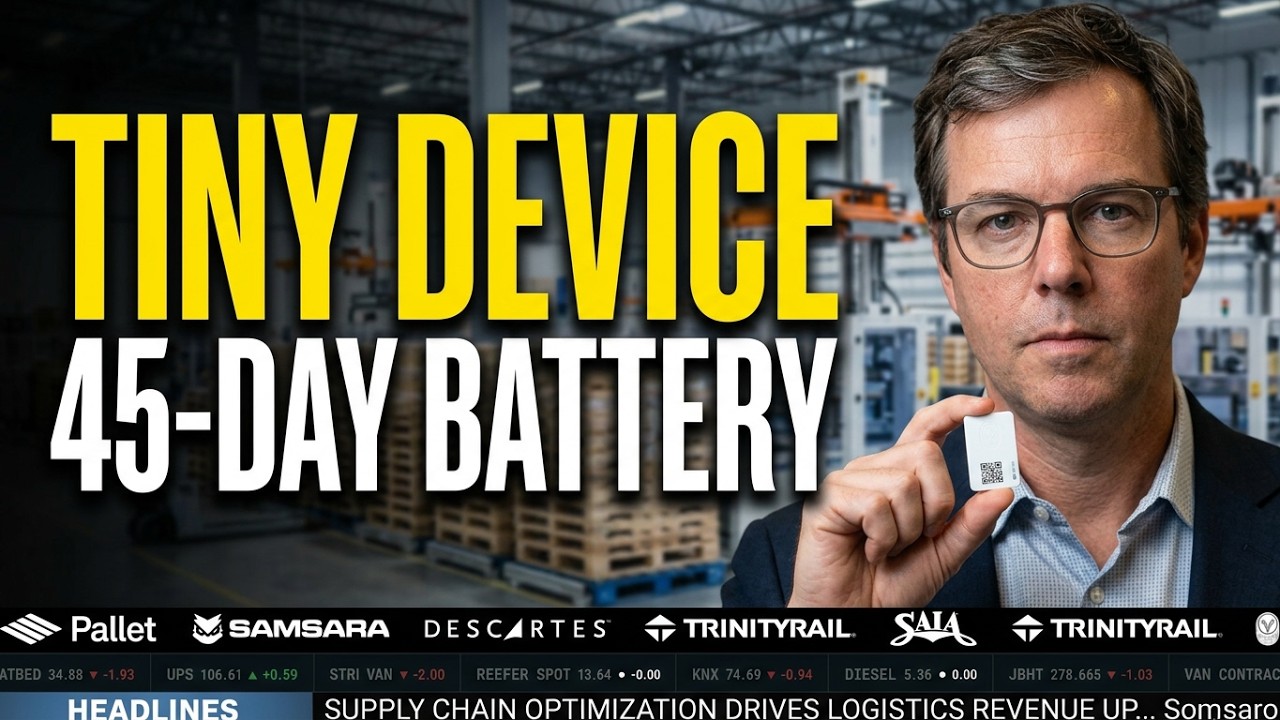
Samsara's new disposable Bluetooth sticker gives shippers up to 45 days of real-time cargo visibility at roughly single-digit dollar pricing per shipment, a price point that positions it between costly cellular trackers and RFID tags, according to FreightWaves. For supply chain leaders, the product shifts exception management from reactive to proactive without requiring capital infrastructure or reverse logistics — a strategic option for one-way freight movements where durable trackers are impractical.
What happened and why
Samsara has introduced a paper-thin, disposable Bluetooth sticker designed to give shippers real-time visibility on any shipment for up to 45 days — roughly six weeks — after activation, FreightWaves reported. The product targets one-way freight movements where operators do not want to manage reverse logistics of more durable tracking hardware, according to David Gall, Samsara's Vice President of Product and Engineering for Connected Equipment. Gall noted that Samsara's existing durable asset trackers are built to last six years in the field for equipment such as construction machinery, but customers asked for a lower-cost, single-use alternative for outbound shipments they never expect returned.
How the tracker works
The sticker does not require dedicated reader infrastructure. Instead, it leverages Samsara's network of millions of trucks, trailers, buses, and other connected equipment already on the road, plus phones and warehouse scanners. "The way the sticker works is it chirps out a little hello world signal, and all those millions of pieces of moving equipment and phones and warehouse scanners are listening for that hello," Gall said. The label does not need to be on a Samsara customer's vehicle to be detected — any truck or device on the Samsara network within range will pick up the Bluetooth ping and report the location, a critical distinction for shippers whose freight moves on carriers outside their own network.
Gall said the open-air range is a couple hundred feet, and the density of the Samsara network allows the signal to pass through cargo and metal trailer walls to be picked up by passing vehicles on the opposite side of a highway.
Cost and positioning vs. existing solutions
The tracker's commercial significance lies in its pricing and network reach. Gall said customers should expect "roughly single-digit dollar pricing per shipment" at volume, with no capital infrastructure required for deployment. That positions the sticker between costly LTE/GPS cellular trackers and RFID tags — which lose visibility the moment a labeled item leaves first-party reader infrastructure.
| Tracker type | Positioning per source | Visibility window | Infrastructure required |
|---|---|---|---|
| LTE/GPS cellular trackers | Costly | Not specified in source | Cellular network |
| RFID tags | Lose visibility when leaving first-party reader infrastructure | Not specified in source | Dedicated first-party readers |
| Samsara disposable Bluetooth sticker | Roughly single-digit dollars per shipment | 45 days after activation | None — uses Samsara's existing connected-equipment network |
The product is currently available through Samsara's enterprise pricing structure, which includes volume discounting, according to FreightWaves.
Use cases and anti-theft applications
Use cases have extended well beyond standard palletized freight. Gall cited biological samples, GPUs, copper wire destined for building infrastructure projects, and chemicals headed to construction sites as examples already tracked with the device. The discreet form factor also supports anti-theft applications: customers have placed the sticker inside cargo, beneath shipping labels, or have printed shipping labels directly on top of the tracker to conceal it from potential thieves.
Gall contrasted the product with consumer-grade options such as Apple AirTags, noting the key differentiator is disposability.
"Once you ship that out, you're not getting that AirTag back, or if you try to get it back, it's really expensive to do so." — David Gall, Samsara VP of Product and Engineering for Connected Equipment
What this means for procurement teams
For procurement and logistics leaders, the single-use tracker removes the reverse-logistics cost that makes durable trackers uneconomical on outbound, one-way shipments. The sticker's ability to be detected by any device on the Samsara network — not just the shipper's own fleet — means visibility is preserved even when freight moves on third-party carriers, a key consideration for outsourced transportation. The low unit cost also supports broader deployment across lower-value shipments, not just high-ticket items, and the concealment options provide a theft-deterrent layer for sensitive cargo.
Outlook
Gall said Samsara expects costs to continue falling as the technology scales. "We think long-term, in the future, 5, 10 years out, this should be really ubiquitous," he said, adding that the company aims to reach a "pretty exciting place" on cost. With the product available now through enterprise pricing and volume discounts, procurement teams can test the tracker on targeted lanes and measure exception-response improvements before scaling across their network.
Sources: