iGEN
Visit IGEN World Explore IGEN Expo
EXPLORE UPGRADE PLANS
BREAKING
UPI Hits Highest-Ever Monthly Transaction Value of Rs 29.88 Lakh Crore in July AI's dotcom deja vu: KOSPI loses 22% in July as $1.2 trillion vanishes Crude Check: Direction Unclear as Brent Slides 9.1%, MCX Sheds 5.7% India's Samudra Manthan offshore exploration scheme targets game-changing oil and gas output Indian equities ‘probably oversold’: Foreign investors warm up to India after months of outflows Adani Total Gas hikes CNG prices by ₹4 per kg as LNG costs surge $20M in cocaine found beneath floorboards of commercial truck trailer at California border Indian Oil ramps up spot crude purchases as Middle East disruptions hit supplies WhatsApp tests 'Offers & Updates' folder to declutter business chats Aurora Reports Q2 Loss, Details Per-Mile Pricing for Driverless Truck Services UPI Hits Highest-Ever Monthly Transaction Value of Rs 29.88 Lakh Crore in July AI's dotcom deja vu: KOSPI loses 22% in July as $1.2 trillion vanishes Crude Check: Direction Unclear as Brent Slides 9.1%, MCX Sheds 5.7% India's Samudra Manthan offshore exploration scheme targets game-changing oil and gas output Indian equities ‘probably oversold’: Foreign investors warm up to India after months of outflows Adani Total Gas hikes CNG prices by ₹4 per kg as LNG costs surge $20M in cocaine found beneath floorboards of commercial truck trailer at California border Indian Oil ramps up spot crude purchases as Middle East disruptions hit supplies WhatsApp tests 'Offers & Updates' folder to declutter business chats Aurora Reports Q2 Loss, Details Per-Mile Pricing for Driverless Truck Services
Home ›› Technology ›› Ai ›› AI's dotcom deja vu: KOSPI loses 22% in July as $1.2 trillion vanishes

AI's dotcom deja vu: KOSPI loses 22% in July as $1.2 trillion vanishes

The KOSPI Composite Index lost 22% in July, its third-worst month, as concentrated AI chip bets unwound. $1.2 trillion of market cap evaporated. The report says AI-front-runner stocks are down 30% on average, erasing $6 trillion, with the S&P 500's 33x P/E echoing dotcom bubble conditions.

iG
iGEN Editorial
August 1, 2026
AI's dotcom deja vu: KOSPI loses 22% in July as $1.2 trillion vanishes

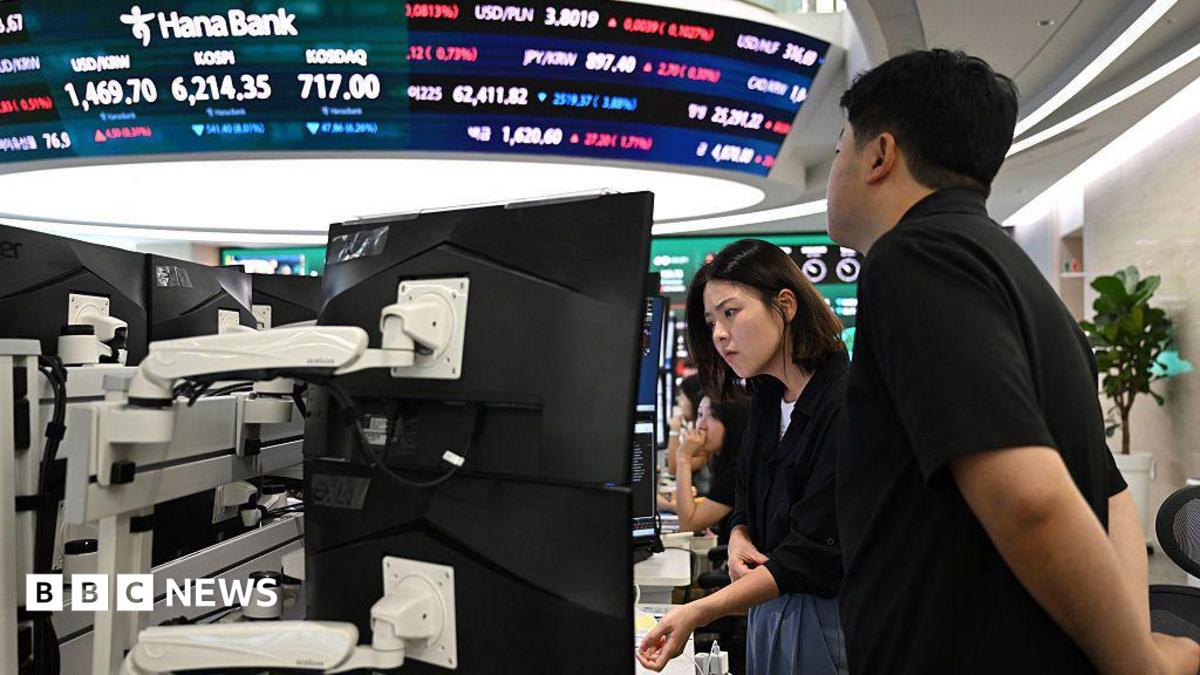
The AI trade that powered South Korea's stock market to a $5.1 trillion peak has reversed with brutal speed. According to a report in The Hindu BusinessLine by Nishanth Gopalakrishnan, the benchmark KOSPI Composite Index lost 22 per cent in July — its third-worst month on record, after the 27 per cent crash in October 1997 and the 23 per cent plunge in October 2008. The report notes that $1.2 trillion of the country's market capitalisation has been erased in a matter of weeks, a brief demonstration of the possible fallout if the AI trade were to go south across the globe.

South Korea's concentrated AI bet

The rout is concentrated in the two semiconductor giants that dominate the Korean bourse. According to the report, SK hynix and Samsung Electronics account for roughly 50 per cent of KOSPI companies' market capitalisation. Both slumped to intra-week lows in July — SK hynix down 20 per cent and Samsung Electronics down 24 per cent versus the previous week's close. The report says these were the very stocks that had taken the Korean market to record highs.

The damage was intensified by single-stock leveraged ETFs, high-risk funds that use derivatives to multiply daily returns. The report highlights the CSOP SK Hynix Daily (2x) Leveraged Product ETF, which gains or loses 2 per cent for every 1 per cent move in SK hynix. From its 52-week high on June 25, the ETF has lost over 78 per cent. Such products have wiped out the portfolios of thousands of Korean investors, the report says, and the situation became so dire that the country's finance minister apologised and admitted the products were introduced "without careful consideration."

Market event Decline
KOSPI, July 2026 22%
KOSPI, October 1997 (Asian financial crisis) 27%
KOSPI, October 2008 (global financial crisis) 23%
S&P 500, 2000–2002 dotcom crash 50%
Nasdaq Composite, 2000–2002 dotcom crash 78%

AI front-runners lose $6 trillion

The report tracked 16 front-running AI stocks — spanning hyperscalers, chip design (Nvidia, Broadcom), semiconductor manufacturing, neoclouds (CoreWeave, Nebius) and AI investor SoftBank. From their 52-week highs, these stocks are down 30 per cent on average, erasing about $6 trillion of investor wealth, according to The Hindu BusinessLine. Oracle is one of the starkest examples: after announcing Q1 FY26 results in September, the stock zoomed about 43 per cent to a 52-week high; it has since corrected 62 per cent.

S&P 500 bubble math

The report says the AI unwind is no longer a Korea-only story. Many of the 16 AI constituents are part of the S&P 500, accounting for about 30 per cent of the index's total market-cap and earnings. Consensus estimates show the index's total net income moving from $2.1 trillion in 2025 to $2.9 trillion in 2026, and the AI constituents account for one in every three dollars of the incremental $840 billion in earnings, the report states.

The valuation picture is stretched: the S&P 500's price-to-earnings multiple based on CY25 net income is 33x, a level the report calls "bubble territory." Based on CY26 earnings estimates, the P/E cools to 23x. This expected earnings growth is the "thin line" dividing the bulls and the bears.

If these companies fail to meet earnings expectations, the index being in bubble territory brings back memories of the dotcom crash in which the S&P 500 corrected 50 per cent and the Nasdaq Composite 78 per cent.

Earnings beats, but capex worries

If earnings are strong, what is troubling the market? The report notes these companies have delivered earnings beats "almost all the time in the last four quarters." The problem, it says, appears to be capex of "astronomical proportions." Alphabet is cited as a case in point, according to the report.

The dotcom deja vu is hard to ignore, and the report suggests the outcome depends on whether the AI cohort can convert heavy capital expenditure into earnings growth that justifies current valuations. For investors, the South Korean experience with leveraged ETFs is a cautionary example of what concentrated, leveraged exposure to AI stocks can deliver in a correction.


Sources: Market-TOI

Keep Reading

Recommended Stories

AI in Supply Chains: Bubble or Boom? Technology

AI in Supply Chains: Bubble or Boom?

The AI-driven surge in stock market valuations raises concerns about a potential bubble, especially in supply chain technologies. We explore the implications for global trade and logistics.

June 8, 2026
Is AI facing a big financial reckoning? Chip stocks tumble as investor euphoria fades Technology

Is AI facing a big financial reckoning? Chip stocks tumble as investor euphoria fades

Sharp falls in chip maker stocks have triggered investor concerns that the AI euphoria is fading. Korean chip makers SK Hynix and Samsung dropped 46% and 35% in a month, while US firms Micron and Intel fell 28% and 35%. China's reported chip breakthrough and worries over AI monetization add pressure. Despite the sell-off, Eileen Burbidge calls it a healthy correction after massive gains.

July 29, 2026
HCLTech to invest Rs 14,257 crore in AI data centre at Odisha Sovereign AI Park, partners with Sarvam Technology

HCLTech to invest Rs 14,257 crore in AI data centre at Odisha Sovereign AI Park, partners with Sarvam

HCLTech announced a Rs 14,257 crore investment to build its first AI data centre at the Odisha Sovereign AI Park, in partnership with AI startup Sarvam and the Odisha government. The project includes financial assistance from the state and aims to strengthen India's sovereign AI ecosystem. Separately, HCLTech will set up a global technology centre in Bhubaneswar employing about 5,000 people, expected to begin operations by 2028.

July 25, 2026
SAP Tightens Hiring and Travel to Fund Growing AI Investments Technology

SAP Tightens Hiring and Travel to Fund Growing AI Investments

German software major SAP is tightening hiring, travel, and third-party spending to fund growing investments in artificial intelligence. According to an internal email, new hiring will focus exclusively on core AI roles, internal travel is paused, and third-party spending is being reduced through a reintroduced Spend Council process.

July 3, 2026