
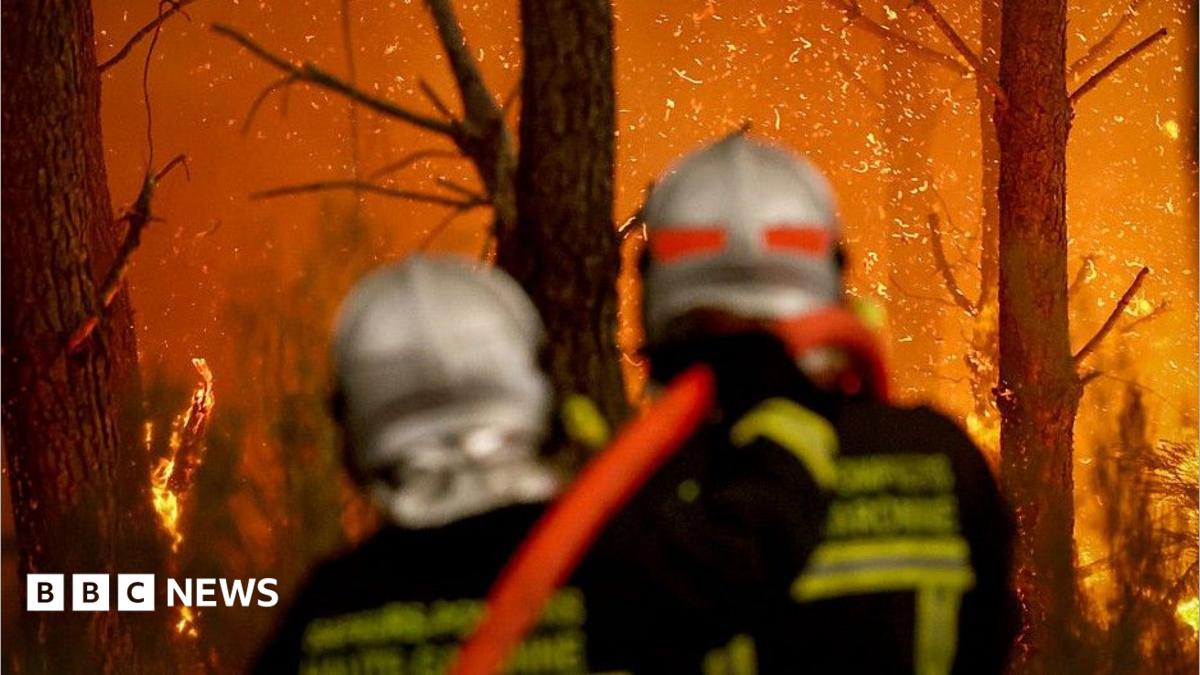
Hundreds of thousands of people have been forced to leave their homes across France, Spain and Portugal as wildfires tore through forests this summer, the BBC reported. In France, four firefighters have lost their lives battling the blazes and another 150 have been injured. Yet the aerial counter-attack still relies on planes around 30 years old. The BBC's John Laurenson posed a pointed question: why can drones replace soldiers in Ukraine but not firefighters? The answer emerging in France is not machine-for-human replacement of crews, but a technology shift in early detection that buys the most valuable commodity in firefighting: time.
Human lookouts replaced in Gironde
Chief sergeant Guillaume Millet, a firefighter of 24 years' experience, heads the Fire and Rescue Service branch of the CFDT union in the Gironde, the region worst hit by wildfires in France this summer. He told the BBC that while the techniques for tackling fire have not changed much, technology in forest fire detection has.
"The big change, especially in my département, is that now we've got cameras assisted by artificial intelligence to watch the forest and see where fires are starting," Millet said. "In the Gironde, cameras have replaced the human look-outs we had in watch towers in every town throughout the summer months" — lookout posts often staffed by students.
The switch has reduced false alarms, Millet said. "An AI-assisted camera can distinguish with almost total certainty between smoke and dust thrown up by a tractor in a field, for example." The cameras have an impressive range too, detecting fires up to 20km (12 miles) away. In the Gironde, the system was installed by a company called Midgard; elsewhere in France, a start-up called FireTracking provides comparable coverage.
FireTracking's detection toolkit
FireTracking's CEO Jean-Simon Chaudier described the alert workflow to the BBC: "As soon as the system detects a fire, there's an alert on the fire fighters' telephones. They open the application and see what the camera is seeing with a x40 [40 times] zoom."
Beside that real-time video, he said, sits a map with the exact location of the fire, the position of any nearby houses, and a simulation of how — given weather, humidity and other inputs — the fire is expected to spread minute by minute. The time margin is decisive. Chaudier cited feedback from a firefighter: "For the past 10 days, for example, we have the feedback from a firefighter that our AI detected seven fires 15 minutes before the first phone call. If you can help a firefighter to save 15 minutes, it's the difference between a catastrophe and a fire which can be limited to two or three hectares."
The escalation math
Chaudier framed the value of early detection in stark, operational terms:
"After one minute you can put out a fire with a glass of water, after two you need a tank of water, after three minutes you need to send a Canadair."
Canadairs are the amphibious planes that scoop water from rivers, lakes and the sea — the spearhead of forest firefighting in France and around the world, the BBC noted.
Deployment cost in Indre-et-Loire
FireTracking's cameras are currently surveying a million hectares, mainly in France, according to the BBC. The cost of comprehensive coverage is quantifiable. In the French département of Indre-et-Loire, the company has installed 11 detection sites. "In all €1.2m [$1.4m; £1m] was spent to cover the whole 6,000 sq km area [2,300 sq miles]," Chaudier said. The terrain is mainly agricultural, where crop fires are a huge and expensive problem — some 300 occur each year in that single département, he said.
| Metric | Human lookouts (previous) | AI-assisted cameras (current) |
|---|---|---|
| Detection range | Tower sightline only | Up to 20 km (12 miles) |
| False alarms | Higher (dust confused with smoke) | "Almost total certainty" between smoke and dust |
| Alert lead time | After visible smoke is called in | Reported 15 minutes before first phone call in one case |
| Coverage example | Staffed towers all summer | 11 sites cover 6,000 sq km for €1.2m |
FireTracking's cameras give crews the equivalent of an always-on aerial observation network at a known capital cost — €1.2m to blanket a 6,000 sq km département, the BBC reported. In the Gironde, Midgard delivered the same class of capability for the region hit hardest this summer. The technology does not fly the Canadairs or hold the hoses; it tells crews where to point them earlier. For emergency-services technology buyers, the measurable outcome is a 15-minute lead time that, in Chaudier's words, separates a containable fire from a catastrophe.
Sources:

