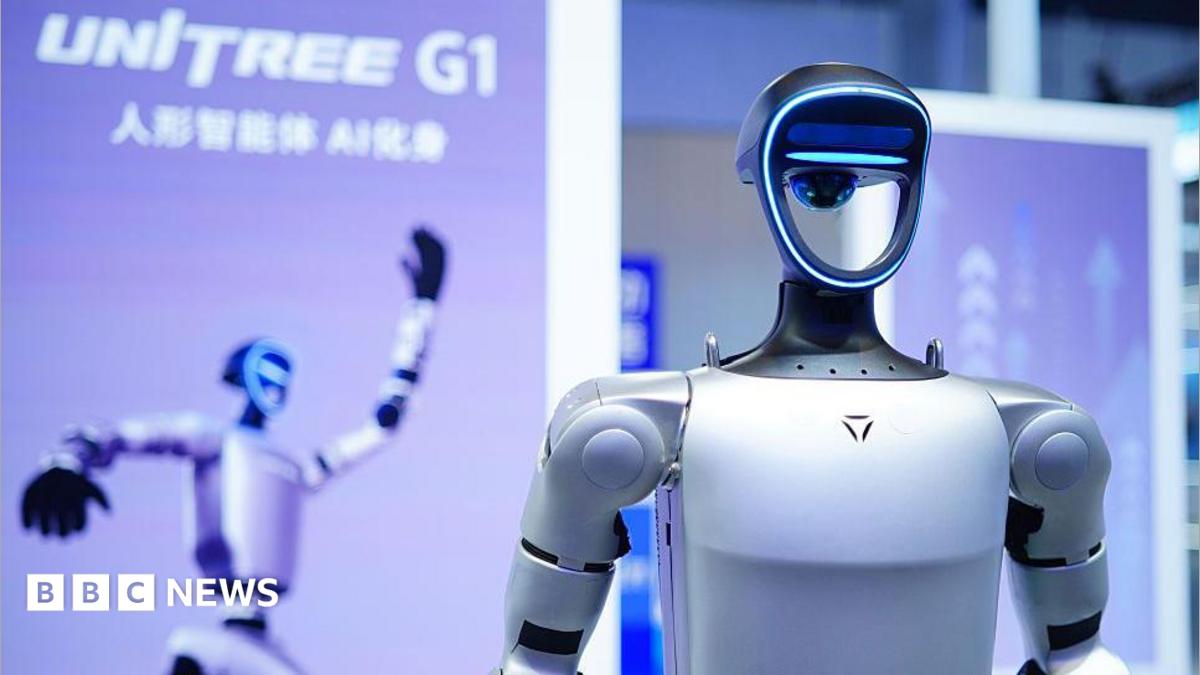
When a 4-foot-tall humanoid robot named Edward Warchocki began wandering the streets of Poland, it initially scared people. Then its creator, software developer Bartosz Idzik, wired it to a large language model to hold live conversations in Polish, and the reaction flipped. According to WIRED, Edward now has over 1 million followers and 4 billion views across social media, and it has visited the Polish parliament, hiked mountains, and even chased wild boars in Warsaw. But the more consequential story is the machine underneath the viral clips: the Unitree G1, a Chinese-made humanoid robot that is about to take its maker public.
The Viral Influencer That Is a Robot
Edward Warchocki is just one of several humanoid influencers running around the world in 2026, WIRED reported. There is "Rizzbot" in Austin, "Bart Robot" breakdancing with Knicks fans in New York, and the "Brickell Clanker" partying with World Cup fans. All of them are the same model: the Unitree G1, a child-sized robot with a hollowed-out face, a ring of blue light, and light-gray aluminum limbs. The G1 has appeared on America's Got Talent, streamed with Kai Cenat, and been ordained as a monk in Japan and Korea. Idzik described the robot as "not super intelligent, but very emotional, very easy to make friends with," adding that without speech, "it's just a 40-kilogram machine."
The robot was created by Idzik and his friend Radosław Grzelaczyk, who bought it from China six months ago and named it after Grzelaczyk's dog Eddie and the Polish word for growling, "warczeć," WIRED said. During its first outings it could not speak, and people were scared; after being wired to a large language model, it began holding live conversations in Polish. It even visited the Polish parliament and talked to politicians, hiked mountains, waded in a lake, and was jokingly arrested by the police. In April, a video of Edward chasing wild boars in Warsaw while wearing a backpack and a Rolex went viral, and one anonymous shitposter on X wrote, "This clanker is lit as fuck!"
Unitree's Commercial Breakthrough
Unitree is scheduled to go public on the Chinese stock market in about two weeks, WIRED reported. Its financial disclosure shows that more than half of Unitree's 2025 revenue came from delivering humanoid robots to real customers, rather than lab pilots. The company shipped 5,511 humanoids in 2025 at an average price of less than $25,000 each, and 43 percent of sales came from outside China. Unitree became profitable for the first time last year.
| Metric | 2025 figure (WIRED) |
|---|---|
| Humanoid robots shipped | 5,511 |
| Average price per unit | Less than $25,000 |
| Revenue from real customers | More than half of total |
| Share of sales outside China | 43% |
| Profitability | First profitable year |
The Real-Job Question
Despite its commercial success, the company and its robots face intense doubts, WIRED noted. They can perform clout-seeking, crowd-pleasing tasks, but can they hold down a traditional job contributing to the economy, like working on an assembly line or cleaning a house? The question echoes the gap between the G1's entertainment uses and the enterprise expectations of a robot workforce.
"We tested a lot of humanoids, and the G1 was the best for its purpose. We are used to China copying other countries, but from the perspective of humanoids, other people should copy China." — Bartosz Idzik, via WIRED
Enterprise buyers take notice
The G1's consumer appeal is already translating into orders. Jake Cooperstein, a 24-year-old in Miami, told WIRED he was inspired by Edward and other accounts to create a humanoid influencer of his own. In January, he visited the warehouse of a robotics shop in New York and tested the G1. He was impressed by how easy it was to operate; the next day, he paid a deposit. Unitree's website prices a basic G1 at $13,500, WIRED reported.
For technology procurement leaders, the story so far is about a hardware line that has moved from lab curiosity to a shipped product with a real price tag, global demand, and a listed company behind it. The unanswered question, according to WIRED, is whether that price tag pays off in productivity for traditional roles. Until a G1 works a shift on an assembly line or vacuums a floor reliably, the business case beyond entertainment remains unproven.
Sources: