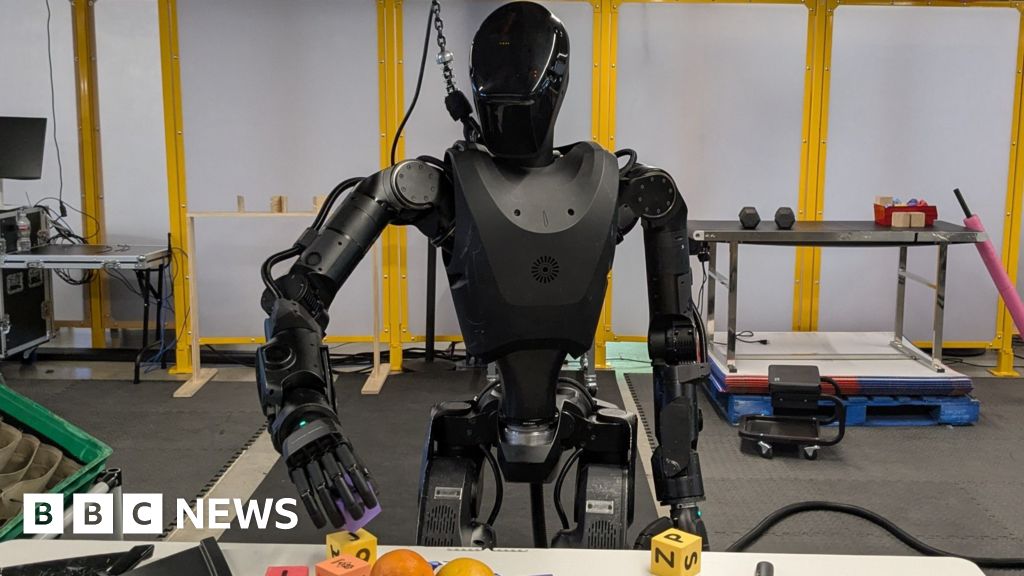
While some humanoid robotics companies focus on folding laundry or working in warehouses, Foundation Future Industries has a different ambition: creating an all-American robot supersoldier. According to WIRED, the startup’s CEO, Sankaet Pathak, says the company plans to give its humanoids lethal capabilities soon, though he declined to share specifics. “We have some kinetic things we're exploring,” Pathak told WIRED, referring to weapons systems. “We'll probably unveil something in the next couple of months.” Beyond combat, the company says its robots could be used for logistics, reconnaissance, and inspection.
Military Ambitions and Testing
The US military has long shown interest in humanoid robots. WIRED notes that the Defense Advanced Research Projects Agency (DARPA) funded major humanoid contests between 2012 and 2015, and the Army runs a program called xTechHumanoids that supports “militarized humanoid capabilities.” Militaries worldwide are adopting autonomous systems, including aerial drones and small vessels. Legged systems like humanoids can traverse challenging terrain, and the hope is they might replace human soldiers in dangerous tasks. Foundation claims it has tested its humanoid, the Phantom MK1, with Ukrainian forces, using the war in Ukraine as a development laboratory.
Eric Trump’s Role
Foundation Future Industries has a high-profile backer: Eric Trump, the president’s son, is both an investor and the company’s chief strategy adviser. According to WIRED, Pathak said of Trump: “People don't realize he actually is an engineer at heart, so he does a lot of milling and things like that at his home.” In a Fox Business interview on April 23, Trump touted the robots: “When you go up and you interact with these robots, and they fist-bump you, they high-five you, they follow your commands. You bring in AI autonomy, it's going to change industry, going to change military application, it's going to change hospitality. The uses are unlimited, and I think it’s a very beautiful thing.”
Contracts and Financial Backing
According to WIRED, Foundation was founded in 2024 and soon after acquired Boardwalk Robotics, a company that worked closely with the Institute for Human and Machine Cognition (IHMC), a Florida nonprofit research institute known for humanoid robotics. During Trump’s Fox segment, the host claimed a “$24 million contract with the Pentagon,” but WIRED reports that the reality is more nuanced. When asked, Foundation shared details of two contracts inherited from Boardwalk and three that came through IHMC. The company does not appear to have independently secured new government funding. Nevertheless, the startup has government contracts worth millions and a promising niche, according to one anonymous roboticist familiar with Foundation: “If you put a military hat on, it makes a lot of sense, because it’s where soldiers still die—that first entry through a door. … I think it is so close to feasible that I'm surprised they’re not already fielded.”
Expert Skepticism
Despite the enthusiasm, some experts caution that fully autonomous robot soldiers are a distant dream. Robert Griffin, a senior research scientist at IHMC who worked on a project involving Boardwalk and served as a technical adviser, told WIRED: “Right now, it is difficult to disentangle the current state of the art from the potential of the state of the art” with humanoids. The gap between demonstration and reliable battlefield performance remains wide. Foundation, like many humanoid companies, often portrays its robots performing tasks autonomously, but Griffin and others suggest that truly autonomous combat robots are not yet feasible.
Implications for Enterprise Technology Leaders
For CTOs and technology procurement leaders in defense and logistics, Foundation’s approach highlights both the promise and the hype in humanoid robotics. While the startup focuses on lethal applications, the underlying technologies—AI autonomy, legged locomotion, and sensor integration—could eventually spill over into industrial and supply chain use cases, such as warehouse operations or hazardous materials handling. However, the current reliance on government contracts and the uncertainty around autonomy levels mean that enterprise buyers should temper expectations and monitor real-world deployments carefully. The involvement of high-profile political figures also adds a layer of reputational risk that procurement teams must evaluate.
Sources: